
The right mount can make the difference between sharp, detailed night-sky images and a frustrating session filled with trailing stars. Today’s portable astrophotography mounts range from compact camera trackers to computerized equatorial systems designed for heavier telescope loads.
We’ve gathered 10 noteworthy options for photographers and astronomers who need a practical balance of portability, tracking accuracy, payload capacity, setup speed, and control features.
Best 10 Portable Astrophotography Mounts Picks for 2026
Best Portable GoTo Mount

- Complete kit with tripod, pier extension, and counterweight
- GoTo control, built-in Wi-Fi, and multiple tracking rates
- Illuminated polar scope for field alignment
Best For: Portable setups needing automated pointing and tracking
Best Smart Camera Mount

- Three-axis head supports rigs up to 15 pounds
- App control with star tracking and automated shooting modes
- 24-hour battery and IPX6 water resistance
Best For: Feature-focused astro, timelapse, and landscape photography
Best Lightweight Tracker

- Compact 2.2-pound camera mount
- Handles up to 11 pounds when balanced
- Illuminated polar scope and 20-hour battery
Best For: Backpack-friendly camera and lens astrophotography
Best Telescope Wedge

- Converts compatible alt-az telescopes to equatorial tracking
- Supports long exposures and autoguiding
- Tool-less adjustment with scale and bubble level
Best For: Celestron NexStar, Evolution, and Origin owners
Best All-in-One Travel Mount
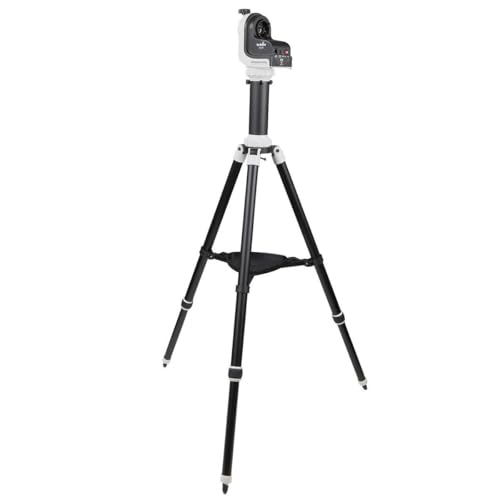
- Lightweight 8.6-pound design with included tripod
- 11-pound payload for telescopes and many DSLRs
- Wi-Fi app control plus time-lapse and panorama modes
Best For: Traveling observers and beginners seeking app-controlled GoTo convenience
Best Compact Star Tracker

- Small PETG and carbon-fiber equatorial design
- Custom, stellar, and lunar rotation speeds
- Power-bank operation with hemisphere switching
Best For: Camera photographers building a compact, customizable tracking setup
Best Simple Steel Tripod Mount

- Compact EXOS Nano EQ3 equatorial design
- Includes alloy-steel ST1 tripod
- Listed weight is 1,000 grams
Best For: Buyers wanting a basic portable EQ3-style mount and tripod
Best with Extra Features

- Full GoTo equatorial tracking
- Built-in Wi-Fi and illuminated polar scope
- Includes counterweight hardware
Best For: Portable camera-based astrophotography with automated control
Best App-Controlled Mount
Explore Scientific iEXOS-100-2

- Eight-CPU PMC-Eight control system
- Wi-Fi and Bluetooth tablet control
- Includes equatorial mount and tripod
Best For: Tablet-based GoTo astrophotography and precise balancing
Best Lightweight Tripod

- Weighs just 5.3 pounds
- 44-pound stated payload
- Adjustable from 19.7 to 29 inches
Best For: Portable support for Wave mount imaging setups
Best Portable GoTo Mount – Star Adventurer GTi Kit
For photographers seeking portable astrophotography mounts with automated pointing and tracking, the Sky-Watcher Star Adventurer GTi is a complete kit rather than a mount head alone. It includes a tripod, pier extension, counterweight system, illuminated polar scope, and built-in Wi-Fi.
Best For: Portable camera or lightweight telescope setups that benefit from GoTo control and a complete included support system.
Pros:
- Full GoTo functionality with built-in Wi-Fi
- Includes tripod, pier extension, counterweight bar, and 5-pound counterweight
- Illuminated polar scope supports alignment in low light
- Multiple tracking rates and a portable design
Cons:
- At 26 pounds, it is heavier than camera-only tracking mounts
- Not water resistant
The GTi is a practical all-in-one choice when you want portable astrophotography mounts with more automation and fewer extra accessories to purchase. Its included tripod and alignment features make it especially convenient for field use.
Best Smart Camera Mount – Benro Polaris Astro Edition
The Benro Polaris Astro Edition brings app-based control and automated shooting modes to portable astrophotography mounts. Its three-axis design supports camera rigs up to 15 pounds, while Bluetooth, a long battery life, and an IPX6 rating suit demanding field sessions.
Best For: Advanced camera shooters who want remote control, star tracking, timelapse, panorama, and focus-stacking features in a travel-ready system.
Pros:
- Supports camera rigs up to 15 pounds
- Smartphone app enables remote control and image review or download
- Includes star tracking, motion timelapse, panorama, and focus stacking modes
- Offers up to 24 hours of battery life and IPX6 water resistance
Cons:
- Heavier than its compact 4.3-inch height might suggest, at 7.8 pounds
- Its feature-rich operation may require more setup than a basic tracker
Choose the Polaris Astro Edition when creative automation is as important as tracking. It is particularly compelling for photographers combining astrophotography with timelapse and landscape work.
Best Lightweight Tracker – iOptron SkyGuider Pro
The iOptron SkyGuider Pro is one of the more compact portable astrophotography mounts for camera-based setups. Its 2.2-pound mount body, all-metal construction, illuminated polar scope, and rechargeable battery make it well suited to backpack-style observing and imaging.
Best For: Photographers who prioritize a compact tracker for camera and lens combinations up to 11 pounds when properly balanced.
Pros:
- Compact mount design weighs 2.2 pounds
- Supports up to 11 pounds when balanced
- Illuminated AccuAlign polar scope helps with precise alignment
- Internal rechargeable battery provides up to 20 hours of operation at 20°C
Cons:
- Camera-mount design does not provide the GoTo functionality listed for the Star Adventurer GTi
- Not water resistant
- Tripod and other support accessories may need to be planned separately depending on the setup
The SkyGuider Pro is a strong portability-first option for manual camera astrophotography. Its useful payload capacity and long battery life make it practical for extended sessions without carrying a full telescope mount.
Best Telescope Wedge – Celestron Equatorial Wedge
Unlike standalone portable astrophotography mounts, the Celestron Equatorial Wedge is an accessory that converts compatible NexStar and Evolution alt-azimuth telescope setups into an equatorial platform. Tilting the azimuth axis enables long-exposure astrophotography and autoguiding.
Best For: Celestron NexStar 6/8SE, Evolution, and Origin telescope owners who want to add equatorial tracking capability to an existing system.
Pros:
- Enables long-exposure astrophotography and autoguiding
- Captive hardware and tool-less operation simplify adjustments
- Latitude adjustment screw includes an easy-to-read scale
- Integrated bubble level and sturdy, portable construction
Cons:
- Compatible only with specified Celestron telescope families
- At 15 pounds, it adds substantial weight to a portable setup
- It is a wedge accessory rather than a standalone tracking mount
This wedge makes sense when you already own a compatible Celestron telescope and want a more astrophotography-ready configuration. It offers useful alignment and adjustment conveniences, but its narrow compatibility limits it as a general-purpose mount.
Best All-in-One Travel Mount – AZ-GTi Portable GoTo Mount
For portable astrophotography mounts that combine computerized pointing with flexible field use, the Sky-Watcher AZ-GTi is a practical option. Its 8.6-pound design, 11-pound payload capacity, Wi-Fi control, and included tripod make it suitable for mobile astronomy and compatible DSLR setups.
Best For: Travelers and beginners who want app-controlled GoTo astronomy, time-lapse capability, and a ready-to-use tripod package.
Pros:
- Lightweight 8.6-pound mount designed for on-the-go use.
- Supports up to 11 pounds, including most telescope tubes and many DSLR cameras.
- Built-in Wi-Fi, SynScan Pro app control, and Freedom Find dual encoders.
- Supports time-lapse and panorama photography with a built-in SNAP port.
Cons:
- It is an alt-az mount rather than an equatorial mount.
- AA batteries or a separate 12V external power source are required for mobile operation.
The AZ-GTi stands out when convenience and portability matter most. Its included pier extension and tripod add practical setup flexibility, while the motorized gearing and multiple power options make it a versatile choice for casual imaging and observing.
Best Compact Star Tracker – Equatorial Mount Star Tracker
This compact equatorial mount is one of the more specialized portable astrophotography mounts for camera-based tracking. Its PETG and carbon-fiber shell, USB-C power, adjustable rotation speeds, and northern or southern hemisphere support make it a flexible tracker for field imaging.
Best For: Camera users who want a lightweight, open-source-style equatorial tracker with customizable stellar, lunar, and rotation speeds.
Pros:
- Compact 3.54-by-3.54-by-3.15-inch design made from PETG and carbon fiber.
- Supports stellar speed, moon speed, and custom rotation speeds.
- Works in both northern and southern hemispheres.
- Can run from a power bank and also function as a time-lapse gimbal head.
Cons:
- No built-in battery; USB-A-to-USB-C power is required.
- A ball head is required to connect a camera, and a 1/4-to-3/8-inch sleeve may be needed.
- The product notes warn against unauthorized disassembly.
This tracker is appealing for photographers who prioritize a small footprint and adjustable tracking behavior. The required ball head and specific power-cable guidance mean it is best suited to buyers comfortable assembling a camera-tracking setup.
Best Simple Steel Tripod Mount – FirstLight EXOS Nano EQ3
Explore Scientific FirstLight EXOS Nano EQ3 Mount; Steel ST1 Tripod, FL-EXOSNANOT1-00
Check Price On AmazonThe Explore Scientific FirstLight EXOS Nano EQ3 is a straightforward choice among portable astrophotography mounts for buyers who prefer a compact equatorial mount and sturdy steel tripod. The supplied specifications identify a new unit with an alloy-steel tripod and a 1,000-gram listed weight.
Best For: Buyers seeking a basic, compact EQ3-style mount with a steel tripod for portable astronomy setups.
Pros:
- Equatorial EXOS Nano EQ3 design suited to portable astronomy.
- Includes a steel ST1 tripod.
- Listed weight of 1,000 grams supports a relatively transportable setup.
Cons:
- The supplied notes provide limited information about payload capacity and included accessories.
- No app-control, power, or photography-specific features are listed.
With fewer documented features than the other options, this model is best considered a simple mount-and-tripod platform rather than a feature-rich imaging system. Confirm compatibility, payload specifications, and included hardware before purchase.
Best with Extra Features – Star Adventurer GTi
For photographers seeking portable astrophotography mounts with automated tracking, the Sky-Watcher Star Adventurer GTi combines a compact GoTo equatorial mount head with a counterweight system, built-in Wi-Fi, and an illuminated polar scope. Its DSLR or mirrorless camera dovetail supports camera-based setups, though the camera itself is not included.
Best For: Portable DSLR or mirrorless-camera astrophotography setups needing full GoTo control.
Pros:
- Full GoTo performance in a compact package.
- Built-in Wi-Fi supports convenient control.
- Includes a counterweight bar and 5-pound counterweight.
- Built-in illuminated polar scope assists polar alignment.
Cons:
- Camera or mirrorless body is not included.
- At 6.9 kg, it is less lightweight than the smallest tracking options.
This is a strong choice when portability matters but you still want a more complete GoTo feature set. The included balancing hardware and polar scope make it a practical, ready-to-build foundation for lightweight imaging.
Best App-Controlled Mount – Explore Scientific iEXOS-100-2
The Explore Scientific iEXOS-100-2 is one of the more feature-rich portable astrophotography mounts for users who prefer tablet-based control. Its PMC-Eight system uses eight independent CPUs, while the ExploreStars app provides GoTo operation through Apple, Android, and Windows tablets.
Best For: Astrophotographers who want app-controlled GoTo operation and precise equatorial balancing.
Pros:
- PMC-Eight system assigns functions across eight independent CPUs.
- Wi-Fi and Bluetooth enable app-based control.
- ExploreStars supports navigation of tens of thousands of celestial objects.
- Clutched RA and declination axes help with balancing and repositioning.
Cons:
- Requires a compatible tablet for the listed app-based control.
- Alignment uses an RA-axis sight hole rather than a polar scope.
The iEXOS-100-2 suits users who value connected operation and responsive GoTo control. Its clutched axes make setup adjustments practical, while the included tripod provides a complete mount-and-tripod package.
Best Lightweight Tripod – Sky-Watcher Wave Carbon Fiber
The Sky-Watcher Wave Carbon Fiber Tripod is a lightweight support option for compatible Wave mount setups and other listed camera or camcorder equipment. At 5.3 pounds, it is designed for grab-and-go use while offering a stated 44-pound payload and an adjustable height range from 19.7 to 29 inches.
Best For: Wave mount users who need a lightweight, high-capacity tripod for portable imaging or outreach.
Pros:
- Carbon fiber construction keeps the tripod weight to 5.3 pounds.
- Supports a stated payload of up to 44 pounds.
- Adjusts from 19.7 to 29 inches.
- Designed for grab-and-go outreach, observing, and imaging setups.
Cons:
- This is a tripod only, not a complete tracking mount.
- It is not water resistant.
- Compatibility is specifically emphasized for Wave mounts.
This tripod is best viewed as a portability upgrade or support component rather than a standalone astrophotography mount. Its low weight and substantial stated payload make it useful when your existing Wave setup needs easier transport.
How We Picked These Portable Astrophotography Mounts
We compared these mounts by focusing on the factors that matter most in real observing and imaging sessions: payload capacity, portability, tracking design, setup requirements, control options, tripod stability, and compatibility with cameras or telescopes. The selection includes lightweight star trackers, GoTo equatorial mounts, alt-azimuth systems, wedges, and supporting tripod hardware so different users can find a suitable starting point.
Portability does not mean the same thing for everyone. A camera shooter may prioritize a small tracker that fits in a backpack, while a telescope user may accept a heavier mount for improved payload capacity and GoTo performance.
Quick Comparison
| Best For | Look For |
|---|---|
| Wide-field camera imaging | Compact tracker, accurate sidereal tracking, easy polar alignment |
| Travel and grab-and-go observing | Low weight, quick setup, app or hand-controller operation |
| Small telescopes | Equatorial tracking, counterweight support, adequate payload margin |
| Automated locating | GoTo controls, Wi-Fi or computer connectivity, reliable alignment routines |
| Existing telescope systems | Compatible wedge, tripod, mounting interface, and total system weight |
Key Buying Factors for Portable Astrophotography Mounts
Payload Capacity and Stability
Check the mount’s rated payload, but avoid treating the maximum figure as an ideal imaging load. Cameras, lenses, telescope tubes, guide scopes, adapters, and counterweights all add weight. A useful margin improves balance and reduces vibration.
Tracking and Mount Type
Equatorial mounts are generally the most useful for longer-exposure deep-sky imaging because they follow the sky with less field rotation. Alt-azimuth mounts can be easier for visual astronomy, time-lapse work, and quick setup, but may require additional equipment or software for demanding long exposures.
Portability and Setup
Consider the complete packed system rather than the mount head alone. Tripod, counterweights, pier extensions, batteries, cables, and alignment accessories can significantly affect transport. A lighter system that you will actually carry to dark skies may outperform a heavier one that stays at home.
Control, Power, and Compatibility
GoTo, Wi-Fi, app control, and computer interfaces can simplify target acquisition, but they also add setup and power requirements. Confirm that the mount works with your camera, telescope, dovetail plate, controller, operating system, and preferred imaging workflow.
Polar Alignment and Vibration
For equatorial imaging, a usable polar scope or alignment routine is important. A rigid tripod, secure leg locks, and a stable mounting connection are equally valuable; even accurate tracking cannot compensate for movement from wind, loose hardware, or an overloaded tripod.
Who Should Buy Which Portable Astrophotography Mounts?
Choose a compact camera tracker if you mainly use mirrorless or DSLR cameras with wide or moderate telephoto lenses and want the simplest travel setup.
Choose a GoTo equatorial mount if you plan to image with a small telescope, need automated target finding, or expect to expand into guiding and longer focal lengths.
Choose an alt-az mount or wedge-based solution if fast visual observing, time-lapse work, or compatibility with an existing telescope system matters more than advanced deep-sky imaging.
Choose a stronger tripod or complete kit when stability and convenience outweigh the smallest possible packed size. The best Portable Astrophotography Mounts are the ones that match your actual payload and observing habits without creating unnecessary setup friction.