
The best stereo microscopes for children make small discoveries feel hands-on, whether kids are examining insects, rocks, leaves, or everyday objects. The right model should be easy to focus, comfortable to use, and supplied with enough accessories to encourage independent exploration.
This roundup compares 10 child-friendly microscope kits and stereo models across magnification, viewing style, lighting, portability, included specimens, and educational value. Use the guide below to match each type of microscope with your child’s age, interests, and experience level.
Best 10 Stereo Microscopes for Children Picks for 2026
Best Dual-View Starter Kit
National Geographic Dual LED Microscope

- Upper and lower LED lighting
- 20x and 50x optical lenses
- 50+ accessories plus prepared slides
Best For: Kids ages 8-12 starting hands-on specimen exploration
Best Portable Binocular Option
Aomekie 20x/50x Stereo Microscope

- Binocular viewing for both eyes
- 20x/50x magnification and adjustable working range
- Includes mineral, insect, and slide specimens
Best For: Home or classroom inspection of larger specimens
Best Higher-Magnification Learning Kit
National Geographic 400x Microscope

- Magnification up to 400x
- LED lighting above and below
- Includes specimens, slides, tools, and lab guide
Best For: Kids ages 6+ who enjoy guided science activities
Best Portable Stereo Microscope

- 20x binocular viewing
- Longer focal length for large specimens
- Battery-powered upper LED light
Best For: Young students exploring rocks, stamps, jewelry, and other solid specimens
Best High-Magnification Learning Kit
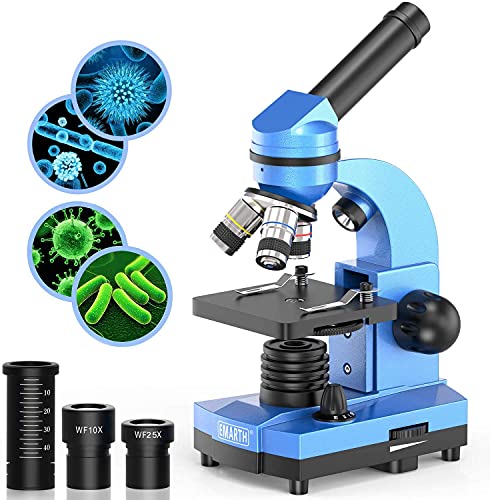
- 40x-1000x compound magnification
- 52-piece educational kit
- Top-and-bottom LED illumination
Best For: Ages 8-12 and beginners learning biology with prepared slides
Best Complete Starter Kit
Uarzt 58-Piece Kids Microscope

- 58-piece experiment kit
- 100x-1200x magnification
- Metal body with LED lighting
Best For: Ages 5-12 beginning guided plant, insect, and specimen exploration
Best All-Around Optics
PALOBIL Compound Microscope Kit

- Six stated settings from 100X to 2000X
- Top and bottom adjustable LED lighting
- Prepared slides and smartphone adapter included
Best For: Older children and beginner homeschool labs
Best Screen-Based Explorer
TOMLOV DM302K Digital Microscope

- 4.3-inch screen avoids small eyepieces
- Records photos and videos
- WiFi and USB viewing support sharing
Best For: Shared family learning and classroom projects
Best Portable Discovery Kit

- Pocket-size 0.34-pound handheld design
- 32GB card and five real glass slides
- Rechargeable for about 2.5 hours
Best For: Portable family and outdoor science exploration
Best Dual-View Starter Kit – National Geographic Dual LED Microscope
For families comparing stereo microscopes for children, this National Geographic kit is a versatile starter option. Its upper and lower LED lights let children examine both opaque 3D objects and biological slides, while the 20x and 50x optical lenses keep operation straightforward.
Best For: Kids ages 8-12 who want a broad, hands-on science kit with plenty of included materials.
Pros:
- Dual LED illumination supports slides and 3D specimens.
- Includes 10 prepared slides, 10 blank slides, and more than 50 accessories.
- Comes with a geode, tweezers, eye-dropper, storage container, and learning guide.
Cons:
- Maximum listed magnification is 50x, so it is focused on larger specimens rather than highly magnified cellular detail.
- Battery power means replacement batteries may be needed.
This is a practical pick when variety and ease of use matter more than high magnification. The included slides and 3D specimens give children several ways to begin exploring immediately.
Best Portable Binocular Option – Aomekie 20x/50x Stereo Microscope
This Aomekie is a useful choice among stereo microscopes for children when binocular viewing and portability are priorities. Its adjustable interpupillary distance, longer working range, and battery-powered LED light make it suitable for examining rocks, insects, stamps, slides, and other larger objects.
Best For: Young users who want a movable binocular microscope for home or classroom inspection.
Pros:
- Binocular eyepieces support viewing with both eyes.
- 20x and 50x magnifications with a 65mm-102mm adjustable working range.
- Includes insect specimens, 10 slides, and 12 mineral specimens.
- Battery-powered LED lighting avoids reliance on a power cord.
Cons:
- Two AA batteries are required but not included.
- The supplied notes do not specify an age range or include a detailed learning guide.
Its binocular design and generous working distance make it especially practical for larger specimens. It is a stronger fit for observation projects than for a guided, experiment-heavy starter kit.
Best Higher-Magnification Learning Kit – National Geographic 400x Microscope
Families seeking stereo microscopes for children with a higher stated magnification range may prefer this National Geographic science kit. It offers up to 400x magnification, adjustable lighting above and below, large focus knobs, and an adjustable platform designed to make specimen positioning easier.
Best For: Children ages 6 and up who want a guided introduction to slides, rocks, minerals, and basic science experiments.
Pros:
- Offers three magnification levels with a maximum listed magnification of 400x.
- Upper and lower LED lights help illuminate different specimen types.
- Includes prepared and blank slides, six rocks and minerals, and basic tools.
- Lab guide adds viewing activities, a game, and merit badge stickers.
Cons:
- Its plastic enclosure may be less durable than a heavier glass-and-metal instrument.
- Battery operation requires access to replacement batteries.
This kit stands out for its combination of higher stated magnification and structured activities. It is a good match for children who benefit from an experiment guide rather than open-ended observation alone.
Best Experiment-Focused Kit – ESAKO Dual LED Kids Microscope
This ESAKO kit is a compelling option for families comparing stereo microscopes for children who want more than basic slide viewing. Dual LED lights handle opaque objects and biological slides, while the included brine shrimp cultivation experiment adds a longer-running observation project to the 20x and 50x microscope setup.
Best For: Kids ages 8-12 who enjoy hands-on experiments and tracking a specimen over time.
Pros:
- Upper and lower LEDs support 3D objects and slides.
- Includes more than 50 accessories, including prepared and blank slides, minerals, and an insect specimen.
- Brine shrimp experiment includes a hatchery, eggs, petri dish, and lab manual.
- Two eyepieces provide 20x and 50x magnification.
Cons:
- Maximum listed magnification is 50x.
- Battery-powered operation may require keeping spare batteries available.
The brine shrimp project gives this kit a distinctive educational angle, encouraging repeated observation and record-keeping. Choose it when an ongoing biology activity is more appealing than simply viewing prepared specimens.
Best Portable Stereo Microscope – AmScope SE100-LED
AmScope SE100-LED Portable Binocular Stereo Microscope, 20X Magnification | LED Ring Light
Check Price On AmazonFor shoppers comparing stereo microscopes for children, the AmScope SE100-LED is a practical choice for supervised home or classroom exploration. Its binocular design, low-power 2x objective, and reflected LED lighting suit larger objects that children can handle, such as rocks, stamps, jewelry, and biological specimens.
Best For: Young students and hobbyists examining larger, solid specimens with adult guidance.
Pros:
- Binocular viewing head with adjustable interpupillary distance can simplify viewing for young users.
- 2x objective provides 20x magnification with a longer focal length for larger specimens.
- Battery-powered upper LED illumination lights objects from above.
- Reversible black-and-white stage plate and clips support contrast and specimen stability.
Cons:
- Its 20x maximum magnification is not intended for detailed cellular viewing.
- Battery power requires replacement batteries rather than a mains connection.
- Designed for reflected-light objects, so it is less suited to translucent slide specimens.
The SE100-LED stands out when ease of handling and comfortable binocular viewing matter more than very high magnification. It is a particularly sensible fit for examining objects that are too large for a conventional compound microscope stage.
Best High-Magnification Learning Kit – Emarth 40x-1000x Microscope
Among stereo microscopes for children and beginner-friendly science instruments, this Emarth model is geared toward slide-based biology learning rather than large-object inspection. Its 40x-1000x range, 52-piece kit, and dual illumination give students materials and flexibility for guided experiments at home or school.
Best For: Children ages 8-12, homeschoolers, and beginners studying prepared or translucent specimens.
Pros:
- 40x-1000x compound magnification supports substantially more detailed biological observation.
- 52-piece kit includes prepared slides, blank slides, and hands-on tools.
- Top-and-bottom LED illumination accommodates opaque and translucent specimens.
- Metal construction, smooth focusing, and six color filters support beginner use.
Cons:
- This is a compound microscope, not a true stereo microscope for three-dimensional large objects.
- Batteries are required and are not included.
- The higher magnification range may require more patient focusing and adult guidance for younger users.
Choose this Emarth kit when the goal is structured biology exploration and slide work. Its included supplies make it more ready for experiments than a microscope sold without specimens or accessories, while the dual lighting broadens what children can examine.
Best Complete Starter Kit – Uarzt 58-Piece Kids Microscope
For families seeking stereo microscopes for children but also considering a broad introductory science kit, the Uarzt model offers a ready-to-use starting point. It combines 100x-1200x magnification with prepared and blank slides, basic tools, a guide, and a carrying box for supervised exploration at home or in a classroom.
Best For: Beginner scientists ages 5-12 who benefit from a complete, hands-on activity set.
Pros:
- 58-piece kit includes 13 prepared specimens, 31 blank slides, tweezers, a dropper, and a scalpel.
- 100x-1200x range supports introductory viewing of plants, insects, and everyday objects.
- Metal body and LED light provide a sturdy, illuminated learning platform.
- Carrying box and colorful guide support organization and guided discovery.
Cons:
- It is a beginner compound-style microscope rather than a dedicated stereo microscope.
- Requires two AA batteries, which are not included.
- The small size and high magnification range may require adult assistance for younger children.
The Uarzt kit is strongest as an all-in-one introduction to microscope skills. Its large accessory bundle and guide can help keep children engaged, while the compact carrying box makes storage and transport easier.
Best All-Around Optics – PALOBIL Compound Microscope Kit
For shoppers comparing stereo microscopes for children, the PALOBIL is a sturdy, traditional option with interchangeable objective lenses, adjustable lighting, and accessories for slide-based experiments. Its metal frame and broad magnification range make it suitable for older children, beginners, and supervised homeschool use.
Best For: Older children and beginners who want hands-on biological observations with prepared slides and opaque objects.
Pros:
- Offers six stated magnification settings from 100X to 2000X.
- Includes both top incident and bottom transmitted LED lighting for different specimen types.
- Comes with prepared slides, blank slides, tools, instructions, and a smartphone adapter.
- Metal construction provides a sturdy, durable frame.
Cons:
- Its compound-microscope design may require more setup and focusing practice than a simple digital viewer.
- Three AA batteries are required and are not included, although an AC adapter is included.
- The extensive magnification and accessories may be more than younger children need.
This is the strongest fit for families prioritizing conventional optics, adjustable illumination, and a complete starter lab over instant screen-based viewing. Adult supervision will help younger users get the clearest results.
Best Screen-Based Explorer – TOMLOV DM302K Digital Microscope
The TOMLOV DM302K is a convenient choice among stereo microscopes for children who may find traditional eyepieces difficult. Its 4.3-inch display, simple focus controls, photo and video capture, and wireless phone viewing make shared STEM exploration straightforward.
Best For: Children ages 8-12, families, and classrooms that want to view, record, and share discoveries on a screen.
Pros:
- Large 4.3-inch screen allows comfortable viewing without squinting through a small eyepiece.
- Can capture photos and videos for projects or later review.
- WiFi phone viewing supports wireless sharing with family and friends.
- USB connectivity allows images to be displayed on a computer for demonstrations.
Cons:
- Digital screen viewing may be less suitable for shoppers specifically seeking conventional optical stereo viewing.
- The supplied notes do not specify battery life, storage capacity, or the complete accessory list.
- Wireless and USB features may add setup steps compared with a basic handheld scope.
The DM302K stands out when collaboration and documentation matter as much as magnification. It is especially practical for family learning, presentations, and science projects where several people need to see the same image.
Best Portable Discovery Kit – BEBANG PM1000 Kids Microscope
The BEBANG PM1000 is a compact, handheld alternative for families seeking stereo microscopes for children to use indoors or outdoors. Its rechargeable design, 32GB card, real glass slides, carrying case, and simple focus wheel support low-friction exploration at home, in class, or on nature trips.
Best For: Ages 4-12 and families wanting a portable microscope for backyard discoveries, travel, homeschool, and beginner science activities.
Pros:
- Lightweight 0.34-pound body and neck strap make it easy to carry.
- Includes a 32GB memory card for storing photos and videos.
- Comes with five real glass prepared slides and a fitted EVA case.
- Rechargeable battery provides approximately 2.5 hours of continuous use.
Cons:
- Its 24-degree real angle of view is narrower than some viewing setups.
- Handheld operation may require steady positioning for consistent images.
- The supplied notes do not identify a built-in display size or wireless viewing feature.
This model is a strong pick when portability and ready-to-use accessories outweigh the need for a full-size laboratory instrument. The case and memory card also make it convenient for keeping discoveries organized and documenting outdoor observations.
How We Picked the Best Stereo Microscopes for Children
We focused on models that make observation approachable for young users rather than treating maximum magnification as the only measure of quality. Our comparison considers optical clarity, focusing controls, binocular or digital viewing, illumination, construction, portability, and the usefulness of included slides or specimens.
We also considered age suitability and setup. A good children’s microscope should offer a stable base, straightforward controls, and enough practical materials to begin exploring immediately. Kits with educational accessories can add value, but accessories matter less if the microscope is difficult to focus or uncomfortable to view through.
Quick Comparison
- Best for hands-on discovery: Dual-LED kits with insect, mineral, and prepared slide specimens.
- Best for portability: Compact stereo microscopes with battery or simple LED lighting.
- Best for shared viewing: Binocular models, which are generally more comfortable during longer sessions.
- Best for group demonstrations: Digital microscopes with built-in screens or camera-style viewing.
- Best for beginners: Lower-magnification models with simple controls and sturdy platforms.
Key Buying Factors for Stereo Microscopes for Children
Magnification and Viewing Style
Stereo microscopes typically use lower magnification than compound microscopes, making them better for three-dimensional objects such as insects, rocks, plants, and small collectibles. High advertised magnification on children’s compound kits can be appealing, but usable clarity and easy focusing are more important than the top number. Choose moderate magnification for general exploration and higher ranges only when a child has a specific interest in tiny prepared specimens.
Lighting and Focus
Dual LED lighting is especially versatile because top lighting helps illuminate solid objects while lower lighting works well with translucent slides. Smooth focus controls and adjustable illumination reduce frustration. Models with coarse-only focusing may be adequate for younger children, while older students may appreciate finer adjustment.
Comfort, Stability, and Durability
Binocular eyepieces can be more comfortable for extended use, but monocular designs are often lighter and simpler. Look for a weighted base, secure stage, protective eyepiece position, and a body that can tolerate supervised handling. A carrying case is useful for portable kits, particularly when accessories are included.
Included Accessories
Prepared slides provide immediate results, while blank slides, specimen containers, tweezers, droppers, and sample materials encourage experiments. Check whether the kit includes genuinely useful specimens and whether replacement slides or common accessories are easy to find.
Who Should Buy Which Stereo Microscopes for Children?
For younger children and first-time users, choose a stable, easy-focus kit with moderate magnification, bright LED lighting, and familiar specimens. For ages roughly eight to twelve, a dual-light model or a more capable compound microscope can support longer-term science projects. Older children and serious hobbyists may prefer a binocular stereo microscope with better ergonomics and sturdier construction.
Choose a digital-screen model when several people need to observe together or when eyepiece use is difficult. Choose a portable stereo model for outdoor collecting and object-based exploration. Above all, match the microscope to the child’s likely subjects: stereo viewing suits larger three-dimensional objects, while compound microscopes are better for thin samples on slides.