
Mineralized soil can make ordinary detectors chatter, lose depth, and produce inconsistent target readings. The right detector combines effective ground balancing with a search coil and frequency system suited to hot rocks, iron-rich dirt, and gold-bearing terrain.
We selected 10 options spanning dedicated prospecting detectors, versatile all-purpose models, multifrequency platforms, and accessible choices for beginners. Use the guide below to match detection technology, operating controls, coil design, and budget to the ground you plan to search.
Best 10 Metal Detectors for Mineralized Soil Picks for 2026
Gold Prospecting Specialist

- 71 kHz frequency targets small gold nuggets
- Manual ground balance and mineralization controls
- Lightweight 2.9-pound hip-mountable design
Best For: Serious prospectors searching mineralized ground for small gold
All-Terrain Depth Hunter

- True All Metal mode emphasizes depth and sensitivity
- Waterproof to 10 feet for all-terrain use
- Includes Z-Lynk wireless headphones
Best For: General-purpose land and shallow-water detecting
Beginner-Friendly Adjustable Detector
DD60 Rechargeable Gold Detector

- 11-inch submersible Double-D coil
- Six modes with adjustable sensitivity
- USB-C rechargeable battery and adjustable shaft
Best For: Beginners and families seeking flexible outdoor detection
Versatile Mineralization Reader
Fisher F75 Multi-Purpose Detector

- FastGrab ground balance for changing conditions
- Mineralization bar graph and readout
- Lightweight design with multi-purpose search modes
Best For: Experienced users covering prospecting, relic, coin, and beach hunting
Prospecting Precision

- 18 kHz frequency for small-target sensitivity
- Manual and automatic ground balance
- Waterproof Pro-Pointer AT included
Best For: Gold prospecting in changing soil conditions
Easy Multi-IQ Versatility

- Multi-IQ works without frequency switching
- Lightweight 2.6-pound design
- IP68 waterproof to 16 feet
Best For: Beginners hunting across varied terrain
Extreme-Ground Gold Specialist
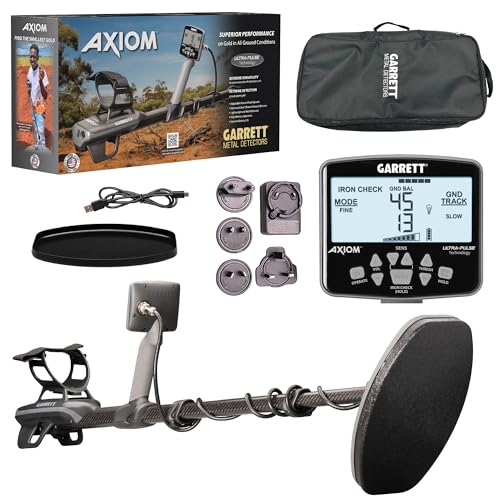
- Pulse technology for extreme soil
- Terra-Scan dual-channel ground balance
- Up to 16 hours of battery life
Best For: Gold prospecting in highly mineralized ground
Best All-Around Value

- DSP processing supports target separation in mineralized soil
- Five modes with pinpoint and discrimination functions
- Waterproof coil and useful starter accessories included
Best For: Hobbyists seeking versatile features and a complete detecting kit
Best for Challenging Ground

- FMF is designed for mineralized soil and varied terrain
- HF2 coil emphasizes small-target sensitivity and separation
- Lightweight wireless design with included headphones
Best For: Experienced prospectors working difficult ground and seeking small gold
Best Portable Beginner Kit

- Lightweight 2.4-pound foldable design with carrying backpack
- DSP chip and DD coil support stable searching
- Four modes and complete accessories simplify setup
Best For: Beginners and families wanting an easy-to-carry outdoor detector
Gold Prospecting Specialist – Fisher Gold Bug 2
For prospectors choosing metal detectors for mineralized soil, the Fisher Gold Bug 2 stands out for its 71 kHz operating frequency, manual ground-balance control, and mineralization settings. It is designed for sensitive gold-nugget detection in challenging ground, including areas with black sand and hot rocks.
Best For: Serious gold prospectors working in highly mineralized soils and seeking sensitivity to small nuggets.
Pros:
- 71 kHz frequency is highly sensitive to small gold nuggets.
- Manual 16-turn ground balance and three-position mineralization switch support fine adjustments.
- Lightweight 2.9-pound design with hip-mountable control housing helps reduce fatigue.
- Audio boost and iron discrimination help clarify faint or unwanted signals.
Cons:
- Its specialized gold-prospecting design may be less versatile for general-purpose detecting.
- Manual ground balancing requires more hands-on adjustment than an automatic system.
- IP44 protection and a waterproof coil do not indicate that the entire detector is submersible.
The Gold Bug 2 is a focused choice when mineralization handling and tiny-gold sensitivity matter more than broad, all-purpose features. Its light weight and adjustable controls make it practical for extended prospecting sessions.
All-Terrain Depth Hunter – Garrett AT Max
The Garrett AT Max is a practical option among metal detectors for mineralized soil when you want strong depth, all-metal operation, and all-terrain flexibility. Its enhanced electronics, true all-metal mode, and Iron Audio feature support target evaluation in difficult outdoor conditions.
Best For: Detectorists who want a waterproof, general-purpose machine for land, low-light, and shallow-water hunting.
Pros:
- Enhanced electronics and 13.6 kHz specification are intended to improve depth and sensitivity.
- True All Metal mode provides maximum detection depth and sensitivity across metal types.
- Fully waterproof to 10 feet for versatile all-terrain use.
- Included Z-Lynk wireless headphones provide near-zero-delay audio.
Cons:
- At 6.7 pounds, it is considerably heavier than the Fisher Gold Bug 2.
- The supplied details list both a 13.6 kHz feature claim and a 7.69 kHz operating-frequency specification.
- Its 8.5-inch coil offers less stated coverage than the larger coils in this roundup.
The AT Max suits buyers who value waterproofing and broad usability alongside mineralized-soil performance. Iron Audio and the backlit display add practical help when sorting targets or hunting in low light.
Beginner-Friendly Adjustable Detector – DD60 Rechargeable Gold Detector
The DD60 offers an approachable entry point for shoppers comparing metal detectors for mineralized soil, with six search modes, adjustable sensitivity, and an 11-inch Double-D coil. Its controls are geared toward flexible outdoor use, while the rechargeable battery and backlit display simplify longer detecting sessions.
Best For: Beginners, families, and casual users who want adjustable controls and a submersible coil at a lower-complexity starting point.
Pros:
- 11-inch fully submersible Double-D coil is designed for deeper, more accurate detection.
- Six modes include All Metal, DISC, Jewelry, Relic, Custom, and Pinpoint.
- Seven-level sensitivity adjustment and three audio tones offer control over hunting behavior.
- Rechargeable USB-C battery, backlit LCD, and adjustable 28-to-55-inch shaft support convenient use.
Cons:
- The supplied notes do not specify a dedicated mineralization-adjustment or ground-balance control.
- Its advertised performance figures for reducing false alarms and missed targets are manufacturer claims.
- The product details do not state that the control unit is waterproof; the coil is described as submersible.
The DD60 is appealing when ease of use, flexible modes, and rechargeable operation are priorities. For especially mineralized ground, buyers should weigh its general adjustment options against detectors with explicitly documented ground-balance controls.
Versatile Mineralization Reader – Fisher F75 Multi-Purpose Detector
The Fisher F75 is a versatile choice among metal detectors for mineralized soil, combining a magnetic mineralization bar graph and readout with FastGrab ground balance. Its numeric target identification, discrimination modes, and lightweight ergonomic design make it suitable for prospecting as well as coin, relic, and beach hunting.
Best For: Experienced users who want one detector for mineralized-ground prospecting and broader coin, relic, and beach applications.
Pros:
- FastGrab ground balance helps adjust to changing ground conditions.
- Magnetic mineralization bar graph and readout provide useful ground information.
- Double-filter discrimination modes help when searching trashy areas.
- Lightweight ergonomics, pinpoint trigger, backlight, and long stated battery life support extended use.
Cons:
- The supplied notes do not describe the search coil as fully waterproof.
- At 4.7 pounds, it is heavier than the Gold Bug 2.
- Its broad multi-purpose design may be less specialized for tiny gold than a 71 kHz detector.
The F75 is a strong middle-ground option for buyers who need mineralization information without giving up general-purpose capability. FastGrab and the mineralization readout make it particularly useful when ground conditions vary during a hunt.
Prospecting Precision – Garrett A.T. Gold
For metal detectors for mineralized soil, the Garrett A.T. Gold offers an 18 kHz operating frequency, plus manual and automatic ground balance controls designed to help manage changing soil conditions. Its True All Metal mode prioritizes sensitivity and depth for prospecting.
Best For: Gold prospectors who want adjustable ground balance and a focused detector with an included pinpointer.
Pros:
- 18 kHz frequency supports detection of small gold nuggets, jewelry, coins, and relics.
- Manual and automatic ground balance, including a Ground Balance Window, help address variable soil.
- Included Pro-Pointer AT is waterproof up to 20 feet and offers 360° detection.
- Iron Audio helps identify iron targets before you dig.
Cons:
- The 5-inch search coil provides a relatively compact search area.
- Its two listed programs offer less mode variety than some detectors.
The A.T. Gold is a practical choice when ground-balance adjustment and small-target sensitivity matter more than a broad selection of search modes. The included pinpointer also makes target recovery more efficient.
Easy Multi-IQ Versatility – MINELAB Vanquish 360
The MINELAB Vanquish 360 is a lightweight option among metal detectors for mineralized soil, using Multi-IQ technology without requiring manual frequency changes. Park, Beach, and All Metal modes make it adaptable across common hunting environments.
Best For: Beginners who want a simple, lightweight detector for parks, beaches, fields, and wet terrain.
Pros:
- Multi-IQ technology is designed for straightforward operation across different soils.
- At 2.6 pounds, it is easy to carry and handle during longer hunts.
- IP68 waterproofing allows submersion up to 16 feet.
- Built-in rechargeable battery provides up to 10 hours of operation.
Cons:
- The supplied notes do not specify manual ground-balance controls.
- Its plastic construction may appeal less to buyers seeking a metal-bodied detector.
Choose the Vanquish 360 for convenience and broad usability rather than specialized manual tuning. Its waterproof design, rechargeable battery, and included 10-inch V10X Double-D coil make it ready for varied outings.
Extreme-Ground Gold Specialist – Garrett Axiom Lite
For especially challenging mineralized soil, the Garrett Axiom Lite uses advanced pulse technology to target both large nuggets and sub-gram gold. Its Terra-Scan dual-channel ground balance is designed to smooth performance in mineralized ground and saltwater.
Best For: Gold prospectors working extreme soil conditions who need pulse technology, specialized ground balancing, and long battery life.
Pros:
- Advanced pulse technology is intended for large nuggets and sub-gram gold.
- Terra-Scan ground balance addresses mineralized ground and saltwater.
- At 4.2 pounds with an 11-inch coil, it is designed to reduce fatigue.
- Built-in lithium-ion battery provides up to 16 hours of detecting.
Cons:
- Its 4.2-pound weight is higher than the 2.6-pound Vanquish 360.
- Iron Check requires a DD-FC search coil according to the supplied notes.
The Axiom Lite is the most specialized choice here for difficult mineralized ground and gold prospecting. Its pulse platform and Terra-Scan system are compelling when soil handling and sub-gram sensitivity take priority.
Best All-Around Value – DSP 12-Inch Metal Detector
For shoppers comparing metal detectors for mineralized soil, this model stands out for its digital signal processor, target-separation features, and claimed detection depth of up to 12.8 inches in suitable conditions. Its five search modes and adjustable design make it a versatile choice for coin shooting, relic hunting, and gold prospecting.
Best For: Hobbyists who want a feature-rich detector with useful accessories and adaptable controls.
Pros:
- DSP chip is designed to improve noise filtering and target separation in mineralized soil.
- Five modes include All-Metal, Disc, Notch, Memory, and Pinpoint.
- 12-inch IP68 waterproof coil, backlit LCD, headphones, shovel, backpack, and batteries are included.
- Stem adjusts from 20 to 53 inches and folds for transport.
Cons:
- The control box is splash-proof, not waterproof, so it must not be immersed.
- Depth performance depends on soil and target conditions.
This is a practical all-purpose package for users who want mineralized-soil capability without giving up beach, park, or shallow-water versatility. The included kit also reduces the need for immediate accessory purchases.
Best for Challenging Ground – XP Deus II Gold FMF Detector
For serious searches in mineralized soil, the XP Deus II Gold pairs Fast Multi-Frequency technology with the 5×9 HF2 coil. It is designed to maintain sensitivity to both larger and tiny nuggets while providing ground subtraction, target separation, and EMI resistance across difficult terrain.
Best For: Experienced gold prospectors and detectorists who prioritize sensitivity, wireless operation, and performance on demanding ground.
Pros:
- FMF and high-frequency options are designed for mineralized soil, beaches, and diving conditions.
- HF2 coil emphasizes target separation and sensitivity to low-conductive targets.
- Mono-frequency range spans 9 to 120 kHz, with a high-frequency multifrequency band from 9 to 90 kHz.
- Light 1.65-pound design, wireless headphones, and interchangeable high-capacity battery support longer sessions.
Cons:
- Its advanced feature set may be more than beginners need.
- The narrow 5×9 coil covers less ground per sweep than larger coils.
This is the most specialized option here for mineralized soil and small-gold work. Its wireless, lightweight design and strong separation capabilities suit users willing to invest time in learning advanced settings.
Best Portable Beginner Kit – Foldable 11-Inch DD Detector
This foldable detector is a convenient entry point for shoppers looking at metal detectors for mineralized soil, especially when portability matters. Its upgraded DSP chip, 11-inch IP68 DD coil, and four search modes are intended to provide more stable searching for coins, relics, jewelry, and other buried metal objects.
Best For: Beginners, families, and casual outdoor users who want a lightweight detector that packs easily.
Pros:
- DSP processing is designed to improve signal response and detection stability.
- 11-inch IP68 DD coil is suitable for beaches, wet grass, shallow-water edges, and other outdoor locations.
- Four modes include All Metal, DISC, Notch, and Pinpoint, with nine target metal types.
- Weighs 2.4 pounds, folds into the included backpack, and includes headphones, shovel, and batteries.
Cons:
- The control box is not waterproof; only the search coil is waterproof.
- Its claimed 12.8-inch depth depends on suitable conditions.
With its internal cable design, adjustable 22-to-60-inch stem, and compact folding format, this model is easy to carry to parks, beaches, and backyards. It offers approachable controls while still including features useful for mineralized-ground searches.
How We Picked These Metal Detectors for Mineralized Soil
We focused on detectors with features that matter in challenging ground: adjustable or automatic ground balance, strong mineralization handling, useful target identification, waterproof or weather-resistant coils, and controls that help reduce false signals. The selection includes very high-frequency gold detectors, multifrequency models, pulse-style technology, and general-purpose detectors with prospecting capability.
We also considered practical factors such as coil size, weight, interface simplicity, operating modes, pinpointing, and whether the detector can transition from nugget hunting to coins, relics, or beach use.
Quick Comparison
| Type | Best For | Main Advantage | Potential Trade-Off |
|---|---|---|---|
| High-frequency VLF | Small gold nuggets | Excellent sensitivity to tiny targets | Can require careful ground balancing |
| Multifrequency | Mixed terrain and general use | Versatility across target types | Often costs more than basic VLF models |
| Pulse-style gold detector | Highly mineralized ground and deeper targets | Strong mineralization tolerance | Less detailed target identification |
| General-purpose VLF | Coins, relics, and occasional prospecting | Flexible settings and lower cost | May be less specialized for extreme soil |
Key Buying Factors for Metal Detectors for Mineralized Soil
Ground Balance and Mineralization Control
Look for automatic, manual, or tracking ground balance. Manual control can help experienced users fine-tune performance, while automatic and tracking systems simplify changing soil conditions. Threshold stability and mineralization indicators are also valuable when hot rocks create false responses.
Operating Frequency and Technology
Higher frequencies are generally useful for small, low-conductivity gold, but they may respond strongly to mineralized soil. Multifrequency detectors offer broader versatility. Pulse-style technology can be a better fit for severe mineralization and depth, although it may provide less precise discrimination.
Coil Design, Size, and Waterproofing
Double-D coils commonly provide useful ground coverage and stability in mineralized terrain. Smaller coils separate targets and handle difficult ground more easily; larger coils cover more area but can be harder to stabilize. Waterproof construction matters for wet soil, creek crossings, and shallow-water searching.
Controls, Weight, and Battery Life
Prospecting often involves long walks, so balance and weight can matter as much as raw depth. Confirm battery runtime, charging options, display readability, audio controls, and whether the detector supports headphones. A complicated detector may be less effective if its settings are difficult to adjust in the field.
Who Should Buy Which Metal Detectors for Mineralized Soil?
Dedicated gold prospectors: Choose a high-frequency gold detector when sensitivity to small nuggets is the priority and you are comfortable adjusting ground balance. For exceptionally mineralized locations or deeper prospecting, consider a pulse-style model.
Users who want one detector for several hobbies: A multifrequency or versatile all-purpose detector is the better choice for switching between gold, coins, relics, parks, and beaches.
Beginners: Start with a detector offering automatic ground balance, clear modes, a waterproof coil, and straightforward controls. This reduces setup time while you learn how mineralized soil affects audio and target IDs.
Experienced users upgrading: Prioritize fine ground-balance control, adjustable sensitivity and threshold, interchangeable coils, and a platform that supports the specific search conditions you encounter most often.