
Finding the right first string instrument means balancing age, size, durability, play value, and realistic musical potential. These picks cover simple wooden rhythm toys, mini ukuleles, and more capable banjos for children ready to practice.
Use the guide below to compare construction, tuning, accessories, and age suitability before choosing an instrument that matches your child’s interest and coordination.
Best 10 Banjos for Children Picks for 2026
Playful Jungle Pick

- Child-sized wooden design for ages 3+
- Three strings for beginner sound exploration
- Colorful jungle artwork with leaf-shaped tuning keys
Best For: Young beginners who enjoy imaginative musical toys
Colorful Starter Choice
Blue Lion 17-Inch Kids Ukulele

- Lightweight 17-inch design for preschoolers
- Soft nylon strings and sturdy ABS body
- Includes a pick and colorful lion artwork
Best For: Preschoolers wanting a fun first string instrument
Montessori-Inspired Option

- Recommended for ages 36 months to 6 years
- Encourages rhythm, listening, and fine-motor skills
- Wooden, child-safe design for self-directed play
Best For: Montessori homes and early-learning music spaces
Durable Practice Alternative

- Portable 17-inch size for young players
- Rounded ABS design built for regular play
- Four strings and included picks for beginners
Best For: Children needing a durable, easy-to-carry starter instrument
Best Mini Banjo Kit

- Compact 26-inch design for travel and lessons
- Includes tuner, bag, strap, pickup, and tools
- Mahogany body with comfortable 3mm action
Best For: Older children and beginners wanting a complete portable banjo kit
Best First Instrument

- Sized for young hands and ages 3+
- Playable, tunable, and fitted with nylon strings
- Non-toxic finish supports child-friendly play
Best For: Young children starting with rhythm, strumming, and musical exploration
Best Banjolele Starter Kit
Kmise 23-Inch Concert Banjolele
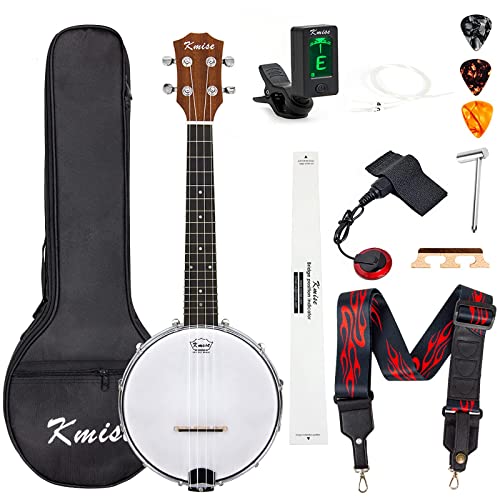
- Compact four-string design with low 3mm action
- Includes bag, tuner, strap, pickup, and tools
- Switches between resonator and open-back styles
Best For: Beginners wanting a portable, flexible four-string banjolele kit
Best Starter Guitar

- 26-inch beginner instrument
- Four tunable strings
- Recommended for ages 3+
Best For: Young beginners exploring guitar-style musical play
Best Realistic Banjolele Kit

- Four-string banjolele design
- Nylon strings and low action
- Includes bag, tuner, picks, and guide
Best For: Beginners wanting a portable banjo-ukulele setup
Best Toddler-Friendly Toy

- Compact 17-inch size
- Four nylon strings
- Designed for ages 3+
Best For: Toddlers and preschoolers learning rhythm through play
Playful Jungle Pick – Janod Wooden Children's Banjo
For families seeking banjos for children aged 3 and up, this Janod wooden model offers a colorful, child-sized introduction to musical play. Its three strings, leaf-shaped tuning keys, and jungle artwork make it inviting for little hands, while the compact design supports simple strumming and sound exploration.
Best For: Young beginners who enjoy imaginative designs and hands-on musical discovery.
Pros:
- Designed for children from age 3, with a child-sized wooden body.
- Three strings encourage simple early musical exploration.
- Jungle illustrations and leaf-shaped tuning keys add visual appeal.
- Includes three spare strings for continued play.
Cons:
- Its three-string layout is intended for introductory play rather than advanced musicianship.
- The supplied details describe it as a manual children’s instrument, not a full-size professional banjo.
This is a cheerful choice when appearance, manageable sizing, and early developmental play matter most. It combines musical experimentation with a playful jungle theme that may help keep young children engaged.
Colorful Starter Choice – Blue Lion 17-Inch Kids Ukulele
Although styled as a mini guitar or ukulele rather than a banjo, this 17-inch instrument is a practical alternative for families comparing banjos for children ages 3 to 5. Its lightweight ABS body, soft nylon strings, rounded design, and bright blue lion theme are aimed at safe, approachable musical play.
Best For: Preschoolers who want a colorful, easy-to-carry first string instrument.
Pros:
- Lightweight 17-inch size is designed for small hands.
- Soft, adjustable nylon strings are gentler for beginning players.
- Impact-resistant ABS construction is suited to active play.
- Includes a pick for experimenting with strumming techniques.
Cons:
- It is a guitar/ukulele-style toy, not a banjo.
- The product details list an unusually small dimensional specification, so shoppers should verify sizing before purchase.
This option makes sense if your child is drawn to bright cartoon styling and needs a simple instrument for rhythm, coordination, and creative play. Choose it as a banjo alternative rather than a traditional banjo purchase.
Montessori-Inspired Option – PlanToys Wooden Banjo
For shoppers choosing banjos for children between 36 months and 6 years, the PlanToys Banjo emphasizes sensory exploration and self-directed music-making. Its wooden construction and simple manual design invite children to pluck, strum, compare tones, and experiment with rhythm without unnecessary electronic features.
Best For: Montessori-style homes, early-learning spaces, and children developing fine-motor control.
Pros:
- Recommended for children from 36 months to 6 years.
- Supports fine-motor skills, hand control, auditory stimulation, and rhythm concepts.
- Made with sustainably sourced wood and child-safe finishes, according to the supplied notes.
- Simple design encourages calm, self-guided creative play.
Cons:
- At 16 ounces, it may feel heavier than some lightweight plastic alternatives.
- Its minimalist styling may be less immediately flashy for children seeking bright graphics.
This is a strong fit when educational value, tactile materials, and open-ended exploration take priority. It offers a more refined wooden alternative for music corners and preschool environments.
Durable Practice Alternative – 17-Inch Kids Ukulele Guitar
This 17-inch guitar-style toy is another alternative to consider when comparing banjos for children. Built from ABS plastic with rounded edges and a smooth surface coating, it is designed for ages 36 months to 9 years and includes four strings and picks for straightforward beginner strumming.
Best For: Children who need a portable, durable starter instrument for casual musical play.
Pros:
- Compact 17-inch format is sized for young players.
- ABS construction, rounded edges, and a smooth coating support child-friendly handling.
- Four strings provide a simple introduction to notes and rhythmic patterns.
- Includes picks so children can begin playing immediately.
Cons:
- It is a guitar/ukulele-style instrument rather than a banjo.
- The strings are described as stainless steel, which may feel less forgiving than nylon for some beginners.
- The plastic construction may appeal less to shoppers specifically seeking a wooden instrument.
Consider this model if portability, easy cleanup, and impact resistance are more important than traditional banjo styling. Its straightforward four-string setup makes it suitable for informal practice and musical discovery.
Best Mini Banjo Kit – Vangoa 26-Inch 5-String Banjo
For shoppers comparing banjos for children, the Vangoa 26-inch model offers a compact beginner setup with a five-string layout. Its mahogany body, 3mm action, and included accessories make it a practical option for learners who need a portable instrument and starter gear in one package.
Best For: Older children or beginners who can manage a full five-string banjo format and want a portable practice kit.
Pros:
- Compact 26-inch size and 2.8-pound weight are convenient for travel, classes, and parties.
- Includes a carrying bag, tuner, strap, pickup, extra strings, picks, and adjustment tools.
- Mahogany construction and bronze strings are designed for a warm, punchy sound.
- 3mm action and an adjustable truss rod support comfortable play and setup changes.
Cons:
- The five-string banjo format may be more involved for very young beginners.
- It is a manually played instrument rather than a simplified toy-style starter.
Choose this Vangoa when portability, included accessories, and a traditional five-string experience matter more than the simplest possible introduction to music.
Best First Instrument – Hape Kid's Wooden Ukulele
Although it is a ukulele rather than a banjo, the Hape wooden model belongs in a roundup of banjos for children because it provides a straightforward first step into strumming and rhythm. It is sized for young hands, uses nylon strings, and is recommended for children ages three and up.
Best For: Young children who are beginning to explore string instruments, rhythm, coordination, and creative play.
Pros:
- Recommended for ages three and up and sized for young hands.
- Fully playable and tunable with nylon strings.
- Supports rhythm, strumming, motor coordination, and auditory skills.
- Uses durable wood with water-based paint and non-toxic finishes.
Cons:
- It is a four-key ukulele, not a banjo.
- It does not include the broader accessory bundle supplied with the Vangoa or Kmise kits.
For preschool-age children, this Hape instrument is a gentler and simpler alternative to a full banjo. It is best viewed as an accessible musical-learning toy rather than a banjo substitute.
Best Banjolele Starter Kit – Kmise 23-Inch Concert Banjolele
For families seeking banjos for children with a lighter four-string approach, the Kmise concert banjolele combines a 23-inch portable body with ukulele-style nylon strings. Its low action, smooth fretboard, adjustable design, and extensive beginner kit make it suitable for learners who want a bright, percussive sound.
Best For: Beginners who prefer a compact four-string instrument with low action, flexible sound options, and included accessories.
Pros:
- 23-inch concert size and 2.6-pound weight make it portable.
- 3mm action, smooth fretboard, and neat fret wires are designed for comfortable learning.
- Includes a gig bag, tuner, strap, strings, pickup, bridge, wrench, ruler, and picks.
- Detachable back supports resonator or open-back playing, while the pickup enables connection to recording equipment.
Cons:
- It has four strings and a banjolele format rather than a traditional five-string banjo layout.
- The supplied warranty description is limited to a six-month return and refund period.
The Kmise is a versatile middle ground for beginners: smaller and simpler than a five-string banjo while offering more setup flexibility and performance features than a basic toy instrument.
Best Starter Guitar – Hape Blue Lagoon Kids Guitar
Although it is not a banjo, this Hape wooden guitar can suit families comparing banjos for children with other beginner-friendly string instruments. Its 26-inch size, four tunable strings, and recommended age of 3 years and up make it an approachable option for early musical exploration.
Best For: Young beginners who want a larger, guitar-style instrument for indoor musical play.
Pros:
- Recommended for children ages 3 and up.
- Four tunable strings provide an introduction to tuning and strumming.
- Wood-and-ABS construction with a bright blue finish.
Cons:
- It is a guitar rather than a banjo or banjolele.
- The 26-inch body may be relatively large for some younger children.
This is a practical alternative for children who are ready to handle a fuller-size beginner instrument. Choose it when guitar-style play and tunable strings matter more than a banjo’s distinctive sound.
Best Realistic Banjolele Kit – Mulucky 23-Inch Banjolele
For shoppers specifically seeking banjos for children, the Mulucky banjolele offers a genuine four-string banjo-ukulele format with a 23-inch body. Its nylon strings, low action, and included travel accessories make it a more instrument-focused choice for older or supervised beginners.
Best For: Beginners who want banjo twang with ukulele-style nylon strings and a ready-to-use travel kit.
Pros:
- WeatherKing synthetic head and nylon strings provide a bright, resonant sound profile.
- Includes a padded gig bag, clip-on tuner, three picks, and starter guide.
- Low-action strings are described as beginner-friendly.
- Lightweight design includes backpack straps for portability.
Cons:
- At 23 inches and 1.15 kg, it may be more suitable for older children than toddlers.
- It is a banjolele, so its sound and playing feel differ from a full-size banjo.
- The listed warranty is only two months.
This is the strongest match here for families wanting an actual banjo-style instrument rather than a toy. The included tuner, bag, picks, and guide also reduce the need to buy basic accessories separately.
Best Toddler-Friendly Toy – 17-Inch Kids Toy Ukulele
Families browsing banjos for children may prefer this compact ukulele-style toy for toddlers and preschoolers who are still developing basic rhythm and coordination. Its 17-inch size, lightweight plastic body, and four carbon nylon strings are designed for small hands and introductory play.
Best For: Toddlers and preschoolers beginning to explore strings, rhythm, and musical play.
Pros:
- Compact 17-inch design is intended to be easy for small hands to grip.
- Recommended for children ages 3 years and up.
- Four nylon strings and a coated surface support beginner play.
- Educational focus includes hand-eye coordination, hearing, and rhythm.
Cons:
- It is a plastic toy ukulele, not a banjo.
- It is designed for basic musical exploration rather than advanced playing.
- The package includes the instrument only.
This option makes sense when size, simplicity, and toddler-friendly play are the priorities. It can introduce string instruments before a child moves on to a more realistic banjolele or full-size instrument.
How We Picked the Best Banjos for Children
We selected instruments across the main categories families encounter: preschool wooden toys, small ukulele-style instruments, banjoleles, and compact five-string banjos. Our priorities were age-appropriate sizing, manageable weight, robust construction, comfortable stringing, and the likelihood that an instrument will encourage repeated play.
We also considered practical details such as included picks, straps, bags, tuners, replacement strings, and whether the instrument is designed for imaginative exploration or actual beginner practice. Product descriptions and specifications should still be checked carefully, since finishes, accessories, and dimensions can vary by seller.
Quick Comparison
- Best for very young children: Wooden toy banjos and ukuleles with simple designs and easy handling.
- Best for musical exploration: Small four-string ukuleles that introduce basic strumming and chord shapes.
- Best for a traditional banjo feel: A compact five-string model with a resonant head and beginner accessories.
- Best for progressing players: A 23-inch banjolele with a gig bag, tuner, strap, and pickup.
Key Buying Factors for Banjos for Children
Age, Size, and Comfort
For toddlers and preschoolers, prioritize a lightweight instrument with a short body and neck. A toy that is too large can be frustrating and difficult to hold. Older children with better reach may manage a 23- or 26-inch instrument, but adult-sized models are usually unnecessary for beginners.
Toy Instrument or Playable Instrument?
Wooden Montessori-style products are excellent for sensory play, rhythm, and pretend performance, but they may not maintain precise tuning. If your child wants to learn songs, choose a model with tunable strings, a stable bridge, and a neck that feels comfortable in the hand.
Strings and Tuning
Nylon strings are generally softer and easier on young fingers than steel strings. Four-string ukulele and banjolele layouts can also be simpler to understand than a traditional five-string banjo. A clip-on or included tuner makes early practice more productive.
Build Quality and Safety
Look for smooth edges, secure tuning hardware, a firmly attached bridge, and finishes suitable for children. Inspect small accessories such as picks and straps, and supervise younger children around strings or detachable parts.
Accessories and Long-Term Value
A gig bag protects the instrument, while a strap can make holding it easier. Extra strings and a tuner reduce the need for immediate add-on purchases. For a child who may lose interest quickly, a durable toy offers better value; for a committed beginner, a playable instrument can last longer.
Who Should Buy Which Banjos for Children?
Choose a wooden toy banjo or ukulele for a toddler who is exploring rhythm, sound, and imaginative play. Pick a small four-string ukulele for a preschooler or young child who wants to strum recognizable songs with minimal hand stretch. Choose a compact five-string banjo for an older beginner specifically interested in traditional banjo sound and willing to learn tuning. A banjolele is a strong middle ground for children who want banjo styling, ukulele-like playability, and useful travel accessories.