
If you want a compact Jackery power bank for travel, camping, or backup charging, the Explorer 240D is built around portability first.
Its mix of DC-only output, fast charging, and LiFePO4 durability makes it a focused choice rather than a do-everything station.
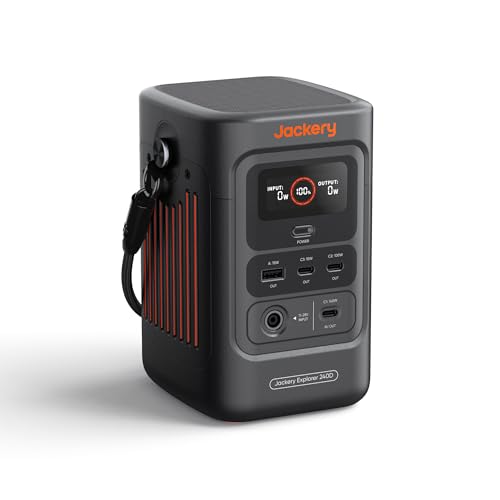
Explorer 240D Review Summary
The Jackery Explorer 240D review comes down to one simple question: do you want a small, light, long-life power source that is easy to carry and quick to top up?
If the answer is yes, this model makes a strong case because it prioritizes portability, modern USB-C charging, and a battery chemistry that is designed for long service life.
It suits campers, road-trippers, commuters, and anyone who wants a compact emergency backup for phones, tablets, cameras, lights, and other low-to-moderate power gear.
It is less compelling if you need AC wall outlets, high-wattage appliance support, or a battery that behaves like a traditional portable power station with inverter output.
Review Scorecard
| Category | Score | Why it scores this way |
|---|---|---|
| Portability | 9/10 | At 4.85 lb, it is easy to pack, carry, and stash in a car or bag. |
| Charging speed | 8/10 | The listing supports 1-hour fast charging with the right dual-input setup. |
| Output flexibility | 7/10 | Four ports and up to 200W DC output cover many devices, but there is no AC output. |
| Battery longevity | 9/10 | LiFePO4 chemistry and a 10-year lifespan claim are strong for long-term buyers. |
| Travel utility | 8/10 | Compact size, strap cable, and multi-input charging fit mobile use well. |
| Emergency readiness | 8/10 | Solar, car, and AC-DC charging options make it flexible for outages and trips. |
| Overall value fit | 8/10 | Best for buyers who value size, durability, and USB-C/DC convenience over full power-station features. |
Key Features and Specifications of Explorer 240D
The Explorer 240D is positioned as a compact portable power solution with a 256Wh battery and a 200W DC output ceiling.
The listing highlights four output ports in total: three USB-C ports and one USB-A port, with up to 140W per port.
That matters because it is clearly designed around modern small-device charging rather than running household appliances.
The included 2-in-1 USB-C strap cable is a practical detail rather than just a marketing line.
It doubles as a carry strap and a fast-charging cable, which reinforces the product’s travel-first design.
For people who move between home, car, campsite, or airport-style carry, that kind of integrated accessory is genuinely useful.
The battery uses LiFePO4 chemistry, and the listing claims a 10-year lifespan with at least 70% remaining energy after 6,000 charge cycles.
That is one of the strongest reasons to consider this model if you plan to keep it for years instead of replacing a cheaper unit after a short cycle life.
Other important listing facts:
- Weight: 4.85 lb
- Dimensions: 4.73 x 4.19 x 6.69 in
- Output types: USB-C and USB-A
- Charging methods: USB-C, solar, car charging, and AC-DC dual input
- Fast charging: up to 0% to 80% in about one hour with the 100W charger and dual input
- Solar input: up to 100W
- Operating range listed: -4°F to 113°F
The most important specification to understand is what this product is not.
It is not an AC portable power station in the usual sense, and it is not trying to be one.
That makes it smaller and lighter, but it also narrows the devices it can sensibly support.
Pros and Cons of Explorer 240D
Pros
- Very portable for a battery with 256Wh capacity.
- LiFePO4 battery is a major plus for long-term durability.
- Fast charging options make it easy to top up before a trip.
- USB-C-heavy port layout matches the devices most people actually carry.
- Car, solar, and AC-DC input support improves flexibility in real-world use.
- Included strap cable adds convenience without extra accessories.
Cons
- No AC outlets, so it will not suit users who need wall-style power.
- 200W DC output is useful, but still limited for bigger gear.
- Best fit is device charging, not powering a broad mix of appliances.
- The compact design trades away versatility that larger station-style units provide.
Who Should Buy Explorer 240D?
The Explorer 240D is a good fit for buyers who care more about carrying comfort than maximum output variety.
If you want a compact battery for phones, tablets, cameras, routers, lights, and other smaller electronics, the size and port selection make sense.
It is also a strong option for travelers and campers who want something easy to keep in a car, backpack, or RV storage bin.
The low weight and mixed charging methods are especially appealing if you expect to recharge from a wall, vehicle, or solar setup depending on where you are.
It is not the right choice if you want a general-purpose backup unit for appliances, desktop gear, or anything that expects AC power.
Buyers who need that kind of flexibility should look at a fuller portable power station instead of this DC-first model.
Why the Explorer 240D Makes Sense for Mobile Power
Compact Size, Real Carryability
The strongest practical advantage here is how easy it should be to move around.
At 4.85 pounds and under 7 inches in each dimension, this is the sort of product you are likely to actually bring along instead of leaving at home.
That matters more than spec-sheet ambition when a product is meant for road use or emergency grab-and-go storage.
Long-Life Battery Chemistry
LiFePO4 is a meaningful selling point because it is associated with long cycle life and stable day-to-day use.
For buyers comparing compact power options, the difference between something that feels disposable and something built for years of use is important.
The listing’s 10-year lifespan claim and 6,000-cycle figure reinforce that this model is aimed at durability-minded buyers.
Charging Convenience
The charging story is better than you might expect from a compact unit.
USB-C, solar, car charging, and AC-DC dual input give it multiple ways to refill, and the one-hour fast-charging claim with the right charger makes it more travel-friendly.
That combination is especially useful if you do not always have a consistent power source available.
Limits You Should Accept
The tradeoff is that this is not a miniature everything-machine.
The output is DC-focused, and the lack of AC outlets will be a deal-breaker for some shoppers.
If your use case includes a laptop that truly wants AC power, a small kitchen appliance, or anything with a higher startup demand, you should choose a different category of product.
Alternatives to Explorer 240D
If you like the idea of a compact power bank but want a different balance of size and output, consider the Anker 521 Portable Power Station, which is a common compact alternative for buyers who want a more traditional station form factor.
If you need more mainstream portable-power-station behavior, the EcoFlow RIVER 2 is worth a look for shoppers who want a broader power-station ecosystem.
If you prefer a well-known brand with a wide range of sizes, the BLUETTI portable power station line is another credible place to compare features and capacity.
If your priority is ultra-portable charging rather than station-style backup, the Anker power bank lineup may be a better fit for slimmer, lower-capacity carry options.
Is Explorer 240D Worth It?
Yes, if your buying priority is a compact, durable, easy-to-carry power source for modern USB-C devices and small electronics.
The Explorer 240D is most convincing when viewed as a portable DC companion with strong battery longevity, not as a substitute for a full AC power station.
If you want lightweight backup power for trips, emergencies, or day-to-day carry, this is a sensible buy.
If you need wall outlets, broader appliance support, or a more traditional portable power station experience, look elsewhere.