
If you’re an intermediate crafter looking to enhance your skills, choosing the right vacuum chamber can make a significant difference in your projects. These tools not only help in degassing resins and silicones but also improve the quality of your work. With a variety of options available, from durable stainless steel to clear acrylic models, you’ll want to know which chambers stand out. Let’s explore the top picks that could elevate your crafting experience.
VEVOR 5 Gallon Vacuum Chamber and Pump Kit for Degassing Resin Epoxies

If you’re an intermediate user looking to enhance your resin casting projects, the VEVOR 5 Gallon Vacuum Chamber and Pump Kit is an excellent choice. This kit features a robust 3.5 CFM vacuum pump that achieves an impressive 5Pa ultimate vacuum, ensuring thorough air extraction and eliminating bubbles from your resin. Constructed from high-quality stainless steel, the chamber is durable and resistant to warping. With a transparent acrylic lid, you can easily monitor the degassing process. The ergonomic design and rubber-coated handle provide a secure grip, while the visible oil viewing window simplifies maintenance during operation. Elevate your crafting today!
Best For: Intermediate users looking to enhance their resin casting projects through effective degassing.
Pros:
- High-performance 3.5 CFM vacuum pump ensures thorough air extraction for bubble-free resin.
- Durable stainless steel construction resists warping and deformation under high pressure.
- Transparent acrylic lid allows for easy monitoring of the degassing process.
Cons:
- Not suitable for wood stabilization, limiting its versatility.
- Requires regular maintenance, including monitoring oil levels.
- The size may be cumbersome for users with limited workspace.
PB Motor Tech 3 Gallon Vacuum Chamber Kit with Vacuum Pump

The PB Motor Tech 3 Gallon Vacuum Chamber Kit with Vacuum Pump is perfect for intermediate users looking to elevate their crafting and stabilization projects. With a 4.5CFM vacuum pump featuring a sturdy copper motor, you’ll achieve efficient degassing of silicones, epoxies, and essential oils. The thickened stainless steel chamber can withstand temperatures up to 160ºF, while the bulletproof tempered glass lid guarantees visibility. Dual rubber seals enhance sealing efficiency, and the reinforced aluminum housing offers durability. Just remember, you’ll need to purchase vacuum pump oil separately. This kit’s quality makes it an excellent choice for your creative endeavors.
Best For: This product is best for intermediate users looking to enhance their crafting and wood stabilization projects with efficient degassing capabilities.
Pros:
- High 4.5CFM flow rate ensures quick and effective vacuuming.
- Durable construction with thickened stainless steel and bulletproof tempered glass for visibility.
- Dual rubber seals improve sealing efficiency for better performance.
Cons:
- Vacuum pump oil must be purchased separately, adding to initial costs.
- May be too advanced for beginners who require simpler options.
- Limited capacity of 3 gallons may not meet the needs of larger projects.
VEVOR 3 Gallon Vacuum Chamber with Pump
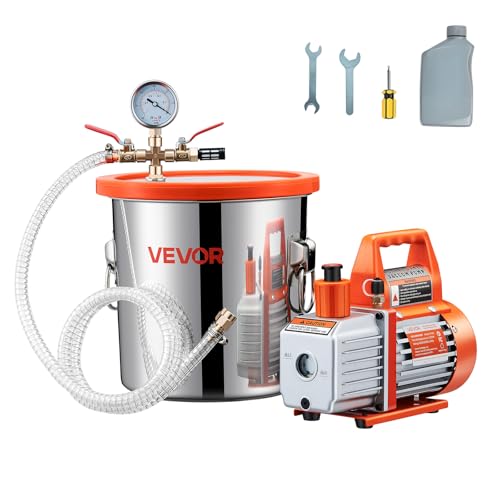
For those diving into more advanced degassing and de-bubbling applications, the VEVOR 3 Gallon Vacuum Chamber with Pump stands out as an exceptional choice. This unit features a powerful 4-pole high-torque motor, delivering a vacuum level of 5 Pa, ensuring efficient performance. Its stainless steel design is both durable and resistant to high pressure, while the tempered glass lid lets you monitor the process easily. With user-friendly elements like an ergonomic handle and clear oil window, it simplifies operation. The complete kit, including all essential components, makes it an ideal option for your laboratory work or crafting projects.
Best For: This vacuum chamber is best for professionals and hobbyists involved in laboratory work, food packaging, resin casting, and wood stabilization.
Pros:
- Powerful Performance: Achieves an ultimate vacuum of 5 Pa, ensuring efficient degassing and de-bubbling.
- Durable Construction: Made from high-quality stainless steel, resistant to deformation under high pressure.
- User-Friendly Features: Ergonomic handle and clear oil window enhance ease of use and monitoring.
Cons:
- Size Limitation: The 3-gallon capacity may not be sufficient for larger projects or bulk applications.
- Weight: The stainless steel construction can make the unit heavier and less portable than plastic alternatives.
- Oil Maintenance: Requires regular oil checks and changes for optimal pump performance, which may be inconvenient for some users.
BACOENG 1.5 Gallon Acrylic Vacuum Chamber for Resin

Designed specifically for intermediate users, the BACOENG 1.5 Gallon Acrylic Vacuum Chamber excels in degassing resins, silicones, and epoxies with its durable acrylic construction. With a size of 8.1 x 6.5 x 7.1 inches, it offers a 1.5-gallon capacity and features an acrylic lid that lets in 92% light. You’ll appreciate the large transparent window to observe the defoaming process. The silicone gasket guarantees long-lasting use, with a lifespan of over 10,000 cycles. Its vacuum gauge ranges from 0-30 inHg, and the reinforced vacuum hose makes installation a breeze. Just avoid stabilization resins to prevent lid cracking.
Best For: Intermediate users looking for a reliable vacuum chamber to degas resins, silicones, and epoxies.
Pros:
- Durable acrylic construction with a long lifespan of over 10,000 cycles.
- Large transparent window allows for easy observation of the defoaming process.
- Equipped with a vacuum gauge and reinforced vacuum hose for effortless installation.
Cons:
- Not compatible with stabilization resins, which may lead to lid cracking.
- Limited to a maximum medium temperature of 212℉.
- Not suitable for making fishing baits.
BACOENG 2 Gallon Acrylic Vacuum Chamber Kit for Resin and Epoxies

If you’re an intermediate user looking to enhance your resin and epoxy projects, the BACOENG 2 Gallon Acrylic Vacuum Chamber Kit stands out with its durable acrylic construction and excellent visibility. Its large transparent window allows you to observe the defoaming process easily, while the adjustable speed lets you monitor your work closely. The vacuum gauge measures up to 30 inHg, and the reinforced vacuum hose connects seamlessly to your vacuum pump. Just remember, it’s not compatible with certain solvents like alcohol and acetone, so keep those out to avoid damaging the acrylic lid. Enjoy crafting with confidence!
Best For: Intermediate users looking to enhance their resin and epoxy projects with a reliable vacuum chamber.
Pros:
- Durable acrylic construction ensures longevity and repeated use over 10,000 times.
- Large transparent window provides excellent visibility for monitoring the defoaming process.
- Adjustable speed feature allows for tailored observation during the vacuuming process.
Cons:
- Not compatible with certain solvents like alcohol, acetone, and stabilization resins, limiting versatility.
- Chemical reactions with incompatible solvents may crack the acrylic lid, requiring careful usage.
- Not suitable for making fishing baits, which may deter some users in that niche.
BACOENG Universal Vacuum Chamber Kit for Resin and Silicone

The BACOENG Universal Vacuum Chamber Kit stands out as an ideal choice for intermediate users seeking a reliable and efficient solution for resin and silicone applications. This 2-quart stainless steel chamber is durable, promising over 10,000 uses. Its acrylic lid allows 92% light transmittance, so you can easily monitor your materials. The liquid-filled gauge measures vacuum levels up to 30 inHg, while the professional-grade vacuum hose connects directly to your pump without hassle. However, it is essential to recognize that this kit isn’t suitable for stabilizing certain resins or solvents like alcohol and acetone, so plan accordingly.
Best For: Intermediate users looking for a reliable vacuum chamber for resin and silicone applications.
Pros:
- Durable stainless steel construction allows for over 10,000 uses.
- Acrylic lid with 92% light transmittance provides excellent visibility during defoaming.
- Professional-grade vacuum hose with swivel ends simplifies setup and operation.
Cons:
- Not suitable for stabilizing certain resins like Cactus Juice and Gator Venom.
- Incompatible with solvents such as alcohol, ethanol, and acetone.
- Requires a separate vacuum pump for operation, which is not included in the kit.
BACOENG 1.5 Gallon Stainless Steel Vacuum Chamber

For those diving into resin work or wood stabilization, the BACOENG 1.5 Gallon Stainless Steel Vacuum Chamber stands out as an excellent choice. With a maximum rated vacuum of 29 inHg at sea level, it guarantees efficient degassing of silicones, epoxies, and essential oils. The tempered glass lid offers durability, while the silicone gasket assures a tight seal. Its increased bottom thickness prevents depressions during use. Plus, installation is a breeze—just tighten the screws for the side gauges and valves. This versatile chamber is perfect for various experiments, making it a valuable tool in your crafting journey.
Best For: This product is best for hobbyists and professionals engaged in resin work, wood stabilization, and those needing efficient degassing of various compounds.
Pros:
- Durable tempered glass lid ensures longevity and visibility during use.
- Effective silicone gasket provides a perfect seal, enhancing vacuum efficiency.
- Simple installation with no special tools required, making it user-friendly.
Cons:
- Not recommended for use with acrylic crystal lids, as they may crack with volatile compounds.
- Limited capacity of 1.5 gallons may not be sufficient for larger projects.
- The maximum vacuum rating of 29 inHg may not meet the needs of all applications.
BACOENG Universal Vacuum Chamber Kit for Resin and Epoxies

Ideal for those delving into resin and epoxy projects, the BACOENG Universal Vacuum Chamber Kit stands out with its durable stainless steel construction and user-friendly design. With a compact size of 5.7 inches in diameter and a height of 3.9 inches, it’s lightweight at just 3.15 pounds. The silicone gasket lasts over 10,000 uses, while the acrylic lid lets you observe material defoaming with 92% light transmittance. Equipped with a liquid-filled vacuum gauge and a reinforced vacuum hose, this kit offers reliable performance. Just remember, it’s not suitable for certain solvents, so choose wisely for compatibility!
Best For: Those engaged in resin and epoxy projects looking for a reliable and durable vacuum chamber.
Pros:
- Constructed from strong stainless steel for long-lasting use.
- Features an acrylic lid with high light transmittance for easy observation of material defoaming.
- Includes a reinforced vacuum hose that withstands high pressures, enhancing usability.
Cons:
- Not compatible with stabilization resin, alcohol, ethanol, acetone, and acrylic-based monomers or polymers.
- Limited size may not be suitable for larger projects.
- Requires careful selection of materials to avoid damage to the acrylic lid.
VEVOR 5 Gallon Vacuum Chamber for Wood and Resin Degassing

Crafting bubble-free wood and resin projects becomes effortless with the VEVOR 5 Gallon Vacuum Chamber, making it an excellent choice for intermediate users. Constructed from high-quality 304 stainless steel, this durable chamber withstands high vacuum pressures without deformation. Its thickened 0.75-inch tempered glass lid lets you easily observe the degassing process. With a 24-hour airtight seal and a vacuum level reaching -29inHg, you can achieve outstanding results. The silicone oil-filled vacuum gauge guarantees precise readings, while the included flexible hose and muffler keep operations smooth and quiet. Elevate your crafting experience with this reliable vacuum chamber!
Best For: Intermediate crafters looking to create bubble-free wood and resin projects.
Pros:
- Durable construction with high-quality 304 stainless steel and a thick tempered glass lid for easy observation.
- Excellent vacuum performance with a -29inHg vacuum level and a 24-hour airtight seal for reliable results.
- User-friendly features including a silicone oil-filled vacuum gauge and a flexible hose with a noise-reducing muffler.
Cons:
- Weighty design at 15.4 pounds may be cumbersome for some users to move.
- Limited capacity of 5 gallons might not be sufficient for larger projects.
- Potential learning curve for new users unfamiliar with vacuum chamber operations.
VEVOR 2 Gallon Vacuum Chamber for Resin and Silica Gel Degassing

The VEVOR 2 Gallon Vacuum Chamber stands out for its exceptional airtight seal and vacuum level, making it perfect for intermediate users looking to achieve bubble-free results in their resin and silica gel projects. Constructed from thick acrylic, it endures vacuum pressure while allowing you to observe your work. With a vacuum level of -29inHg and only about 5% leakage over 12 hours, you’ll enjoy consistent performance. The silicone oil-filled gauge provides precise measurements, while the included flexible hose and muffler keep your setup efficient and quiet. This chamber’s durability and functionality truly elevate your crafting experience.
Best For: Intermediate users looking to achieve bubble-free results in their resin and silica gel projects.
Pros:
- High airtightness with a vacuum level of -29inHg and minimal leakage.
- Durable construction from thick acrylic allows for observation and withstands vacuum pressure.
- Includes flexible hose and muffler for efficient and quiet operation.
Cons:
- The oil plug may overflow when cut open, which could be messy.
- Limited capacity of 2 gallons may not be sufficient for larger projects.
- Requires careful handling to maintain the integrity of the acrylic material.
Factors to Consider When Choosing a Vacuum Chamber for Intermediate Users
When choosing a vacuum chamber as an intermediate user, you’ll want to take into account several key factors. Chamber size and capacity, material durability, and pump power rating are essential for your specific needs. Additionally, pay attention to sealing mechanisms and visibility features to guarantee efficient monitoring during your projects.
Chamber Size and Capacity
Choosing the right vacuum chamber size and capacity is essential for intermediate users looking to enhance their degassing processes. The size of your chamber determines how much material you can process at once. If you work on larger projects or need to degas multiple smaller items, a chamber between 3 to 5 gallons might suit you best. For hobbyists or those with limited quantities of resin or silicone, a smaller chamber around 1.5 to 2 gallons may be adequate. Remember to take into account the chamber’s dimensions to verify it fits in your workspace and is easy to handle. Ultimately, selecting the right size enhances efficiency and improves your results, accommodating various project sizes and complexities.
Material Durability and Resistance
Selecting a vacuum chamber that suits your needs goes beyond just size; material durability and resistance play a significant role in performance and longevity. Consider stainless steel for superior durability and corrosion resistance, while acrylic may be more vulnerable to chemical reactions. If you opt for acrylic, make sure the lid thickness is around 0.7 to 0.75 inches to enhance its resistance to deformation. A tempered glass lid adds strength and high-temperature resistance. Additionally, look for silicone gaskets that provide airtight seals and withstand repeated use without degrading. Don’t overlook the construction quality, as reinforced hoses and sturdy valves are essential for maintaining vacuum levels and extending the chamber’s lifespan, especially when working with volatile compounds.
Vacuum Pump Power Rating
The power rating of your vacuum pump is essential for guaranteeing your vacuum chamber operates efficiently. Measured in cubic feet per minute (CFM), a higher CFM means faster vacuum creation. For most degassing applications, look for a pump with a flow rate of 3.5 to 4.5 CFM, as it strikes a good balance between speed and performance. Also, consider the ultimate vacuum level; pumps reaching -29 inHg or 5 Pa are effective for thorough degassing. If you’re planning prolonged use, opt for a pump with a built-in cooling fan to prevent overheating. Finally, verify the pump’s power and efficiency match your vacuum chamber’s size and application needs for ideal results.
Sealing Mechanisms and Efficiency
When it comes to achieving effective vacuuming in your chamber, the sealing mechanisms play an essential role in maintaining ideal performance. Look for effective seals like silicone gaskets and threaded valve connections to guarantee airtight conditions and reduce air leaks. Chambers equipped with dual rubber seals or high-quality silicone seals provide enhanced efficiency, minimizing leakage during extended use. Ideally, you want a leakage rate of less than 5% over a 12-hour period to guarantee effective degassing and prevent air bubbles in your materials. Consider the design of the sealing cover—whether it’s acrylic or tempered glass—as this affects both durability and sealing effectiveness. Regularly monitor vacuum levels with precision gauges to assess sealing performance and maintain consistent operations.
Visibility and Monitoring Features
A vacuum chamber‘s visibility and monitoring features are essential for intermediate users aiming for ideal degassing results. Look for a model with a transparent lid made of tempered glass or acrylic, so you can visually monitor the degassing process without breaking the vacuum. High light transmittance enhances your ability to observe defoaming materials. Integrated vacuum gauges provide real-time readings of the vacuum level, ensuring optimal conditions during operation. Consider silicone oil-filled gauges for shock absorption and more precise measurements. Additionally, some chambers come with airflow control valves, allowing for fine adjustments based on what you see. These features combine to give you better control and insight, helping you achieve the best results feasible.
Compatibility With Materials
Selecting a vacuum chamber that matches your materials is essential for achieving ideal results. You need to confirm compatibility with specific items like resins, silicones, or essential oils, as some chambers may react poorly. For instance, acrylic chambers can crack or degrade when exposed to solvents like alcohol or acetone, so always check material interactions. On the other hand, stainless steel chambers offer durability and versatility, making them suitable for applications like wood stabilization and degassing volatile compounds. If you’re using stabilization resins, choose a chamber designed for that purpose to prevent chemical reactions and sealing issues. Finally, verify the temperature and pressure limits to confirm safety and effectiveness during your processes.