
If you’re stepping into the world of photography, choosing the right telephoto lens can be a game changer. These lenses allow you to capture distant subjects with clarity and detail. From wildlife to sports, having the right tools makes all the difference. In this guide, we’ll explore ten standout options that balance quality and affordability, helping you enhance your skills and creativity. Let’s see which lenses might just be perfect for your journey.
Phone Camera Lens Kit for Smartphones

If you’re a photography enthusiast looking to expand your skills without breaking the bank, the 4 in 1 HD phone camera lens kit is the perfect choice for you. This compact kit includes a 28x telephoto lens for stunning distant shots, a 198° fisheye lens for creative wide-angle perspectives, a 20x macro lens for capturing intricate details up close, and a 0.6x wide-angle lens for expansive landscapes. Easy to install and compatible with most smartphones, it enhances your photography experience while ensuring portability. Users rave about its versatility and impressive clarity, making it a must-have for anyone wanting to elevate their mobile photography game.
Best For: Photography enthusiasts looking to enhance their mobile photography skills with a versatile and affordable lens kit.
Pros:
- High-quality lenses suitable for various photography styles, including telephoto, fisheye, macro, and wide-angle.
- Easy installation and portability, making it convenient for on-the-go photography.
- High customer satisfaction with a rating of 5.0 out of 5 stars, indicating a positive user experience.
Cons:
- May not function properly with smartphones that have multiple camera lenses if settings cannot be adjusted.
- Requires a tripod for optimal use of the telephoto lens to minimize shake.
- Limited compatibility with some smartphone models, potentially affecting performance.
Canon EF 75-300mm f/4-5.6 III Telephoto Zoom Lens for Canon SLR Cameras

The Canon EF 75-300mm f/4-5.6 III Telephoto Zoom Lens is an excellent choice for beginner photographers looking to explore wildlife and family photography without breaking the bank. With a versatile focal length of 75-300mm, you can capture stunning portraits and distant subjects. Weighing just 16.8 ounces, it’s manageable for outdoor adventures. While it lacks image stabilization, using a tripod or faster shutter speed can help avoid blur. The autofocus system may be slower in low light, so manual adjustments might be necessary. Overall, this lens offers great value and versatility for budding photographers enthusiastic to expand their skills.
Best For: Beginner photographers interested in wildlife and family photography who want an affordable telephoto zoom lens.
Pros:
- Excellent for capturing portraits at 75mm.
- Affordable option for a telephoto zoom lens with good build quality.
- Versatile for outdoor and nature photography.
Cons:
- Sharpness decreases significantly above 250mm.
- Autofocus can be unreliable in low light and during action shots.
- Zooming action may not be very smooth.
Canon EF 75-300mm f/4-5.6 III Telephoto Zoom Lens (Renewed)

For those just stepping into the world of photography, the Canon EF 75-300mm f/4-5.6 III Telephoto Zoom Lens (Renewed) offers an excellent balance of performance and affordability. Weighing only 16.8 ounces, it’s lightweight and easy to handle. With a focal length range of 75-300mm, you can capture stunning close-ups from a distance. The DC autofocus motor guarantees quick and accurate focusing, while the improved zoom mechanism allows for smooth adjustments. Plus, the minimum focus distance of 4.9 feet gives you versatility for various shooting scenarios. This lens is a fantastic choice for budding photographers looking to enhance their skills.
Best For: Beginners in photography seeking a versatile and affordable telephoto lens to enhance their skills.
Pros:
- Lightweight design at 16.8 ounces makes it easy to handle and carry.
- Focal length range of 75-300mm allows for capturing detailed close-ups from a distance.
- Smooth zoom mechanism and quick DC autofocus motor improve shooting efficiency.
Cons:
- Limited maximum aperture of f/4-5.6 may affect low-light performance.
- Minimum focus distance of 4.9 feet may not be suitable for extreme close-up photography.
- Image stabilization is not included, which may lead to blurry images in certain conditions.
Telephoto Lens for Nikon DSLR (420-800mm, Manual Focus)

Looking to elevate your photography skills? The Telephoto Lens for Nikon DSLR (420-800mm, Manual Focus) is perfect for capturing distant subjects like wildlife or the moon. With a fixed aperture of F/8.3-16, you’ll need to adjust your ISO and shutter speed manually in mode M. This lens fits a wide range of Nikon DSLRs, ensuring compatibility with your camera. Its durable design means it can withstand tough conditions, while the manual focus allows for precise adjustments. Just remember, you’ll need to turn the focus ring yourself—perfect for honing your skills and capturing stunning shots!
Best For: Photography enthusiasts looking to capture distant subjects like wildlife and the moon with a manual focus telephoto lens.
Pros:
- High focal length range (420-800mm) allows for versatile shooting of distant subjects.
- Durable construction ensures the lens can withstand challenging outdoor conditions.
- Compatibility with a wide range of Nikon DSLRs makes it accessible for many camera users.
Cons:
- Manual focus only requires more skill and practice to achieve sharp images.
- Fixed aperture limits flexibility in exposure settings, potentially leading to overexposure or underexposure.
- Lack of electronic contacts means the camera cannot communicate aperture settings, displaying F– on the screen.
Tamron 70-300mm F/4.5-6.3 Di III RXD Lens for Sony E-Mount

Ideal for budding photographers seeking versatility, the Tamron 70-300mm F/4.5-6.3 Di III RXD Lens for Sony E-Mount offers an impressive zoom range that’s perfect for capturing everything from distant wildlife to close-up portraits. Weighing just 19.2 oz, its lightweight design makes it easy to carry. With a moisture-resistant build and smooth zoom ring, you’ll enjoy a comfortable shooting experience. The RXD autofocus guarantees quick, silent adjustments, ideal for tracking moving subjects. Plus, it delivers stunning image quality, especially in good light. For an affordable price, this lens is a fantastic addition to your photography toolkit.
Best For: Budding photographers looking for a versatile and lightweight telephoto lens for capturing a variety of subjects.
Pros:
- Lightweight and compact design makes it easy to carry for extended periods.
- Quick and silent RXD autofocus system allows for effective tracking of moving subjects.
- Exceptional image quality with a stunning bokeh effect, especially in well-lit conditions.
Cons:
- Not weather-sealed, so caution is needed in extreme weather conditions.
- Some users have reported quality control issues, such as small debris inside the lens.
- Low-light performance may require adjustments, such as increasing ISO or using a tripod.
Evil Eye 20-60X Zoom Telephoto Lens for Smartphones

With its impressive 20X-60X adjustable magnification, the Evil Eye 20-60X Zoom Telephoto Lens is perfect for smartphone photographers enthusiastic to capture distant subjects in stunning detail. Compatible with iPhone and Android devices, this lightweight lens features HD optical glass for clarity and low distortion. Its durable aluminum alloy body guarantees long-lasting performance, while the included storage bag makes it easy to take on your adventures. Users appreciate its optical quality for bird watching but note some challenges with stability. Pair it with a robust tripod and use a timer for the best results. Enjoy stunning shots effortlessly!
Best For: Smartphone photographers looking to capture distant subjects with clarity and detail.
Pros:
- High Magnification: Offers adjustable 20X-60X magnification for versatile photography.
- Optical Quality: Features HD optical glass that provides excellent clarity and low distortion.
- Durable Design: Made from high-precision aluminum alloy, ensuring long-lasting performance and easy portability.
Cons:
- Stability Issues: Users have reported challenges with stability, particularly when using a tripod.
- Learning Curve: Some may find it difficult to use effectively without prior experience with telephoto lenses.
- Tripod Limitations: The included tripod may not provide the necessary sturdiness for optimal shooting conditions.
Phone Camera Lens Kit 28X Telephoto Lens for Smartphones

The Phone Camera Lens Kit 28X Telephoto Lens is a fantastic choice for budding photographers who want to enhance their smartphone photography without the complexity of professional gear. Weighing just 9.1 ounces, it’s lightweight and portable, making it perfect for travel. This lens allows you to capture stunning long-distance shots with clarity, thanks to its individual focus capability. It’s easy to clip on your smartphone and works well with both front and back cameras. Whether you’re at a concert or birdwatching, this lens elevates your photography experience, giving you impressive results without breaking the bank.
Best For: Amateur photographers and smartphone users looking to elevate their photography skills without investing in expensive equipment.
Pros:
- Lightweight and Portable: Easy to carry during travel or outdoor activities.
- User-Friendly: Clips on quickly and aligns perfectly with smartphone cameras.
- Improved Image Quality: Enhances clarity and depth in photos, suitable for various photography subjects.
Cons:
- Compatibility Issues: May not work well with smartphones that have multiple camera lenses due to switching problems.
- Lack of Protective Case: Users suggest the inclusion of a case for better storage when not in use.
- Limited Professional Features: While effective, it may not meet the demands of professional photographers seeking advanced capabilities.
JINTU 420-1600mm Telephoto Zoom Lens for Canon

For aspiring photographers enthusiastic to capture distant subjects like wildlife or sports, the JINTU 420-1600mm Telephoto Zoom Lens for Canon stands out as an exceptional choice. This lens offers a remarkable zoom range, extending from 420mm to 800mm and reaching an impressive 1600mm with the included 2X Teleconverter. Its sturdy metal construction and multi-coated low-dispersion glass enable sharp images, even at great distances. While it requires manual focusing, this feature encourages creativity in your photography. Just remember, you’ll need to shoot in Manual Mode, as this lens lacks autofocus and electronic contacts. It’s a fantastic tool for dedicated photographers!
Best For: Aspiring photographers looking to capture distant subjects such as wildlife, sports, and celestial objects with a high zoom capability.
Pros:
- Exceptional zoom range from 420mm to 1600mm with the included 2X Teleconverter.
- Sturdy metal construction and multi-coated low-dispersion glass for sharp image quality.
- Encourages creativity through manual focus, allowing for personalized photography techniques.
Cons:
- Lacks autofocus and electronic contacts, requiring manual focusing.
- Requires shooting in Manual Mode, which may be challenging for beginners.
- Camera may display F00 due to the absence of direct access to aperture value.
APEXEL 30x HD Telephoto Lens for Smartphones

Looking to elevate your smartphone photography? The APEXEL 30x HD Telephoto Lens is your perfect companion. Designed for devices like iPhone and Samsung, this lens features a 7-element, 10-glass construction with ultra-HD optics. You can capture stunning images from up to 8000 meters away, making it ideal for wildlife and outdoor adventures. Its Quick-Switch Focus Ring allows for real-time zoom control, ensuring sharp and vibrant shots. Weighing just 1.61 pounds, it’s portable and easy to use. Customers rave about its image quality and sturdy design. Take your photography to new heights with this powerful telephoto lens!
Best For: Photography enthusiasts and professionals seeking to capture high-definition images of distant subjects using their smartphones.
Pros:
- Ultra-HD optics for razor-sharp images with accurate colors.
- Quick-Switch Focus Ring for real-time zoom control, enhancing ease of use.
- Sturdy construction with quality materials, ensuring durability and stability.
Cons:
- Some users may face challenges with angling for specific shots.
- Requires a steady hand or tripod for optimal performance at long distances.
- Slightly heavier than typical smartphone lenses, which may affect portability.
JINTU 420-800mm Telephoto Zoom Lens for Canon SLR Cameras
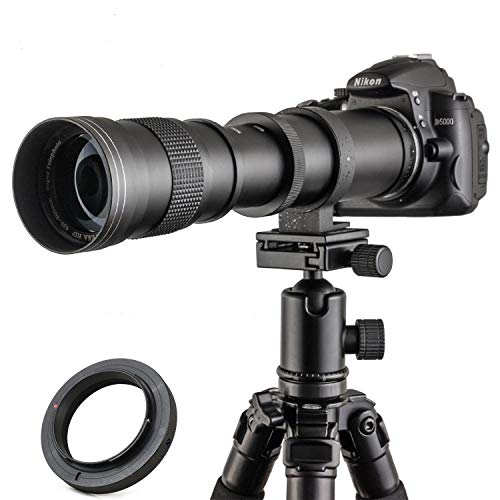
Perfect for aspiring photographers, the JINTU 420-800mm Telephoto Zoom Lens offers an impressive focal range that enables you to capture stunning images of distant subjects like wildlife and the moon. Weighing just 700g, its solid metal body guarantees durability while remaining portable. Since it’s a manual lens, you’ll need to switch to manual focus, which enhances your learning experience. While it excels in daylight, be prepared for challenges in low light. Using a tripod is essential at longer focal lengths for stability. With practice, you’ll reveal its potential for breathtaking shots, especially of nature and sports.
Best For: Aspiring photographers looking to capture distant subjects like wildlife and the moon with a budget-friendly telephoto lens.
Pros:
- Lightweight and portable design makes it easy to carry for outdoor shooting.
- Durable construction with a solid metal body ensures longevity and stability.
- Exceptional image quality for the price, especially in daylight conditions.
Cons:
- Manual focus only, which can be challenging for beginners and requires practice.
- Struggles in low light, limiting effectiveness during nighttime photography.
- Chromatic aberrations may be present, requiring post-processing for optimal results.
Factors to Consider When Choosing a Telephoto Lens for Beginners
When choosing a telephoto lens, you need to contemplate several key factors. Think about compatibility with your camera type, the aperture range, and the focal length options that suit your photography style. Additionally, weigh the differences between manual and autofocus systems, as well as the build quality and durability of the lens.
Compatibility With Camera Type
Choosing the right telephoto lens starts with verifying compatibility with your camera type. Lenses are typically designed for specific mounts, like Canon EF or Nikon F, so check the mount before purchasing. If you’re using a different brand, you may need an adapter. Next, consider the focal length range; longer lengths, like 300mm or more, are perfect for distant subjects such as wildlife or sports. Also, look at the maximum aperture—wider apertures, such as f/4, perform better in low light. If your camera struggles with autofocus on certain lenses, confirm the lens supports manual focus. Finally, features like image stabilization can greatly improve image quality by reducing blur, especially at longer focal lengths.
Aperture Range and Quality
While selecting a telephoto lens, understanding the aperture range is vital for capturing stunning images. The aperture, expressed in f/stops (like f/4.5-6.3), controls how much light enters the lens, influencing low-light performance and depth of field. A wider maximum aperture allows for better light capture, which is fundamental for action or wildlife photography. Lenses with a fixed maximum aperture across the zoom range maintain consistent exposure, making it easier to manage settings as you zoom. Additionally, look for lenses with quality construction, such as multi-coated glass elements, to enhance sharpness and reduce flare. Balancing aperture range and overall image quality guarantees you achieve great results in various lighting conditions without extensive editing.
Focal Length Options
Understanding aperture range and image quality is just the start of selecting the right telephoto lens. When it comes to focal length, most telephoto lenses range from 70mm to 800mm or more. If you’re a beginner, a focal length between 200mm and 300mm strikes a nice balance between reach and handling ease. This range is versatile for capturing everything from sports to wildlife. If you’re aiming for specialized photography like astrophotography, consider lenses 400mm or longer, but keep in mind that you’ll likely need a tripod for stability. Also, remember that longer focal lengths create a shallower depth of field, which can beautifully isolate your subject against a blurred background, enhancing your overall image quality.
Manual vs. Autofocus
How do you decide between manual and autofocus when selecting your first telephoto lens? Consider your comfort level and shooting style. Manual focus lenses let you control the focus ring, enhancing your understanding of depth of field and composition. They’re often simpler and more affordable, appealing to budget-conscious beginners. However, mastering manual focus takes practice and patience.
On the other hand, autofocus lenses offer quicker adjustments, making them ideal for capturing fast-moving subjects. While some entry-level autofocus systems may struggle in low light, they generally provide immediate results, which can be more user-friendly for newcomers. Ultimately, weigh the pros and cons based on your needs, learning goals, and shooting scenarios before making a choice.
Build Quality and Durability
When choosing your first telephoto lens, it’s vital to evaluate build quality and durability, as these factors directly impact your shooting experience. Look for lenses made with high-quality materials like metal bodies and multi-coated glass elements, guaranteeing they can withstand wear and tear. A lightweight design is critical for portability, especially during outdoor shoots or travel. Moisture-resistant construction offers added protection against various weather conditions, maintaining performance when you need it most. Additionally, opt for lenses known for solid build quality to endure regular handling, particularly as you’re still mastering your gear. Finally, check user feedback on durability and stability to confirm your lens performs well under demanding conditions.
Price and Value Considerations
Choosing a telephoto lens involves more than just considering build quality; price and value play significant roles too. You’ll want to balance quality and affordability, especially since many beginner-friendly options are available for under $300. Look for lenses with high customer ratings—those rated 4.5 stars and above generally indicate good value and satisfaction. While higher-quality optics can enhance your photography, they may come at a higher price, so assess if that investment is worth it for you. Also, keep in mind any additional costs for accessories, like tripods or adapters, which can impact your budget. Finally, consider the warranty and customer support; brands offering longer warranties can provide added peace of mind for your purchase.