
Making pasta at scale requires more than a powerful motor. The right machine must match your batch volume, electrical supply, dough capacity, cutting options, and available workspace.
We selected 10 commercial and heavy-duty models ranging from compact electric dough rollers to high-output production machines. Use the guide below to narrow your choices by throughput, versatility, maintenance needs, and kitchen setup.
Best 10 Pasta Machines for Large Batches Picks for 2026
Top Commercial Capacity
Omcan 26 lb Tank Pasta Machine

- 26 lb tank and 55 lb/hr output
- Automatic stainless-steel construction
- Requires 208V three-phase power
Best For: Restaurants and supermarkets with compatible commercial power
Best Adjustable Sheeter
Electric 55–66 lb/h Pasta Maker

- 55–66 lb/h stated dough capacity
- Tool-free sheeting and cutting switch
- 0.1–20 mm thickness adjustment
Best For: Mixed pasta, dumpling, wonton, and dough-sheet production
Best Italian Floor Model
Omcan Heavy-Duty 55 lb Pasta Machine

- 26 lb tank and 55 lb/hr output
- Automatic floor-model operation
- Made in Italy; dies sold separately
Best For: Commercial kitchens with 220V single-phase power
Best Compact 2-in-1
Newhai 750W Commercial Pasta Maker

- Presses dough and cuts pasta in one machine
- 0.12–18 mm adjustable thickness
- Includes 2.5 mm, 2 mm, and 6 mm cutting options
Best For: Flexible pasta production in restaurants or home kitchens
Heavy-Duty Floor Model
Omcan PM-IT-0015 13-Lb Pasta Machine

- 13-lb hourly output and 33-lb maximum capacity
- 1 HP motor with motorized cutters and fan coolers
- Italian-made, CE listed, and QPS approved
Best For: High-volume restaurant and food-service production
Versatile Commercial Countertop
Newhai 550W Dual-Blade Pasta Maker

- 550W automatic pressing and cutting
- Adjustable 0.3-5 mm dough thickness
- 2 mm and 6 mm noodle settings with stainless-steel construction
Best For: Restaurants and home kitchens needing powered versatility
Automatic Production Line
Koalalko 2.2KW Formed Pasta Machine

- Automatic 10-25 kg/h production capacity
- Includes fusilli, spaghetti, and penne molds
- Supports additional dies and vegetable-colored pasta
Best For: Food businesses producing varied extruded pasta shapes
Versatile Commercial Roller
Adjustable Electric Pasta Maker
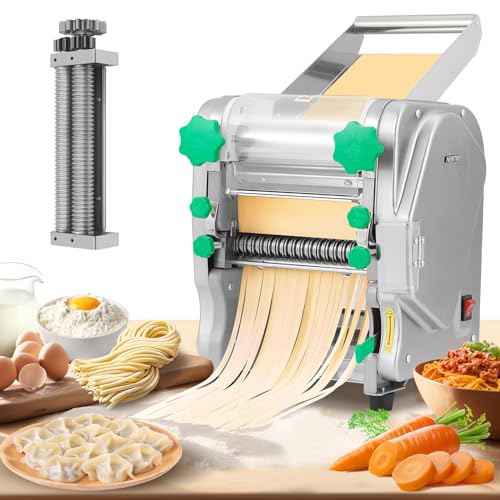
- 0.1–18mm adjustable dough thickness
- 2mm/6mm and 2.5mm cutting blades
- 550W motor with 20cm dough width
Best For: Home cooks and small commercial kitchens making pasta and wrappers
Compact High-Volume Pick

- 45–55lb hourly noodle workload
- 3mm and 9mm dual noodle cutter
- Combines kneading, pressing, and cutting
Best For: Restaurants and households needing multifunctional batch production
Heavy-Duty Throughput Choice

- 45–66lb stated hourly workload
- 750W all-copper motor
- 304 stainless roller and cutter
Best For: Restaurants and high-volume users prioritizing power and throughput
Top Commercial Capacity – Omcan 26 lb Tank Pasta Machine
For restaurants and supermarkets seeking pasta machines for large batches, this automatic Omcan model emphasizes hopper capacity and hourly output. Its 26-pound tank and stated 55-pound-per-hour production rate suit high-volume pasta preparation, provided your facility supports its three-phase electrical requirement.
Best For: Restaurants and supermarkets with compatible 208V, 60Hz, three-phase power.
Pros:
- 26-pound tank capacity and 55-pound-per-hour output.
- Automatic operation with stainless-steel construction.
- Includes a cutting assembly for production use.
- Designed for restaurant and supermarket applications.
Cons:
- Requires 208V/60Hz/3-phase electrical service.
- Dies are sold separately.
- Heavy 347-pound floor-machine design limits portability.
This is a capacity-focused choice for commercial kitchens, but confirm electrical compatibility and budget for separately purchased dies before ordering.
Best Adjustable Sheeter – Electric 55–66 lb/h Pasta Maker
This electric dough sheeter is a versatile option among pasta machines for large batches, combining a 750W motor with a stated 55–66-pound-per-hour dough capacity. Its thickness adjustment and tool-free mode change make it useful when a kitchen alternates between sheets, noodles, wonton skins, and dumpling wrappers.
Best For: Home kitchens, restaurants, and small caterers needing adjustable dough sheets and noodle cutting.
Pros:
- Handles a stated 55–66 pounds of dough per hour.
- Tool-free lever switches between sheeting and cutting modes.
- Adjustable thickness from 0.1 to 20 mm.
- Stainless-steel body with a 750W motor.
Cons:
- Semi-automatic rather than fully automatic operation.
- Requires manual cleaning and periodic oiling.
- Its versatility is centered on sheeting and cutting rather than hopper-style extrusion.
Choose this model when thickness control and quick switching matter more than fully automated extrusion. Its 110V operation may also be simpler to accommodate than three-phase commercial equipment.
Best Italian Floor Model – Omcan Heavy-Duty 55 lb Pasta Machine
Omcan 16643 Italian Heavy-Duty Pasta Machine Floor Model 55 lb (25 kg) capacity
Check Price On AmazonFor buyers comparing pasta machines for large batches, this Italian-made Omcan floor model offers automatic operation, a 26-pound tank, and a stated 55-pound-per-hour output. Its heavy-duty stainless-steel build is aimed at commercial production, though the 220V single-phase requirement still needs to be checked before purchase.
Best For: Commercial kitchens wanting an automatic Italian floor machine with high batch capacity.
Pros:
- 26-pound tank capacity with 55-pound-per-hour output.
- Automatic operation for production workflows.
- Made in Italy with stainless-steel construction.
- Includes a cutting assembly.
Cons:
- Dies are sold separately.
- Requires 220V/60Hz single-phase power.
- Large floor-model dimensions may require dedicated space.
This model is a strong fit for established commercial operations that want automatic production and have the required electrical service. Verify available floor space and die requirements as part of the installation plan.
Best Compact 2-in-1 – Newhai 750W Commercial Pasta Maker
The Newhai combines dough pressing and pasta cutting in one semi-automatic machine, making it a practical contender among pasta machines for large batches where space and flexibility matter. It offers adjustable sheet thickness, a 750W motor, and included 2.5mm round plus 2mm/6mm blade options.
Best For: Restaurants and home kitchens wanting a compact machine for adjustable sheets and multiple noodle sizes.
Pros:
- 2-in-1 pressing and cutting design without removing blades.
- Adjustable thickness from 0.12 to 18 mm.
- 750W motor with steel gears and double-belt transmission.
- Includes 2.5mm round and 2mm/6mm blade options.
Cons:
- Automatically shuts down after 1–2 hours of continuous operation.
- Requires a 10–20 minute cooling period before restarting.
- Semi-automatic operation may require more hands-on handling than floor extruders.
This is a flexible option for kitchens that need varied pasta formats without a larger floor machine. Its built-in thermal pause makes it less suitable for uninterrupted production runs.
Heavy-Duty Floor Model – Omcan PM-IT-0015 13-Lb Pasta Machine
Omcan 13397 (PM-IT-0015) Floor Model Pasta Machine 220V with 13-lb Capacity, 1 HP
Check Price On AmazonFor kitchens comparing pasta machines for large batches, the Omcan PM-IT-0015 is a floor-standing commercial option built around a 13-lb hourly output and a 33-lb maximum pasta capacity. Its 1 HP motor, motorized cutters, and fan coolers are suited to high-volume production.
Best For: Restaurants, bakeries, and food-service operations needing a large-capacity Italian-made pasta machine.
Pros:
- Produces up to 13 lb of pasta per hour.
- Offers a 33-lb maximum pasta output.
- Includes motorized cutters and fan coolers.
- CE listed and QPS approved.
Cons:
- Requires a 220V, 60Hz, single-phase connection.
- Its floor-model format may be excessive for smaller kitchens.
The Omcan stands out when throughput and capacity matter more than compactness. Confirm electrical compatibility and available floor space before purchasing.
Versatile Commercial Countertop – Newhai 550W Dual-Blade Pasta Maker
Among pasta machines for large batches, the Newhai 550W model offers automatic pressing and cutting in one machine. It uses food-grade 304 stainless steel, handles dough thicknesses from 0.3 to 5 mm, and cuts either 2 mm slim noodles or 6 mm wide noodles.
Best For: Restaurants, canteens, and serious home kitchens that want a relatively compact commercial machine for sheets and two noodle widths.
Pros:
- Combines dough pressing and noodle cutting without blade removal during pressing.
- Provides adjustable 0.3-5 mm dough thickness.
- Uses food-grade 304 stainless steel in food-contact areas.
- Features all-steel gears and a double-belt transmission.
Cons:
- Offers only two cutting sizes: 2 mm and 6 mm.
- The 7.8-inch roller width limits sheet width.
- At 44 lb, it is heavy for frequent relocation.
This Newhai is a practical middle ground for buyers who need powered operation and adjustable sheets without moving to a full production line. Its limited noodle widths are the main tradeoff.
Automatic Production Line – Koalalko 2.2KW Formed Pasta Machine
For buyers seeking pasta machines for large batches, the Koalalko TXF-60A is the most production-oriented option here. Its automatic extrusion system is rated for 10-25 kg per hour and includes molds for fusilli, spaghetti, and penne.
Best For: Bakeries, restaurants, snack businesses, and food-processing plants producing multiple extruded pasta shapes.
Pros:
- Automatic production capacity is listed at 10-25 kg per hour.
- Includes three molds for fusilli, spaghetti, and penne.
- Additional dies can expand the available pasta shapes.
- Can process flour mixtures with vegetable juice for colored pasta.
Cons:
- At 176 lb, it is difficult to move once installed.
- Its 2.2 kW power requirement and 110V configuration should be verified for the installation site.
- Additional dies cost extra.
The Koalalko is designed for continuous, shape-varied extrusion rather than small-batch countertop use. Its capacity and automatic operation justify planning for dedicated space and production workflows.
Versatile Commercial Roller – Adjustable Electric Pasta Maker
For shoppers comparing pasta machines for large batches, this 550W electric model offers a broad thickness range and straightforward switching between sheeting and cutting. Its 20cm dough width and included dual-use blades make it suitable for several fresh-pasta and wrapper styles.
Best For: Home cooks and small commercial kitchens needing adjustable dough thickness for noodles, fettuccine, dumpling wrappers, or wonton skins.
Pros:
- Adjusts dough thickness from 0.1mm to 18mm.
- Includes 2mm/6mm fettuccine and 2.5mm round-pasta cutting options.
- Uses a 550W motor with an aluminum-alloy shell and 304 stainless-steel components.
- Updated nylon gears and bottom guard are designed to reduce noise and protect the motor.
Cons:
- Its 20cm dough width may be limiting for especially large sheets.
- At roughly 42–45lb, it requires a dedicated, stable countertop location.
- The notes do not specify an hourly noodle-production capacity.
This machine is a flexible choice when adjustable thickness matters more than maximum documented throughput. The automatic operation and commercial-oriented construction make it practical for repeated batches, while the compact 20cm working width keeps its capacity more moderate than some larger sheeters.
Compact High-Volume Pick – Dual-Cutter Noodle Maker
This electric model stands out among pasta machines for large batches by listing a production rate of 45–55lb of fresh noodles per hour. It combines kneading, pressing, and cutting, while its dual cutter produces 3mm and 9mm noodles without requiring blade disassembly.
Best For: Restaurants, snack shops, and households that want a multifunctional machine with a clearly stated hourly noodle capacity.
Pros:
- Rated for approximately 45–55lb of fresh noodles per hour.
- Combines kneading, pressing, and cutting in one machine.
- Dual stainless-steel knives make 3mm and 9mm noodles.
- Can also handle dough for dumpling skins, wonton wrappers, mantou, and pancakes.
Cons:
- The documented dough-width specification is inconsistent, so buyers should verify the usable width.
- At about 46–50lb, it is not especially portable for frequent repositioning.
- The supplied details list a narrower thickness range than some competing models.
With its stated 45–55lb-per-hour output and three-in-one operation, this is a strong throughput-focused option. It is particularly appealing when one appliance needs to support both noodle production and wrapper preparation, though confirming dimensions and dough-width specifications before purchase would be sensible.
Heavy-Duty Throughput Choice – 750W Stainless Pasta Maker
For demanding pasta machines for large batches, this 750W model offers a listed workload of 45–66lb of fresh noodles per hour. It pairs an all-stainless roller and cutter with a stronger all-copper motor and supports a wide selection of cutter sizes for noodles and dough sheets.
Best For: Busy restaurants and serious home users prioritizing higher stated capacity, stainless-steel construction, and cutter flexibility.
Pros:
- Lists a production range of 45–66lb of fresh noodles per hour.
- Uses a 750W all-copper motor with cast-iron gears.
- 304 stainless-steel roller, cutter, and thickened steel shell support heavy-duty use.
- Offers multiple cutter-size options, including 3mm and 9mm, without blade disassembly.
Cons:
- At approximately 46lb, it needs a sturdy, dedicated work surface.
- The supplied thickness specifications are inconsistent and should be confirmed before ordering.
- Its commercial construction may be more machine than occasional users need.
This is the most power- and capacity-oriented option in the group based on its supplied specifications. The stainless-steel build, 750W motor, and selectable cutter options suit repetitive production, but buyers should verify the exact thickness range and available cutter configuration for their intended recipes.
How We Picked the Best Pasta Machines for Large Batches
We focused on machines designed for repeated production rather than occasional countertop use. The lineup includes floor models, electric sheeters, automatic pasta makers, and dual-cutter machines so different kitchens can compare realistic options.
Our main criteria were stated dough capacity, hourly output, motor power, cutter or die versatility, construction, electrical requirements, footprint, and suitability for restaurants, catering operations, meal prep, or high-volume home cooking. Because published specifications can vary by dough type and operating conditions, treat capacity and output figures as guidance rather than guaranteed production rates.
Quick Comparison
| Best For | What to Prioritize | Models to Consider |
|---|---|---|
| Highest throughput | Large tank, strong motor, continuous operation | Omcan 13236; automatic macaroni production machine |
| Restaurant floor use | Heavy-duty frame, stable base, serviceable components | Omcan 16643; Omcan 13397 |
| Flexible noodle shapes | Multiple cutters or interchangeable dies | Newhai 750W; NEWTRY; dual-cutter stainless models |
| Smaller commercial kitchens | Compact footprint, moderate power, simpler controls | Newhai 550W; electric dough roller models |
Key Buying Factors for Pasta Machines for Large Batches
Capacity and Real-World Output
Tank capacity matters when mixing or extruding continuously, while hourly output matters when production deadlines are tight. A machine rated for 50 or more pounds per hour may be excessive for a small café but valuable for catering or packaged-food production. Leave headroom instead of choosing a machine that must run at its limit all day.
Power and Electrical Compatibility
Check voltage, phase, frequency, plug type, and circuit requirements before ordering. Some high-output units require 208V three-phase power, while smaller 550W or 750W machines may be easier to install. Confirm that your kitchen can support the machine without costly electrical upgrades.
Cutters, Dies, and Product Range
Dual cutters can cover common widths such as spaghetti, fettuccine, or noodles, but they may not offer the shaping range of a die-based extruder. If your menu changes frequently, prioritize compatible accessories and easy changeovers. For one or two staple shapes, a simpler fixed cutter can be faster and easier to maintain.
Construction and Cleaning
Stainless steel improves durability and simplifies sanitation, but removable components are equally important. Look for accessible dough-contact surfaces, protected controls, and parts that can be cleaned without awkward disassembly. Avoid assuming that a commercial label means every component is dishwasher-safe.
Footprint and Workflow
Measure the machine, clearance for loading, and space for trays or drying racks. Floor models need a stable location and safe access around moving parts. Countertop units should still leave enough room to portion dough and handle finished pasta without creating bottlenecks.
Who Should Buy Which Pasta Machines for Large Batches?
Choose a high-capacity Omcan floor or production machine if you operate a restaurant, commissary, catering business, or packaged-food line with predictable, frequent demand. Select a 750W commercial model when you want stronger throughput and more cutting flexibility without moving to the largest industrial equipment.
A 550W machine or compact electric roller is a better fit for a small restaurant, specialty shop, or serious home user making regular batches. Buyers who need both noodles and dumpling wrappers should favor a dual-cutter or roller design, while producers focused on shaped pasta should look for an automatic extruder with suitable dies.
Before purchasing, verify the seller’s warranty, replacement cutters or dies, service availability, lead time, and return policy. Those details can matter as much as motor wattage when the machine becomes part of a daily production workflow.