
If you’re an intermediate user looking for the best oscilloscopes, you’ve come to the right place. Choosing the right model can enhance your diagnostics and signal analysis markedly. From handheld designs to more robust digital options, several models stand out for their performance and features. Each choice offers unique advantages that cater to various applications. Let’s explore what makes these oscilloscopes a solid investment for your toolkit.
FNIRSI 2C53T Handheld Oscilloscope

The FNIRSI 2C53T Handheld Oscilloscope is an ideal choice for intermediate users who need a versatile and portable tool for various electronic measurements. With a 50MHz bandwidth and a 250MS/s sampling rate, you’ll find it perfect for testing voltage, current, and more. The upgraded features like math operations and persistence mode enhance your measuring capabilities. You’ll appreciate the 2 channels and a maximum voltage of 400V, plus the multimeter’s extensive range. Its compact design, easy-to-use interface, and long-lasting battery make it a reliable companion for both fieldwork and lab environments. You’ll wonder how you managed without it!
Best For: The FNIRSI 2C53T Handheld Oscilloscope is best for intermediate users seeking a versatile and portable tool for electronic measurements.
Pros:
- Compact design and lightweight for easy portability.
- Extensive measuring capabilities including voltage, current, resistance, and more.
- Long-lasting battery life of up to 6 hours for fieldwork.
Cons:
- May have a steeper learning curve for beginners unfamiliar with oscilloscopes.
- Limited bandwidth of 50MHz may not suffice for advanced applications.
- The 2.8-inch LCD display may be too small for detailed analysis in some situations.
FNIRSI DPOS350P 4-in-1 Tablet Oscilloscope

For those who need a versatile and portable solution, the FNIRSI DPOS350P 4-in-1 Tablet Oscilloscope stands out with its extensive functionality. This handheld device combines an oscilloscope, spectrum analyzer, frequency response analyzer, and DDS generator, making it perfect for various applications. With a bandwidth of 350 MHz and a sampling rate of 1 GSa/s, you’ll enjoy accurate measurements. Its 7″ touchscreen display enhances usability, while features like auto measurements and cursor functionality streamline your analysis process. Plus, the 8000 mAh battery and USB-C charging guarantee you can work in the lab or field without interruption.
Best For: Professionals and hobbyists who require a portable, multifunctional device for electronic measurements and analysis.
Pros:
- High bandwidth of 350 MHz and a sampling rate of 1 GSa/s for precise measurements.
- 4-in-1 functionality combines multiple tools, saving space and increasing versatility.
- Long-lasting 8000 mAh battery with USB-C charging allows for extended use in various environments.
Cons:
- The touchscreen interface may not be as responsive in certain conditions compared to traditional knobs and buttons.
- Limited memory depth of 47 Kpts may not suffice for very complex signal analysis.
- The price point may be higher than basic oscilloscopes, making it less accessible for beginners.
FNIRSI DSO152 Handheld Oscilloscope

Looking for a compact and efficient oscilloscope? The FNIRSI DSO152 Handheld Oscilloscope is your perfect solution. With a real-time sampling rate of 2.5 MS/s and a 200 KHz bandwidth, it handles both periodic analog and aperiodic digital signals effortlessly. Its 2.8″ HD LCD displays clear waveforms, making measurements quick and easy. The one-key AUTO setting simplifies parameter adjustments, while the lightweight design guarantees portability. You can rely on its built-in 1000 mAh battery for about four hours of continuous use. Plus, the Type-C interface allows for seamless data transmission and firmware upgrades. This oscilloscope is ideal for maintenance and education!
Best For: The FNIRSI DSO152 Handheld Oscilloscope is best for professionals and students in maintenance and R&D education looking for a portable and efficient measurement tool.
Pros:
- Compact and lightweight design for easy portability.
- One-key AUTO setting for quick and simple parameter adjustments.
- Clear 2.8″ HD LCD display for easy waveform visualization.
Cons:
- Limited bandwidth of 200 KHz may not meet the needs of advanced applications.
- Continuous use time of approximately 4 hours may require frequent recharging.
- Probe capability is limited to 800 VPP, which may not suffice for high-voltage applications.
FNIRSI 1013D Plus Portable Handheld Oscilloscope

Sleek and portable, the FNIRSI 1013D Plus Portable Handheld Oscilloscope is perfect for intermediate users seeking a versatile tool for both fieldwork and lab environments. With its 100 MHz bandwidth and 1 GSa/s sampling rate, you’ll capture precise waveforms effortlessly. The 7″ TFT LCD touchscreen delivers a vibrant display, while gesture controls make navigation a breeze. You can store up to 1000 screenshots and waveform sets, ensuring you never miss vital data. Its built-in high-voltage protection module and 6000 mAh battery provide reliability and extended use, letting you work confidently in various settings.
Best For: Intermediate users seeking a portable and versatile oscilloscope for both fieldwork and laboratory environments.
Pros:
- 100 MHz bandwidth and 1 GSa/s sampling rate for accurate waveform capture.
- User-friendly 7″ TFT LCD touchscreen with gesture controls for intuitive navigation.
- Built-in high-voltage protection and a 6000 mAh battery for reliable and extended use.
Cons:
- Storage capacity limited to 1 GB, which may restrict data management for extensive projects.
- Portable design may compromise some features found in larger, stationary oscilloscopes.
- Battery life of up to 4 hours might be insufficient for long work sessions without recharging.
FNIRSI 1014D Digital Oscilloscope and Signal Generator
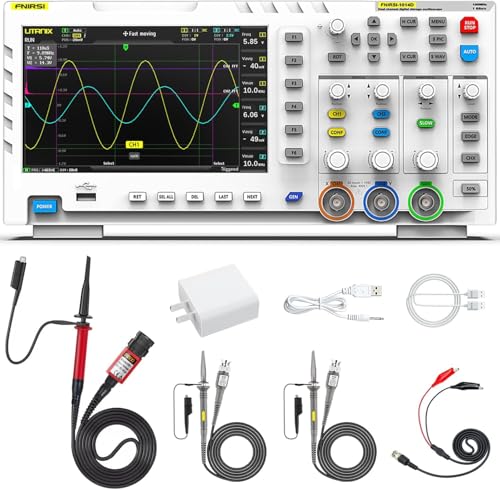
The FNIRSI 1014D Digital Oscilloscope and Signal Generator stands out as an excellent choice for intermediate users seeking a versatile tool that combines both oscilloscopy and signal generation capabilities. With a 100MHz bandwidth and a sampling rate of 1GSa/s, it delivers accurate readings across two channels. You’ll appreciate its DDS function, which allows for customizable signal outputs and supports 14 function types. The 7-inch LCD screen provides a clear display, while the one-button AUTO function simplifies waveform adjustments. Plus, the cursor measurement feature makes it easy to read peak-to-peak values and frequencies without hassle.
Best For: Intermediate users seeking a versatile tool that combines both oscilloscopy and signal generation capabilities.
Pros:
- High bandwidth of 100MHz and a sampling rate of 1GSa/s for accurate readings.
- User-friendly features like the one-button AUTO function and cursor measurement for easy waveform adjustments.
- Versatile signal generation capabilities with 14 function types and customizable outputs.
Cons:
- May not have enough features for advanced users needing more complex functions.
- Limited to a 7-inch screen which might not be ideal for detailed analysis.
- Built-in storage of 1GB may not be sufficient for extensive data logging or signal storage.
FNIRSI DSO-510 Handheld Oscilloscope and Signal Generator

For those diving into automotive applications, the FNIRSI DSO-510 Handheld Oscilloscope and Signal Generator stands out as an ideal choice. With a 10 MHz bandwidth and a 48 MS/s sampling rate, it’s perfect for detailed measurements. You can measure voltages up to 400 V, and its time base ranges from 50 ns to 20 S. The one-key AUTO function simplifies your setup, optimizing parameters for various signals. Plus, the device supports 13 waveform types with a maximum output frequency of 50 KHz. Lightweight and portable, it’s powered by a 1000mAh lithium battery, ensuring you can work on the go.
Best For: Automotive engineers and technicians looking for a portable, efficient oscilloscope and signal generator for precise measurements and testing.
Pros:
- Portable design with a built-in 1000mAh lithium battery for convenient use on the go.
- User-friendly features such as the one-key AUTO function to simplify signal setup and optimization.
- Versatile functionality with the ability to measure high voltages up to 400 V and output 13 different waveform types.
Cons:
- Limited bandwidth of 10 MHz may not be sufficient for high-frequency applications.
- Maximum output frequency of 50 KHz may restrict more advanced signal generation needs.
- Small display size (2.8 inches) could make detailed observations challenging for some users.
FNIRSI 2C53P Handheld Tablet Oscilloscope Multimeter 3 in 1

With a bandwidth of 50 MHz and a sampling rate of 250 MS/s, the FNIRSI 2C53P Handheld Tablet Oscilloscope Multimeter 3 in 1 is perfect for intermediate users who need a reliable tool for both automotive diagnostics and signal analysis. Its 4.3-inch IPS touch screen makes navigation easy, while the one-key AUTO function allows for quick measurements. You can generate 12 waveforms with a max output frequency of 10 MHz, and the FFT spectrum analysis feature helps you estimate harmonic content. With a built-in 4000 mAh battery, you’ll enjoy about 4 hours of uninterrupted operation.
Best For: Intermediate users seeking a reliable tool for automotive diagnostics and signal analysis.
Pros:
- User-friendly interface with a 4.3-inch IPS touch screen and one-key AUTO function for quick measurements.
- Versatile functionality with 12 waveform generation capabilities and FFT spectrum analysis for in-depth signal evaluation.
- Portable design with a built-in 4000 mAh battery providing approximately 4 hours of operation.
Cons:
- Limited battery life may require frequent recharging during extended use.
- Weight of 1.96 pounds may be considered heavy for a handheld device.
- Resolution of 480×272 may not be sufficient for detailed analysis compared to higher-end models.
Hantek DSO2D15 Digital Storage Lab Oscilloscope

Offering a robust 150MHz bandwidth, the Hantek DSO2D15 Digital Storage Lab Oscilloscope stands out as an exceptional choice for intermediate users. With its dual-channel capability and impressive sample rate of 1GSa/s, you can capture complex signals with ease. The 8M memory depth guarantees you won’t miss critical details. You’ll appreciate its cost-effective design, which includes features like arbitrary waveform output and 14 trigger modes, along with 5 serial protocol triggers and decodes. Ideal for applications in communication, aerospace, and embedded systems, this oscilloscope is perfect for enhancing your research and educational projects. Plus, it comes with a waveform generator and high voltage probe!
Best For: The Hantek DSO2D15 is best for intermediate users looking for an affordable yet powerful oscilloscope for various applications such as communication, aerospace, and embedded systems.
Pros:
- Cost-effective design makes it accessible for budget-conscious users.
- High sample rate of 1GSa/s allows for capturing complex signals with high accuracy.
- Includes features like arbitrary waveform output and multiple trigger modes for versatile usage.
Cons:
- May have a learning curve for beginners unfamiliar with oscilloscopes.
- Limited to a bandwidth of 150MHz, which may not suit advanced applications requiring higher bandwidth.
- The memory depth of 8M may be insufficient for very complex signal analysis in some cases.
Rigol DS1202Z-E Digital Oscilloscope

The Rigol DS1202Z-E Digital Oscilloscope stands out with its impressive 200 MHz bandwidth and real-time sample rate of up to 1 GSa/s, making it an ideal choice for intermediate users tackling complex electronic projects. With two analog channels and a memory depth of 24 Mpts, you’ll capture detailed waveforms effortlessly. The 7-inch WVGA display, featuring an intensity graded color scheme, provides clear visuals for easy analysis. Plus, its various triggering and bus decoding functions enhance your measurement capabilities. Connectivity options like USB and LAN guarantee seamless data transfer, making the Rigol DS1202Z-E a versatile tool for your electronic endeavors.
Best For: The Rigol DS1202Z-E Digital Oscilloscope is best for intermediate users who require a reliable and high-performance tool for complex electronic projects.
Pros:
- High bandwidth of 200 MHz allows for accurate measurements of fast signals.
- Large memory depth of 24 Mpts enables detailed waveform capture and analysis.
- Versatile connectivity options, including USB and LAN, facilitate easy data transfer.
Cons:
- May be considered expensive for beginners or casual users.
- The 7-inch display, while clear, may be smaller compared to other oscilloscopes on the market.
- Limited to two analog channels, which may not suffice for all complex testing scenarios.
3 in 1 Handheld Oscilloscope Automotive Dual Channel 50MHz

For automotive enthusiasts and technicians seeking a reliable measurement tool, the 3 in 1 Handheld Oscilloscope Automotive Dual Channel 50MHz stands out with its dual-channel capability and versatile functionalities. This device combines an oscilloscope, digital multimeter, and signal generator in one compact unit. You can easily measure pulse waves and noise waveforms with a sampling rate of up to 280MSa/s. The multimeter mode lets you tackle resistance, capacitance, and current with precision. Plus, the Type-C charging port guarantees fast charging and data transfer. This oscilloscope is an essential tool for anyone serious about automotive diagnostics.
Best For: Automotive technicians and enthusiasts looking for a versatile and reliable measurement tool for diagnostics.
Pros:
- Dual-channel functionality allows for simultaneous measurement of multiple waveforms.
- High sampling rates (up to 280MSa/s) and bandwidth (50MHz) enhance measurement accuracy.
- Compact design with Type-C charging port facilitates fast charging and efficient data transfer.
Cons:
- May have a learning curve for beginners unfamiliar with oscilloscopes and multimeters.
- Limited storage depth of 128K may restrict prolonged data logging for complex signals.
- The price point may be higher compared to standalone multimeters or oscilloscopes.
Factors to Consider When Choosing an Oscilloscope for Intermediate Users
When you’re choosing an oscilloscope as an intermediate user, several key factors come into play. You’ll want to contemplate bandwidth requirements, sampling rates, and the number of channels you need for your projects. Additionally, think about display quality and how portable the design is for your workspace.
Bandwidth Requirements
Choosing the right bandwidth for your oscilloscope is essential, as it directly impacts how accurately you can measure high-frequency signals. For intermediate users, a bandwidth of at least 100 MHz is recommended. This allows you to effectively analyze a wide range of applications, from digital signals to communications. Ideally, you should aim for a bandwidth that’s five times greater than the frequency of the signal you’re measuring. Higher bandwidth enhances your ability to accurately represent fast-changing signals, minimizing the risk of aliasing and preserving critical characteristics. If you’re working with advanced applications, consider oscilloscopes with bandwidths exceeding 200 MHz, especially for high-speed digital circuits and RF signals. Make sure you balance bandwidth with your intended usage for peak performance.
Sampling Rate Importance
Many intermediate users underestimate the significance of sampling rate in oscilloscopes, yet it plays a crucial role in accurately capturing and representing high-frequency signals. The sampling rate determines how often the oscilloscope collects data points from a signal, which is essential for representing fast changes accurately. To avoid aliasing and guarantee proper waveform reconstruction, you should aim for a sampling rate of at least twice the signal frequency, known as the Nyquist rate. For most applications, especially in digital communications and electronic testing, look for oscilloscopes with sampling rates of 250 MS/s or higher. Remember, a higher sampling rate also means greater memory depth, allowing for detailed analysis and longer observation times without losing critical data.
Channel Count Needs
Understanding the sampling rate is just the beginning; channel count also plays a significant role in your oscilloscope selection. The number of channels determines how many signals you can monitor simultaneously. If you’re just doing basic signal analysis, a single-channel oscilloscope might be enough. However, for most intermediate users, a dual-channel model is ideal for comparing input and output signals during testing. If you’re dealing with differential signals or multi-phase systems, consider a four-channel oscilloscope for greater flexibility and detailed analysis. Keep in mind that more channels often mean higher prices and added complexity, but they also provide advanced features and better performance. Choose wisely based on your specific measurement needs to maximize efficiency.
Display Quality Considerations
When selecting an oscilloscope, display quality can greatly impact your analysis experience. A higher resolution, like 800×480 pixels, gives you clearer, more detailed waveforms, making complex signal analysis easier. Opting for a larger screen, such as a 7-inch display, enhances visibility, especially during detailed examinations or team discussions. Touchscreen functionality is another valuable feature, allowing for more intuitive navigation and quicker adjustments compared to traditional buttons. Don’t overlook brightness and contrast levels; these factors guarantee that waveforms remain visible and easy to interpret in various lighting conditions. Additionally, features like intensity grading can help you differentiate overlapping waveforms, improving your ability to analyze and compare multiple signals effectively.
Portability and Design
Choosing an oscilloscope that’s easy to transport can make a significant difference in your workflow, especially if you frequently switch between locations. For intermediate users, weight and compactness are key; a lightweight design helps you move between workspaces effortlessly. Look for a portable oscilloscope with a durable build, especially if you plan to use it in automotive or outdoor settings. The display size and type, like a touchscreen, can enhance navigation and waveform visualization under various lighting conditions. Battery life matters too; many portable models provide hours of use on a single charge, ensuring uninterrupted measurements. Additionally, features like a Type-C charging port offer quick charging and data transfer, making it convenient for saving your work on the go.
Measurement Functions Offered
Portability and design are just the beginning; the measurement functions offered by an oscilloscope play a vital role in enhancing your diagnostic capabilities. When choosing an oscilloscope, consider essential functions like voltage, current, resistance, capacitance, and continuity testing for versatile electronic diagnostics. Look for models with multiple trigger modes—auto, normal, and single—to improve your signal analysis and measurement accuracy. Advanced oscilloscopes may also provide automated measurement functions, saving you time when obtaining key parameters. Additionally, FFT capabilities allow you to analyze harmonic content, which is significant for evaluating signal quality. Finally, verify the oscilloscope supports waveform storage and retrieval to help you compare measurements over time and maintain thorough documentation of your test results.
User Interface Usability
A user-friendly interface can make all the difference in your oscilloscope experience, especially for intermediate users. Look for intuitive controls and clear visual displays to enhance your measurement process. Touchscreen capabilities are a big plus, as they allow for easier navigation and adjustments compared to traditional button interfaces. Features like one-key AUTO functions simplify setup, giving you quick access to ideal measurement settings without the hassle of manual adjustments. Cursor measurement functionalities enable you to read amplitude and frequency values directly, streamlining your analysis. Finally, verify the oscilloscope has robust waveform storage and management options, so you can easily retrieve and compare results during your testing. These usability factors can greatly improve your overall experience.
Battery Life Expectations
When using an oscilloscope, especially in field settings, battery life plays a key role in your experience. Many portable oscilloscopes provide about 4 to 6 hours of continuous use on a single charge. The battery capacity, typically ranging from 1000 mAh to 8000 mAh, directly affects how long you can operate your device. If you often work in the field, prioritize models with longer battery life and fast charging capabilities via Type-C interfaces to reduce downtime. Always check the manufacturer’s specifications for battery performance, as actual usage can vary based on features like display brightness and operational modes. Knowing these factors will help you choose the best oscilloscope for your needs.