
Freshly milled flour can bring more flavor and control to home baking, while a capable grinder can also handle grains, spices, seeds, and other dry ingredients. The best grain mill depends on how often you mill, how much capacity you need, and whether you prefer electric convenience or manual control.
We compared 10 grain mills and KitchenAid-compatible attachments across capacity, power, adjustability, construction, and intended use. Use the guide below to narrow the options quickly and avoid paying for performance you will not use.
Best 10 Grain Mills Picks for 2026
Stand Mixer Milling
KitchenAid All Metal Grain Mill Attachment

- Fits household KitchenAid stand mixers
- Handles wheat, corn, rice, and similar dry grains
- Adjusts from coarse to fine
Best For: KitchenAid owners milling low-moisture grains at home
Compact Electric Milling

- 1200-watt motor for hard grains
- Designed for fine bread flour
- Large hopper and nesting storage design
Best For: Frequent bread bakers needing fast, fine flour
Manual Cast-Iron Milling
Victoria 2400g High-Hopper Grain Mill

- Durable cast-iron hand-crank design
- Clamps to tables 1/2 to 2 inches thick
- Versatile for grains, coffee, seeds, and spices
Best For: Hands-on coarse milling and home brewing
Heavy-Duty Wet and Dry Milling
VEVOR 3000W Electric Grain Mill

- Includes wet- and dry-grinding discs
- Powerful 3000-watt motor
- Adjustable thickness for varied ingredients
Best For: High-volume wet and dry food grinding
Best Mixer Attachment

- Fits KitchenAid mixers without tools
- Nine settings from coarse to fine
- Sturdy aluminum alloy construction
Best For: KitchenAid owners grinding dry grains for home baking
Best High-Capacity Electric Mill

- 2100-watt, 28,000-RPM motor
- 1.8-pound capacity for larger batches
- Timed controls and swing-type design
Best For: Fast grinding of dry grains, spices, and coffee
Best Heavy-Duty Swing Mill
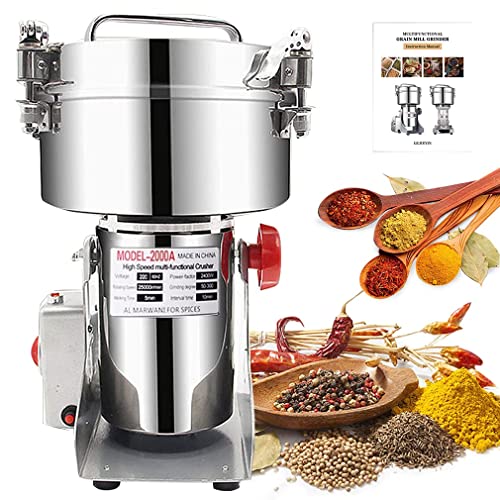
- 2000g capacity with 50–300 mesh fineness
- 3000-watt, 28,000-RPM grinding system
- Overload protection and swing-style body
Best For: Versatile dry-ingredient grinding in larger batches
High-Capacity Pick
VEVOR 750g Electric Grain Mill

- 750g capacity and 2,000W motor
- 30–300 mesh superfine grinding
- Safety shutoff and overload protection
Best For: Higher-volume dry ingredient grinding
Compact Budget Option
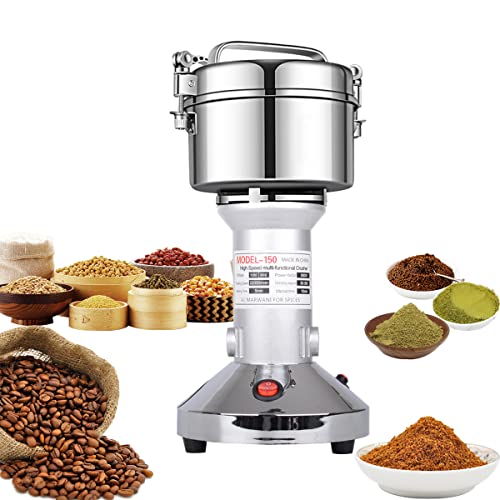
- 150g capacity for small batches
- 900W motor at 22,000 RPM
- Overload shutoff and nonslip base
Best For: Occasional dry grinding in smaller kitchens
Large-Batch Alternative
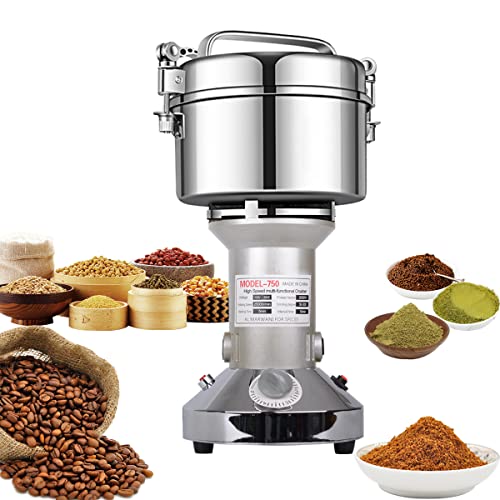
- 750g capacity for larger batches
- 2,000W motor and 25,000 RPM speed
- Three-blade system with overload shutoff
Best For: Repeated dry grinding of grains and spices
Stand Mixer Milling – KitchenAid All Metal Grain Mill Attachment
For shoppers comparing grain mills, this KitchenAid attachment is a convenient option if you already own a compatible household stand mixer. It handles low-moisture, low-oil grains such as wheat, corn, and rice, with an adjustable range from coarse to fine.
Best For: KitchenAid stand-mixer owners who want an attachment for processing common dry grains at home.
Pros:
- Fits all household KitchenAid stand mixers.
- Grinds wheat, corn, rice, and other low-moisture, low-oil grains.
- Offers coarse-to-fine grinding.
- Includes a cleaning brush.
Cons:
- Requires a KitchenAid stand mixer to operate.
- Designed for low-moisture and low-oil grains rather than wet ingredients.
This is a practical choice for occasional or regular home milling when you want to use equipment already on your counter. Its usefulness depends on owning a compatible KitchenAid mixer and milling suitable dry grains.
Compact Electric Milling – NutriMill Impact Grain Mill
Among electric grain mills, the NutriMill Impact Compact emphasizes fast flour production and convenient storage. Its 1200-watt motor and impact milling heads are designed for hard grains and fine-textured bread flour, while the large hopper and canister support bigger batches.
Best For: Frequent bread bakers who want an electric mill for fine flour and comparatively easy storage.
Pros:
- 1200-watt motor handles hard grains such as wheat.
- Impact milling heads are designed for fine bread flour.
- 8-cup hopper and 12-cup flour canister support large batches.
- Nesting parts and cyclone air filtration help with storage and airflow.
Cons:
- Its electric design requires countertop space and access to power.
- The supplied notes focus on dry-grain milling rather than wet grinding.
The NutriMill is a strong fit when speed, batch capacity, and fine flour texture matter more than a manual setup. Its nesting design is especially useful for kitchens where storage space is limited.
Manual Cast-Iron Milling – Victoria 2400g High-Hopper Grain Mill
This Victoria is a manual grain mill for shoppers who prefer a durable hand-crank design without an electric motor. Its cast-iron body, adjustable screw, and high hopper support a range of coarse grinding tasks, from corn and barley to coffee, seeds, spices, and other ingredients.
Best For: Manual milling, home brewing, corn grinding, and versatile coarse food preparation.
Pros:
- Heavy-duty cast-iron construction with double tin plating.
- Adjustable screw changes grinding coarseness and fineness.
- Clamps to most tables 1/2 to 2 inches thick.
- Handles grains and a broad range of foods, including coffee, seeds, spices, and dried beans.
Cons:
- Cannot grind to a superfine texture.
- Will not turn whole wheat into a fine powder.
- Manual operation requires hand-cranking.
Choose this model for traditional, hands-on milling and broad ingredient versatility rather than fine flour production. The clamp and rubber protector help stabilize it during use and protect the work surface.
Heavy-Duty Wet and Dry Milling – VEVOR 3000W Electric Grain Mill
For buyers seeking a high-powered grain mill with wet and dry capability, this VEVOR model combines a 3000-watt motor with separate cast-iron and sand milling discs. It is built for dry powders, soaked soybean or rice pulp, and adjustable grinding applications involving grains, spices, coffee, nuts, and feed.
Best For: High-volume household, workshop, or small food-preparation tasks involving both dry ingredients and wet pulp.
Pros:
- Supports both wet and dry grinding with included discs.
- 3000-watt motor provides high-speed, continuous grinding.
- Adjustable thickness accommodates grains, spices, coffee, cereal, wheat, and nuts.
- Heavy-duty iron body and stainless-steel funnel are designed for prolonged use.
Cons:
- Its industrial-style dimensions may require substantial space.
- The 27.56-inch height may be inconvenient for some countertops or storage areas.
- Its powerful commercial-oriented design may be more than needed for occasional milling.
This VEVOR stands out for versatility and power, especially if you need to process wet and dry ingredients. Measure your available space before buying, since its heavy-duty format is considerably larger than compact home grain mills.
Best Mixer Attachment – 9-Level KitchenAid Grain Mill
If you already own a KitchenAid stand mixer, this grain mills attachment offers a compact way to process dry grains without buying a separate countertop appliance. Its nine settings cover coarse cracked grains through fine flour, making it useful for a range of baking and grinding tasks.
Best For: KitchenAid owners who want adjustable flour and grain grinding in an attachment format.
Pros:
- Fits all KitchenAid stand mixer models and installs without tools.
- Nine grind settings range from coarse to ultra-fine.
- Food-grade die-cast aluminum alloy construction is rust-resistant and sturdy.
- Detachable grinding chamber makes residue removal easier.
Cons:
- Designed for dry, non-oily ingredients; it is not suitable for peanuts, soybeans, or sunflower seeds.
- Requires rest periods, including a 45-minute cooldown between batches.
- Must be cleaned with the included brush rather than water or a dishwasher.
This is a practical choice for occasional or regular home baking when you already have a compatible mixer. Keep the batch size and cooldown guidance in mind, especially if you plan to grind large quantities.
Best High-Capacity Electric Mill – VEVOR 1.8-Lb Grain Grinder
For shoppers comparing standalone grain mills, this VEVOR model combines a 2100-watt motor, a 1.8-pound capacity, and timed operation. It is built for dry grains, spices, cereals, coffee, and similar ingredients, with a swing design intended to help distribute material during grinding.
Best For: Kitchens, labs, or other workspaces that need fast grinding of dry ingredients in larger batches.
Pros:
- High-speed 28,000-RPM motor can produce fine powder quickly.
- Large 1.8-pound capacity suits more substantial grinding jobs.
- Three timing options—5, 15, or 30 seconds—simplify operation.
- Stainless-steel blades and housing support frequent use.
Cons:
- Not intended for wet, oily, or sticky materials.
- Continuous operation is limited to five minutes, followed by a 5–10 minute rest.
- Its 9.3-pound weight and larger footprint make it less portable than an attachment.
The VEVOR is a strong fit when speed and capacity matter more than compact storage. Its timed controls and four-step process are approachable, but dry-material restrictions and rest intervals still require attention.
Best Heavy-Duty Swing Mill – 2000g Superfine Grain Grinder
This 2000g electric grain grinder is aimed at shoppers who want high-speed, superfine processing for dry grains, spices, herbs, nuts, coffee, and rice. Its 28,000-RPM motor, three-layer stainless-steel blades, and swing-style body are designed to produce fine, more uniform powder.
Best For: Home kitchens and small food-processing tasks that require versatile dry-ingredient grinding.
Pros:
- Large 2000g capacity and fineness range of 50–300 mesh.
- 3000-watt motor and 28,000-RPM blades support fast grinding.
- Overload protection automatically shuts off the unit when overloaded.
- Swing design helps distribute material and pour out finished powder.
Cons:
- Operation should be limited to three minutes, with a 5–10 minute rest afterward.
- Materials should remain below two-thirds of the container capacity.
- The grinding chamber should not be rinsed directly with water.
This model offers broad ingredient coverage and substantial capacity, but it is best used in short cycles rather than for uninterrupted production. The overload protection adds a useful safeguard, while the cleaning and ventilation instructions require careful follow-through.
High-Capacity Pick – VEVOR 750g Electric Grain Mill
For shoppers comparing grain mills, this VEVOR model emphasizes capacity and fast, fine grinding. Its 2,000-watt motor, 750-gram bowl, and three-layer blade system are suited to dry grains, spices, coffee, and other dehydrated ingredients.
Best For: Higher-volume home kitchens and small-scale food-processing tasks involving dry ingredients.
Pros:
- Large 750-gram capacity with a 2,000-watt motor.
- Designed for superfine results from 30 to 300 mesh.
- Stainless-steel construction, overload protection, and lid-open shutoff.
- Includes a sieve for separating coarse particles before regrinding.
Cons:
- Only suitable for dry materials; wet, oily, fresh, or sticky foods are not recommended.
- Requires a 5- to 10-minute rest after every five minutes of operation.
- The grinding tank should be cleaned with a dry cloth or brush rather than rinsed.
This is a practical choice when batch size matters, but its timed duty cycle and dry-only design make it better for measured batches than continuous milling.
Compact Budget Option – 150g High-Speed Grain Mill
Among compact grain mills, this 150-gram electric grinder is aimed at smaller batches of dry grains, herbs, spices, nuts, and coffee. Its 900-watt motor and three-blade design can produce powder ranging from 50 to 300 mesh in under a minute.
Best For: Smaller households and users who want a compact mill for occasional dry-ingredient grinding.
Pros:
- Compact 150-gram capacity for small batches.
- 900-watt motor and 22,000 RPM speed.
- Food-grade stainless-steel body with overload shutoff and reset button.
- Snap-on lid, sealing ring, and nonslip base support secure operation.
Cons:
- Recommended operation is limited to three minutes, followed by a five- to 10-minute rest.
- Wet, moist, oily, and other unsuitable ingredients cannot be ground.
- The bowl must not be washed directly with water.
Its smaller capacity keeps this model better suited to quick, single-batch jobs than large quantities, while the safety features add reassurance during routine use.
Large-Batch Alternative – 750g High-Speed Grain Mill
This 750-gram grain mill combines a 2,000-watt motor with a 25,000 RPM blade system for dry cereals, grains, spices, herbs, rice, and coffee. It is designed for quick pulverizing, with stated fineness from 50 to 300 mesh.
Best For: Users who need a large-capacity stainless-steel grinder for repeated dry-ingredient batches.
Pros:
- 750-gram capacity for larger batches.
- 2,000-watt motor with three blades for grinding and powder removal.
- Handles a broad range of dry grains, spices, herbs, nuts, and coffee.
- Automatic overload shutoff helps protect the machine during use.
Cons:
- Operation should be limited to three minutes at a time, with a five- to 10-minute cooldown.
- Not designed for wet, oily, or moisture-containing materials.
- Cleaning requires a moist cloth or paper towel rather than direct rinsing.
With its generous capacity and high power, this model fits batch-oriented grinding, provided you follow the short operating cycles and keep ingredients thoroughly dry.
How We Picked These Grain Mills
We selected models for a range of home-milling needs, from compact electric grinders and KitchenAid attachments to manual cast-iron mills and larger high-speed machines. Our comparison focuses on practical specifications: motor power, hopper or bowl capacity, grind adjustment, construction materials, controls, safety features, and ease of use.
Because product listings can describe similar machines differently, treat advertised wattage and capacity as useful starting points rather than guarantees of real-world output. Always check the manufacturer’s instructions for approved ingredients, operating intervals, and cleaning requirements.
Quick Comparison
| Type | Best For | Main Advantage | Potential Trade-Off |
|---|---|---|---|
| KitchenAid attachment | Existing stand-mixer owners | Uses equipment you already own | Depends on mixer compatibility and capacity |
| Compact electric mill | Everyday home baking | Fast, convenient fresh flour | Usually smaller batches |
| Manual cast-iron mill | Low-tech, power-free milling | Durable and independent of electricity | Requires physical effort |
| High-capacity electric grinder | Frequent or larger-batch grinding | Fast processing and larger chambers | More noise, heat, and storage space |
| Small spice and grain grinder | Small portions and varied dry ingredients | Compact and versatile | Limited capacity and batch size |
Key Buying Factors for Grain Mills
Capacity and Batch Size
Choose a hopper or grinding chamber that matches your routine. Small units suit occasional flour, spices, seeds, and herbs. Larger machines are more practical when you regularly mill several cups or prepare ingredients for bulk baking.
Grinding Adjustment and Results
Look for adjustable settings if you want both coarse meal and finer flour. Some attachments offer multiple levels, while high-speed pulverizers may be better suited to fine powders than carefully controlled flour textures.
Power, Heat, and Run Time
Higher advertised wattage can mean faster grinding, but it may also bring more noise and heat. Timer controls, overload protection, and recommended rest periods matter when processing repeated batches.
Materials and Cleaning
Stainless steel and cast iron can offer durability, but they may add weight. Check whether the grinding parts can be removed safely and whether the manufacturer recommends brushing, wiping, or avoiding water on specific components.
Compatibility and Safety
For attachments, confirm the exact KitchenAid mixer compatibility before buying. For electric models, prioritize secure lids, stable bases, overload protection, and clear instructions about dry ingredients. Do not assume a grain mill is designed for wet foods or every type of grain.
Who Should Buy Which Grain Mills?
Choose a KitchenAid attachment if you already own a compatible stand mixer and want to save counter space. Choose a compact electric mill for convenient weekly baking and modest quantities. Choose the Victoria manual mill if electricity-free operation, traditional construction, and hands-on control are priorities.
Choose a larger VEVOR-style electric grinder if speed and batch capacity matter more than compact storage. Choose a small 150g-class grinder for occasional spices, seeds, herbs, or small flour portions. If you are unsure, prioritize capacity and cleaning convenience over maximum wattage; those factors usually have the greatest effect on day-to-day satisfaction.