
A good starter kit turns a pile of parts into a clear first project. The right choice depends on whether you want guided lessons, a board to program, or extra components for experimenting.
These 10 options range from basic UNO-compatible kits to an official Arduino set and a Wi-Fi-capable kit. Here’s how to match one to your goals and budget.
Best 10 Electronics Starter Kit for Beginners Picks for 2026
Best All-Around Project Variety
ELEGOO UNO R3 Super Starter Kit

- 22+ guided lessons
- Sensors, motors, and displays included
- Solderless breadboard and pre-soldered LCD
Best For: Families and clubs seeking varied Arduino projects
Best Printed Project Guide
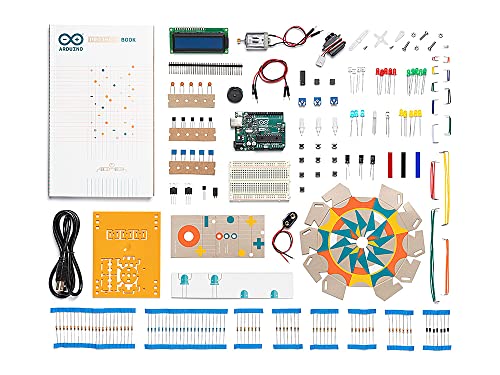
- English step-by-step projects book
- Original Arduino components
- Hands-on circuits and coding
Best For: Learners who prefer a printed project guide
Best for Expanding Projects
ELEGOO Mega 2560 R3 Starter Kit

- 35+ guided projects
- 200+ components
- 54 digital I/O pins for larger builds
Best For: Teens and makers planning multi-component projects
Best for Organized Coursework
DFRobot Basic Electronics Starter Kit

- 83 individually labeled components
- 12 progressive tutorials
- Diagrams, code, and principle explanations
Best For: College STEM coursework and structured self-study
Best for Breadboard Experiments
ELEGOO Electronic Fun Kit Bundle

- 235 parts for breadboard projects
- Selectable 3.3 V or 5 V power rails
- Controller and adapter not included
Best For: Hands-on circuit practice
Best for Guided Lessons
LAFVIN Project Super Starter Kit
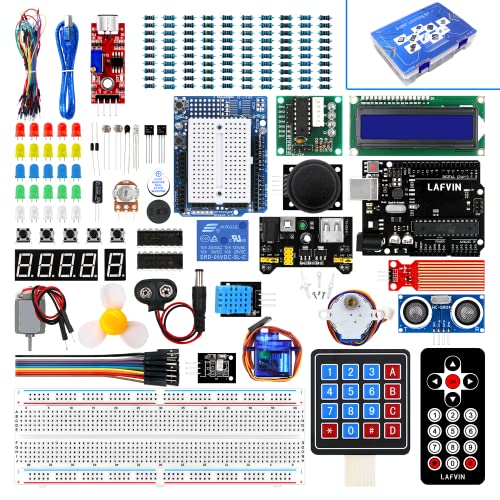
- Tutorial with more than 20 lessons
- Servo, stepper, and DC motors listed
- Check whether a controller is included
Best For: Guided programming and hardware projects
Best for Organized Components
Smraza 298 Pieces Electronics Starter Kit

- Breadboard and power module included
- Storage box and beginner guidance
- Controller board not included
Best For: Organized component practice
Most Complete Pick
ELEGOO UNO R3 Project Starter Kit

- 200+ components across 63 types
- 30+ guided projects
- Solderless setup with organized storage
Best For: Beginners seeking a wide range of hands-on projects
Connected Projects Pick
SunFounder Elite Explorer UNO R4 WiFi Kit

- Original Arduino UNO R4 WiFi
- 300+ components and 50+ projects
- 100+ video lessons
Best For: Video-led learning and connected projects
Fundamentals Pick
ELEGOO UNO R3 Basic Starter Kit

- Core breadboard components
- Tutorial with wiring and code
- Arduino IDE-compatible controller
Best For: Learning basic circuits and microcontroller coding
Best All-Around Project Variety – ELEGOO UNO R3 Super Starter Kit
If you want an electronics starter kit for beginners with plenty to build, this ELEGOO UNO R3 kit pairs 22+ guided lessons with sensors, motors, displays, and everyday circuit parts. Its solderless breadboard and pre-soldered LCD help keep early projects focused on wiring and code.
Best For: Families, homeschoolers, and coding clubs that want a broad range of guided Arduino IDE projects.
Pros:
- 22+ lessons cover input, sensing, motors, and displays.
- Includes an UNO R3 board and a varied selection of components.
- Plug-in modules and a solderless breadboard simplify setup.
Cons:
- The tutorial and code require a download.
- Beginners still need to check polarity, breadboard connections, and power-module voltage.
Choose this kit if project variety matters more than a minimal parts list. Younger builders should work with an experienced adult, particularly during setup.
Best Printed Project Guide – Official Arduino Starter Kit
For shoppers who prefer learning from a physical book, this electronics starter kit for beginners includes an English project guide and original Arduino components. The projects introduce coding and circuit design through hands-on work with parts such as LEDs, motors, and a tilt sensor.
Best For: Learners and classrooms that value a printed, step-by-step guide alongside genuine Arduino components.
Pros:
- Includes a detailed English projects book.
- Uses original Arduino components.
- Covers foundational circuits and programming through guided builds.
Cons:
- The supplied product information gives conflicting project counts: 12 in the listing and 15 in the component details.
- The listed manufacturer defect warranty is 30 days.
The book is the main reason to pick this kit. Check the current listing if the exact number of included projects affects your decision.
Best for Expanding Projects – ELEGOO Mega 2560 R3 Starter Kit
This electronics starter kit for beginners offers room to grow: its Mega 2560 R3 board has 54 digital I/O pins and 16 analog inputs, while 35+ guided projects progress from basic circuits to sensors, RFID, motors, and displays. The 200+ components give you options for combining lessons into larger builds.
Best For: Teens and new makers who want guided lessons now and more connections for ambitious projects later.
Pros:
- 35+ guided projects and example code support progression.
- Mega board offers extensive I/O and four hardware serial ports.
- Includes varied sensors, controls, motors, displays, and organized storage.
Cons:
- More than 200 components may be a lot to sort through for a first build.
- The manufacturer recommends this kit for ages 13 and up.
Pick the Mega kit when you expect to move beyond single-sensor exercises. Its larger component selection makes the most sense if you plan to reuse parts across multiple projects.
Best for Organized Coursework – DFRobot Basic Electronics Starter Kit
If small parts and unclear instructions are your biggest concerns, this electronics starter kit for beginners includes 83 individually labeled components and 12 progressive tutorials. Each project provides wiring diagrams, sample code, and explanations of the underlying principles.
Best For: College STEM students and independent learners who want easy-to-identify parts and structured exercises.
Pros:
- Individually labeled components speed up identification.
- 12 tutorials include diagrams, code, and principle explanations.
- Includes an UNO R3-compatible board, USB cable, and 22-gauge jumper wires.
Cons:
- Its 12 guided projects offer less listed project variety than the ELEGOO kits here.
- Builders seeking specific advanced modules should check the full component list before buying.
This is a practical choice when an orderly learning process matters most. The labeled parts and explanatory tutorials are particularly useful for coursework or self-study.
Best for Breadboard Experiments – ELEGOO Electronic Fun Kit Bundle
If you want an electronics starter kit for beginners focused on building and rewiring circuits, this ELEGOO bundle supplies 235 parts for LED, button, buzzer, and light-sensitive projects. It is a component kit, not a complete programmable setup.
Best For: Beginners practicing breadboard circuits who already have, or plan to buy, a compatible controller for coded projects.
Pros:
- Includes a 400-tie-point breadboard, jumper wires, and a selectable 3.3 V or 5 V power module.
- Offers resistors, capacitors, LEDs, buttons, transistors, diodes, and other parts for repeatable experiments.
- Includes a 74HC595 and 4N35 for exploring output expansion and signal isolation.
Cons:
- No controller board, programming cable, or wall power adapter is included.
- The power module requires a suitable 6.5–9 V DC input; do not exceed 9 V.
Choose this kit for hands-on component practice, but budget separately for a controller and power source if your projects need them.
Best for Guided Lessons – LAFVIN Project Super Starter Kit
For shoppers comparing an electronics starter kit for beginners, this LAFVIN kit emphasizes structured learning: its tutorial manual provides more than 20 lessons along with code, libraries, and datasheets. The listed project hardware includes several motors and displays.
Best For: New makers who want guided electronics and programming exercises with motors and displays.
Pros:
- Includes a tutorial manual with more than 20 lessons, code, libraries, and datasheets.
- Lists servo, stepper, and DC motors for varied motion projects.
- Includes an LCD 1602 module with a preattached pin header, plus a 4-bit 7-segment display.
Cons:
- The supplied notes do not identify an included controller board; verify the package contents before buying.
This is the most lesson-oriented option here, especially if motors and displays interest you; confirm the exact included hardware against your planned projects.
Best for Organized Components – Smraza 298 Pieces Electronics Starter Kit
This Smraza electronics starter kit for beginners pairs commonly used circuit parts with a breadboard, power supply module, and storage box. Its supplied notes also mention a PDF tutorial and 18 beginner projects, making it a practical choice for building a parts collection.
Best For: Beginners who want organized breadboard components and already have a compatible controller.
Pros:
- Includes LEDs, resistors, buttons, capacitors, transistors, and diodes.
- Provides jumper and male-to-female Dupont wires, a breadboard, and a power supply module.
- Comes with a storage box and beginner-project guidance.
Cons:
- A controller board is not included.
- The supplied notes give conflicting item counts, so check the current contents list if a specific part matters.
It suits repeat circuit-building sessions when you value tidy storage, but you will need a separate controller for Arduino- or Raspberry Pi-based projects.
Most Complete Pick – ELEGOO UNO R3 Project Starter Kit
If you want an electronics starter kit for beginners that leaves room to explore, this ELEGOO set pairs an UNO R3 controller with 200+ components across 63 types and more than 30 guided projects. Its solderless breadboard and pre-soldered modules make it easy to move from simple LED circuits to sensors, displays, and motors.
Best For: Beginners who want a broad selection of projects and components in one kit.
Pros:
- Guided projects cover LCD displays, RFID, motion sensing, motor control, and more.
- Includes a PDF tutorial, example code, and Arduino IDE-compatible controller.
- Organized storage and included power accessories simplify setup.
Cons:
- The large assortment may take more time to sort through than a basic kit.
- The breadboard power module should not be used above 9 V.
This is the flexible choice if you expect to keep experimenting after the first few lessons; its range of parts supports both guided builds and modifications of your own.
Connected Projects Pick – SunFounder Elite Explorer UNO R4 WiFi Kit
For an electronics starter kit for beginners with a path into connected builds, the SunFounder Elite Explorer includes an original Arduino UNO R4 WiFi, 300+ components, and projects ranging from basic circuits to IoT. More than 100 video lessons provide a structured way to work through the material.
Best For: Learners who want video-led instruction and WiFi or Bluetooth project options.
Pros:
- Original UNO R4 WiFi board has built-in WiFi and Bluetooth.
- Includes 50+ projects, including basic, fun, and IoT builds.
- Offers video lessons, open-source code, and troubleshooting resources.
Cons:
- Its IoT features may be more than you need for introductory circuit practice.
- Video lessons and support resources are online.
Choose this kit if a guided course and connected projects appeal to you. Its original R4 WiFi board is the main distinction from simpler UNO R3-based sets.
Fundamentals Pick – ELEGOO UNO R3 Basic Starter Kit
If you prefer to start with core circuits, this electronics starter kit for beginners includes an ELEGOO UNO R3-compatible board, breadboard, LEDs, buttons, resistors, and other introductory parts. The project tutorial supplies wiring guidance and example code for learning how inputs and outputs work.
Best For: First-time learners focused on breadboard basics and Arduino IDE coding.
Pros:
- Solderless breadboard and jumper wires let you rebuild circuits easily.
- Tutorial covers wiring and code for hands-on learning.
- Parts support experiments with light sensing, sound, switches, and output control.
Cons:
- Does not list the motors, displays, or broad sensor assortment found in the larger ELEGOO kit.
- Manufacturer recommends it for ages 13 and up.
This smaller-scope option keeps attention on the fundamentals before you move to more elaborate modules or connected projects.
How We Picked the Best Electronics Starter Kit for Beginners
We compared the listed board, tutorial or project materials, component selection, and likely learning path. We favored choices that give beginners a practical way to build circuits and progress beyond a first LED project. Product names alone do not confirm every included part or lesson, so check the current contents before buying.
Quick Comparison: Which Type Fits You?
- Guided first steps: The Official Arduino Starter Kit emphasizes a project book; the ELEGOO UNO R3 Basic and Super kits pair components with tutorials.
- More room to experiment: The ELEGOO UNO R3 Most Complete, ELEGOO Mega 2560, and LAFVIN Super kits are worth comparing for their broader project focus.
- Parts to add to an existing board: Look at the ELEGOO Electronic Fun Kit Bundle or Smraza 298 Pieces kit, but verify whether your chosen listing includes a programmable board.
- Connected projects: The SunFounder Elite Explorer Kit lists an original Arduino UNO R4 WiFi; check its lessons if wireless projects are your priority.
Key Buying Factors for an Electronics Starter Kit for Beginners
Board and Software
First, confirm whether the kit includes a board. An UNO R3 or compatible board is a common starting point, with many introductory examples available. A Mega 2560 can make sense if you expect to use more pins as projects grow. Also check the stated Arduino IDE compatibility, your computer’s connection requirements, and whether the kit uses an original Arduino board or a compatible alternative.
Lessons and Projects
Good instructions matter more than a high component count. Look for a clear parts list, wiring diagrams, example code, and projects that build on earlier skills. A printed book may suit someone who prefers to learn away from a screen; a PDF tutorial is convenient if you want searchable instructions. Check the language and format before purchasing.
Parts You Will Actually Use
A breadboard, jumper wires, LEDs, resistors, buttons, and a few sensors or displays provide plenty of early practice. Compare the specific modules included rather than treating “most complete” or a large piece count as a guarantee of better value. Clearly labeled components can save time when identifying parts and following diagrams.
Who Should Buy Which Electronics Starter Kit for Beginners?
Choose the Official Arduino Starter Kit if you want an original-board experience centered on structured projects. For a lower-commitment introduction, start by comparing the ELEGOO UNO R3 Basic and Super kits or the DFRobot Basic kit for the lessons and parts you prefer. Pick a larger UNO or Mega kit if you are confident you will keep building after the introductory exercises. Consider the SunFounder kit if Wi-Fi-enabled projects are the goal from the outset. If you already own a compatible board, a parts-focused bundle may be enough—just confirm what is in the box before checkout.