
Obstacle avoidance can make a first drone feel less intimidating, but it is not a guarantee against crashes. Sensor coverage, reliable controls, and a clear return-to-home setup matter as much as the feature printed on the box.
These 10 picks span compact starter drones, screen-equipped controllers, and GPS camera models. Here’s how to choose the right level of assistance without paying for features you may not need.
Best 10 Drone with Obstacle Avoidance for Beginners Picks for 2026
Best for Hands-Free Tracking

- 151 g with omnidirectional sensing
- Palm takeoff and ActiveTrack
- Controller and three batteries included
Best For: Portable solo filming and assisted first flights
Best for Casual Travel Shots
- Four-way obstacle sensing
- Dual cameras and adjustable lens
- Foldable body with carrying case
Best For: Travel shots and basic flight practice
Best Phone-Free Viewing

- 2.8-inch screen on controller
- 270° front-and-side sensing
- Optical-flow hover and propeller guards
Best For: Beginners who want phone-free FPV viewing
Best for Longer Practice Sessions

- Claimed 360° obstacle avoidance
- GPS auto-return and optical-flow hover
- Three batteries; up to 75 minutes total
Best For: Extended outdoor practice with GPS assistance
Best Phone-Free Starter

- 2.8-inch screen on controller
- 270° obstacle sensing
- Optical-flow hover assistance
Best For: First flights without a phone display
Best GPS Practice Kit
GPS Drone with 4.5-Inch Screen

- Four-way infrared sensing
- GPS-assisted return options
- 4.5-inch screen and two batteries
Best For: Outdoor practice with GPS flight assistance
Best for Stabilized Footage

- Three-axis mechanical gimbal
- Claimed 360° obstacle sensing
- Verify conflicting weight specifications
Best For: Stabilized aerial video with GPS assistance
Best Phone-Free Mini Drone
FPV Foldable Drone with 2.8-Inch Screen
- 270° obstacle avoidance
- 2.8-inch screen controller
- Optical-flow hovering and propeller guards
Best For: Phone-free practice in a compact format
Best GPS Safety Features
XT606 Drone with 5-Inch Screen
- GPS return functions
- 5-inch FPV controller screen
- EIS, gimbal, and up to 25-minute flight time
Best For: Beginners seeking GPS return and a larger display
Best Two-Battery Starter Kit
S166MAX Foldable Screen-Remote Drone

- Two batteries; up to 30 minutes total
- 4.3-inch screen remote and storage case
- 720p camera despite 4K title
Best For: Beginners wanting extra battery time and easy packing
Best for Hands-Free Tracking – DJI Neo 2 Fly More Combo
If you want a drone with obstacle avoidance for beginners that also makes solo filming easy, the 151 g DJI Neo 2 pairs omnidirectional obstacle sensing with palm takeoff, gesture control, and ActiveTrack. This Fly More Combo includes an RC-N3 controller, digital transceiver, charging hub, and three batteries.
Best For: New pilots who want portable, hands-free subject tracking with a conventional controller available when needed.
Pros:
- Omnidirectional obstacle sensing and full-coverage propeller guards add practical flight protection.
- Palm takeoff, gesture controls, ActiveTrack, and SelfieShot simplify solo captures.
- 4K video and three included batteries make the combo versatile out of the box.
Cons:
- Android users must download the DJI Fly app from DJI rather than Google Play.
- The supplied notes do not specify flight time per battery.
The Neo 2 stands out for its combination of compact size, assisted flying, and tracking features. Obstacle sensing is helpful, but it does not replace watching the drone and its surroundings.
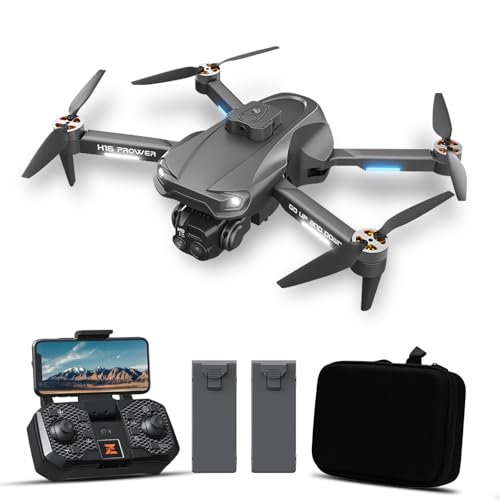
Best for Casual Travel Shots – TODAMU H16 Prowler
The foldable TODAMU H16 Prowler is a drone with obstacle avoidance for beginners who want simple camera controls for everyday outings. Its front, rear, left, and right sensing works when obstacle avoidance is enabled, while optical-flow hover and altitude hold help with practice in suitable spaces.
Best For: Casual flyers who want a portable dual-camera drone for travel shots and basic flight practice.
Pros:
- Four-way sensing helps detect nearby objects when the feature is switched on.
- Front and bottom cameras, a 148° adjustable lens, and Wi-Fi FPV offer flexible framing.
- One-key takeoff and landing, headless mode, and a carrying case suit new pilots on the go.
Cons:
- Obstacle sensing covers four directions, not every approach angle.
- Listed flight time is up to 15 minutes per battery.
This is a practical pick for learning basic moves and framing casual footage. Give it room to fly, particularly above and below the aircraft where four-way sensing is not specified.
Best Phone-Free Viewing – TT19LCD Foldable Drone
For shoppers seeking a drone with obstacle avoidance for beginners without relying on a phone for live viewing, the TT19LCD puts a 2.8-inch FPV screen on its controller. Its stated 270° sensing detects obstacles ahead and to either side, and an optical-flow camera supports hovering.
Best For: First-time pilots who prefer a built-in controller display over a phone connection.
Pros:
- Controller screen shows a live view without a smartphone.
- Front and side obstacle sensing adds assistance in those directions.
- One-key takeoff and landing, headless mode, three speeds, and propeller guards support practice.
Cons:
- Obstacle sensing is specified for the front and sides, not full coverage.
- The supplied notes do not state a numerical camera resolution or flight time.
The built-in display is the main reason to choose this model: it keeps live viewing separate from your phone. The foldable body and adjustable camera add convenience, but leave clearance around the drone even with sensing enabled.
Best for Longer Practice Sessions – Zoiskn V918MAX GPS Drone
The Zoiskn V918MAX is a drone with obstacle avoidance for beginners who want GPS assistance and more time to practice. It combines claimed 360° obstacle avoidance, GPS auto-return, and optical-flow hover with three batteries rated for up to 25 minutes each.
Best For: New outdoor pilots who prioritize GPS return support and multiple batteries.
Pros:
- GPS auto-return attempts to bring the drone back after signal loss or low battery.
- Three included batteries provide up to 75 minutes of combined rated flight time.
- Built-in screen controller supports viewing without a phone; the 4K camera has remote angle adjustment.
Cons:
- Gesture photography, intelligent following, and surround shooting require a phone.
- The supplied listing gives conflicting camera descriptors, including 4K video and an 8K camera claim.
Its GPS features and battery bundle make extended outdoor practice the clearest use case. Treat the stated flight times as maximums, and check the camera specifications closely if imaging quality is your priority.
Best Phone-Free Starter – TT19LCD Mini Drone
If you want a drone with obstacle avoidance for beginners without setting up a phone, the TT19LCD puts a live camera view on its 2.8-inch controller screen. Its foldable design and one-key controls make it approachable for casual flying.
Best For: First-time flyers who want a compact drone with a built-in FPV display.
Pros:
- 270° obstacle sensing helps detect hazards in its flight path.
- Optical-flow positioning helps it hover in small indoor spaces.
- 90° remotely adjustable camera and controller-supported storage up to 32GB.
- One-key takeoff and landing, headless mode, and three speed settings.
Cons:
- Not a 4K camera drone.
- The supplied notes do not specify a flight time.
The controller screen removes one setup step, while the flight aids give new pilots useful practice tools. Choose it for convenience and casual footage rather than 4K video.
Best GPS Practice Kit – GPS Drone with 4.5-Inch Screen
For outdoor practice, this drone with obstacle avoidance for beginners combines four-way infrared sensing with GPS-assisted return features. A 4.5-inch screen on the controller shows the live camera view, and two batteries give you more opportunities to practice.
Best For: New outdoor pilots who want GPS return assistance and a phone-free live view.
Pros:
- One-key, low-battery, and signal-loss return options.
- Four-way infrared obstacle sensing and brushless motors.
- Built-in 4.5-inch FPV screen and two rechargeable batteries.
- Adjustable camera, altitude hold, and one-key takeoff and landing.
Cons:
- Obstacle sensing is specified in four directions, not all directions.
- The supplied notes do not state a total flight time.
This is a practical pick if you value GPS flight assistance alongside obstacle sensing. Allow plenty of space while learning; sensing and return features are aids, not substitutes for steering.
Best for Stabilized Footage – RG808MAX 4K GPS Drone
For beginners interested in aerial video, this drone with obstacle avoidance for beginners pairs a claimed 360° laser-sensing system with a mechanical three-axis gimbal. Its 4.3-inch controller screen lets you frame shots without using a phone.
Best For: New pilots who prioritize stabilized 4K recording and assisted outdoor flight.
Pros:
- Three-axis mechanical gimbal and listed 4K/30fps video.
- Claimed all-direction obstacle detection and GPS auto-return modes.
- Built-in 4.3-inch display, Follow Me, and waypoint planning.
- Two batteries with a claimed 40 minutes of total flight time.
Cons:
- Weight information conflicts: the title says under 249g, while the details list 600g.
- Obstacle sensing should not be treated as permission to fly through tight spaces.
The gimbal makes this the most video-focused option here, but confirm the actual takeoff weight before buying; the conflicting listing details also make its registration claim unreliable.
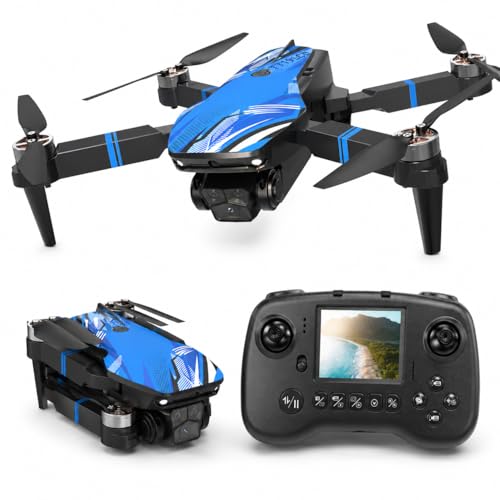
Best Phone-Free Mini Drone – FPV Foldable Drone with 2.8-Inch Screen
If you want a drone with obstacle avoidance for beginners without using your phone as a display, this foldable model pairs a 2.8-inch screen controller with a stated 270° obstacle-avoidance system. Optical-flow positioning helps it hover, while the electrically adjustable camera lets you change your view from the remote.
Best For: First-time flyers who want a compact drone with a built-in FPV display and simple flight controls.
Pros:
- 270° obstacle avoidance and optical-flow positioning add support while learning to fly.
- Screen-equipped controller removes the need to connect a smartphone.
- One-key takeoff and landing, headless mode, three speeds, and propeller guards suit practice sessions.
Cons:
- The controller screen is relatively small at 2.8 inches.
- Storage expansion is limited to 32GB.
This is the most compact, controls-first choice of the three. Its avoidance system is a useful aid, but beginners should still leave plenty of room around obstacles.
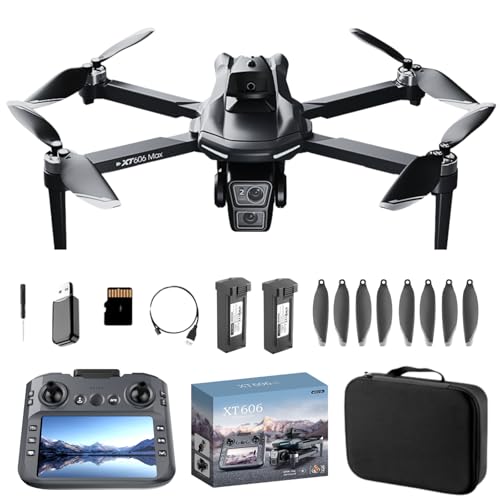
Best GPS Safety Features – XT606 Drone with 5-Inch Screen
For buyers comparing a drone with obstacle avoidance for beginners, the XT606 adds GPS-assisted return functions to its obstacle-avoidance feature. Its 5-inch screen controller provides an FPV view without a phone, and the listing also specifies optical-flow positioning and EIS stabilization.
Best For: Beginners who prioritize GPS return options, a larger controller display, and stabilized camera footage.
Pros:
- One-key, low-battery, and signal-loss return functions offer several ways to bring the drone back.
- 5-inch controller screen provides a larger phone-free flight view.
- Servo gimbal and EIS are listed for steadier photos and video.
- Battery is rated for up to 25 minutes of flight.
Cons:
- The notes do not specify the obstacle sensors’ coverage or detection range.
- Some intelligent modes and map features use app control.
Choose this one if GPS return behavior matters more to you than a pocket-size controller. Treat its flight-time figure as an upper limit, and keep visual watch rather than relying on avoidance alone.
Best Two-Battery Starter Kit – S166MAX Foldable Screen-Remote Drone
The S166MAX is a drone with obstacle avoidance for beginners who want more practice time out of the box. It combines automatic obstacle avoidance, optical-flow hovering, and one-key takeoff and landing with two batteries rated for up to 30 minutes of total flight time.
Best For: New pilots who want two included batteries, a screen-equipped remote, and a foldable travel setup.
Pros:
- Two batteries provide up to 15 minutes each, according to the listing.
- 4.3-inch controller screen displays the FPV feed without a separate phone display.
- Foldable arms and blades, plus an included storage case, simplify packing.
- Three speeds and optical-flow hovering give beginners room to practice.
Cons:
- Despite “4K” in the title, the supplied bullets and specifications describe a 720p camera.
- The listing does not describe the avoidance system’s detection range or coverage.
The extra battery and carrying case make this a practical starter package. If camera resolution is a deciding factor, go by the stated 720p specification rather than the title’s 4K claim.
How We Picked the Best Drone with Obstacle Avoidance for Beginners
We focused on the features a new pilot can actually use: stated obstacle-avoidance capability, approachable controls, camera and live-view options, and flight aids such as GPS or optical-flow positioning. The lineup includes mini drones, models with screens built into their controllers, and more camera-focused options. Product-name claims are a starting point, not proof of performance; check the current listing and manual for sensor directions, operating modes, and included accessories before buying.
Quick Comparison: Which Type Fits You?
- For simple first flights: A compact model with easy takeoff and landing may be more useful than an ambitious camera specification. Consider the DJI Neo 2 bundle if its current feature list and included RC-N3 controller match how you want to fly.
- For phone-free viewing: Several picks advertise a screen on the controller. Compare screen size, live-view reliability, and whether a phone is still needed for setup or advanced features.
- For outdoor camera flying: Look at the GPS models, especially if return-to-home and steadier positioning are priorities. A claimed 3-axis gimbal or electronic stabilization may also matter more than resolution alone.
- For a tight budget: Mini and foldable models can be appealing, but confirm what their avoidance system detects and at what speeds it works.
Key Buying Factors for a Drone with Obstacle Avoidance for Beginners
Sensor Coverage and Limits
“Obstacle avoidance,” “270°,” and “360°” do not necessarily describe the same protection. Ask which directions the sensors cover, whether detection works during every flight mode, and how the drone responds: stop, route around, or simply warn. Thin branches, wires, glass, darkness, and fast flight can defeat even capable systems. Leave generous clearance and keep the aircraft in sight.
Positioning, Return-To-Home, and Controls
GPS can help outdoors and may enable return-to-home, but that feature depends on a good signal and a correctly set home point. Optical flow can help with low-altitude hovering, subject to lighting and ground texture. For either system, prioritize clear status indicators and controls you can understand quickly. A built-in controller screen reduces dependence on a phone, though it does not automatically improve flight performance.
Camera, Batteries, and Ownership Costs
Check sample footage rather than assuming every “4K” label means equally sharp or stable video. If filming matters, compare stabilization and actual recorded resolution. Also check expected flight time per battery, spare-battery availability, replacement propellers, charging requirements, and the weight and registration rules that apply where you fly.
Who Should Buy Which Drone with Obstacle Avoidance for Beginners?
Choose a small, straightforward drone if your goal is learning basic stick control in a spacious area. Pick a screen-controller option if you want an all-in-one viewing setup. Step up to a GPS camera drone if you plan to fly outdoors regularly and value positioning and return-to-home; choose a gimbal-equipped option if smoother footage is worth the added cost. Whatever you buy, treat avoidance as a backup—not permission to fly close to people, trees, or buildings.