
A compact camera slider can add controlled motion, polished reveals, and repeatable time-lapse movement without the bulk of a full-size dolly system. The right model depends on your camera weight, travel needs, shot length, and whether you want manual or motorized control.
We compare 10 compact camera sliders ranging from simple portable rails to app-controlled systems, helping you find a practical fit for DSLR, mirrorless, action-camera, and video-production setups.
Best 10 Compact Camera Sliders Picks for 2026
Best Travel Pick
Zecti 24-Inch Carbon Fiber Slider

- 24-inch rail with a lightweight, travel-friendly design
- Adjustable legs and multiple mounting threads
- Supports phones, action cameras, and small cameras
Best For: Travelers wanting a versatile manual slider with extended movement
Best Motorized Mini
IFOOTAGE Shark Slider Pico Pro

- Motorized 15.7-inch slider for smoother camera moves
- Compatible with phones, action cameras, and DJI Pocket cameras
- Handles cameras up to 2.4 pounds
Best For: Mobile creators wanting automated movement in a compact setup
Best Accessory Bundle

- Includes ball head, phone clamp, and action-camera mount
- Smooth four-bearing carbon fiber rail
- Adjustable legs support multiple shooting angles
Best For: Hybrid shooters using cameras, phones, and action cameras
Best Foldable Design

- Folds to a compact 5.7-inch size
- Mechanical operation needs no batteries or motor
- Supports cameras up to 6.6 pounds
Best For: Traveling DSLR and mirrorless filmmakers needing maximum packability
Best Motorized Value
NEEWER ER1 80cm App-Controlled Slider

- App, manual, video, and time-lapse control
- 11-pound horizontal load capacity
- Includes 4400mAh battery and tripod threads
Best For: Creators and product-video setups needing quiet automated movement
Best Budget Manual Rail
Andoer 30cm Aluminum Camera Slider

- Compact 30cm manual rail
- Supports up to 11 pounds
- Multiple mounting threads for accessories
Best For: Simple DSLR and camcorder sliding shots on a budget
Best Advanced Motion Control

- 360-degree pan and dual-axis motorized control
- Eight waypoints plus app and touchscreen operation
- AI tracking and DJI gimbal compatibility
Best For: Professional and live-production setups needing programmable multi-axis movement
Versatile Motorized Pick

- Automated time-lapse, video, and round-trip modes
- Tripod and ground mounting with adjustable feet
- Supports horizontal, vertical, and 45-degree shooting
Best For: Creators needing flexible automated camera movement
Quiet Compact Pick
Zeapon EVO D40 Motorized Slider
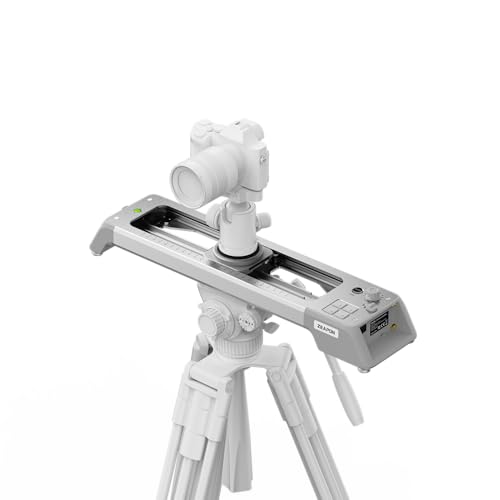
- Quiet brushless motor with smooth speed control
- App or keyboard control for waypoints and loops
- Supports up to 5 kg for horizontal and vertical slides
Best For: Portable, quiet, repeatable camera movements
Carbon-Fiber Workhorse
NEEWER ER1-80 Motorized Slider

- 11-pound horizontal load capacity
- App control with video and time-lapse modes
- Carbon-fiber rail with included 4400mAh battery
Best For: Longer, heavier-duty automated tracking shots
Best Travel Pick – Zecti 24-Inch Carbon Fiber Slider
For creators who want compact camera sliders with useful positioning flexibility, the Zecti combines a 24-inch track with adjustable legs, multiple mounting threads, and a relatively light 1.4-pound design. It supports horizontal, vertical, diagonal, and sideways operation, making it a practical choice for travel photography and video work.
Best For: Travelers and small-camera users who need a longer manual slide with flexible setup options.
Pros:
- 24-inch carbon fiber track weighs about 1.4 pounds and includes a carrying bag.
- Adjustable legs, non-skid feet, and a bubble level help with placement on varied surfaces.
- Multiple 1/4-inch and 3/8-inch threads support cameras, phones, action cameras, and ballheads.
- Compatible with devices from smartphones and GoPros to Sony, Canon, Lumix, and Insta360 cameras.
Cons:
- The manual slider may become noisy or feel rough if its screws are overtightened.
- Its maximum recommended load is 4.4 pounds.
- It is not water resistant.
The Zecti is a versatile manual option when travel portability and a generous 24-inch movement range matter. Buyers should be prepared to fine-tune the hardware for the smoothest, quietest operation.
Best Motorized Mini – IFOOTAGE Shark Slider Pico Pro
The IFOOTAGE Shark Slider Pico Pro is a compact motorized choice for creators who want smoother camera movement without relying on handheld operation. Its 15.7-inch format is designed for smartphones, DJI Osmo Pocket cameras, action cameras, and cameras weighing up to 2.4 pounds.
Best For: Mobile filmmakers and social-video creators seeking motorized movement in a small rig.
Pros:
- Motorized operation is suited to smooth, repeatable camera moves.
- Works with smartphones, DJI Osmo Pocket 3/4, action cameras, and compatible cameras.
- Supports payloads up to 2.4 pounds.
- Its 15.7-inch size keeps the slider more compact than a full-length track.
Cons:
- Its 2.4-pound payload is lower than some larger manual sliders.
- The supplied notes do not specify included accessories or detailed mounting options.
- The shorter rail provides less travel than the 24-inch model in this roundup.
This IFOOTAGE model stands out when automation and compact size are higher priorities than maximum payload or travel distance. It is especially appealing for phone, pocket-camera, and action-camera setups.
Best Accessory Bundle – NEEWER CS1M 16-Inch Slider
The NEEWER CS1M is one of the most flexible compact camera sliders for creators using a mix of cameras and mobile devices. Its 16-inch carbon fiber rail includes a 360-degree ball head, phone clamp, action-camera mount, adjustable legs, and multiple mounting threads.
Best For: Hybrid shooters who frequently switch between DSLR, mirrorless, smartphone, GoPro, and Insta360 setups.
Pros:
- Includes a 360-degree ball head, phone clamp, and action-camera adapter.
- Four precision bearings are designed for smooth, noiseless movement.
- Adjustable legs and a bubble level help with uneven terrain and alignment.
- Supports up to 4.4 pounds horizontally and offers horizontal, vertical, and 45-degree use.
Cons:
- Its 16-inch travel range is shorter than the Zecti’s 24-inch track.
- Payload drops to 2.2 pounds at a 45-degree tilt or vertically.
- It is not water resistant.
The CS1M offers the most complete device compatibility of the group, particularly for creators who use phones and action cameras alongside conventional cameras. Its compact rail and included accessories make it a convenient all-around kit.
Best Foldable Design – PROAIM Sway Portable Slider
For filmmakers prioritizing packability, the PROAIM Sway is a foldable mechanical slider that fits into backpacks and carry-on luggage. Its friction-controlled aluminum body provides manual camera movement without batteries or a motor, while the 1.3-foot travel range supports compact push-pull and side-to-side shots.
Best For: DSLR and mirrorless users who want a highly portable manual slider with a higher stated payload.
Pros:
- Foldable 5.7-inch design is suited to backpacks and carry-on travel.
- Supports up to 3 kg or 6.6 pounds.
- Mechanical friction control requires no batteries or motor.
- Includes 1/4-inch-20 and 3/8-inch-16 mounting compatibility for cameras and tripods.
Cons:
- Its 1.3-foot travel range is shorter than the full-length sliders in this roundup.
- The supplied notes do not mention included phone or action-camera adapters.
- It is not water resistant.
The PROAIM Sway is a strong fit when folded size and payload capacity matter most. Its short travel range is the tradeoff for a notably compact mechanical design that can be used without batteries.
Best Motorized Value – NEEWER ER1 80cm App-Controlled Slider
The NEEWER ER1 is a practical choice among compact camera sliders when you want automated movement without a complicated setup. Its 31.5-inch carbon-fiber rail supports horizontal camera moves, 45-degree tilting, video, manual, and time-lapse modes, while app control helps fine-tune speed and intervals.
Best For: Content creators, product videos, time-lapse photography, and outdoor shooting where quiet motorized movement is useful.
Pros:
- App control with manual, video, and time-lapse shooting modes
- Silent motor and included 4400mAh NP-F750 battery
- Supports up to 11 pounds horizontally and includes 1/4-inch and 3/8-inch mounting threads
- Carbon-fiber construction with four roller bearings for added stability
Cons:
- 5.5-pound maximum load when tilting upward at 45 degrees
- Minor shake may occur during macro photography
- 2.4G remote control and Type-C portable charger are not included
The ER1 balances useful automation, portability, and mounting flexibility. It is a strong fit for creators who need repeatable camera motion but do not require the advanced multi-axis features of a professional motion-control system.
Best Budget Manual Rail – Andoer 30cm Aluminum Camera Slider
The Andoer 30cm slider is a straightforward option for shoppers comparing compact camera sliders for manual camera moves. Its aluminum-alloy rail uses four precision bearings for smooth, quiet travel, and the sliding plate accepts both 1/4-inch and 3/8-inch mounting connections.
Best For: DSLR and camcorder users who want a compact manual slider for photography, filming, and accessory mounting.
Pros:
- Compact 30cm rail with 50cm and 40cm length options also available
- Supports loads up to 11 pounds
- Four high-precision bearings provide smooth, quiet sliding
- Multiple 1/4-inch and 3/8-inch threads accommodate tripods, lights, monitors, and microphones
Cons:
- Manual design does not provide motorized or app-controlled movement
- Aluminum construction may be less lightweight than carbon-fiber alternatives
Choose the Andoer when simplicity and a low-profile rail matter more than automated motion. It offers the essential hardware for controlled slides and accessory expansion without adding motor, battery, or app-related complexity.
Best Advanced Motion Control – IFOOTAGE Shark Nano II 860
The IFOOTAGE Shark Nano II 860 is a feature-rich pick among compact camera sliders for creators who need coordinated motion. It combines motorized slide travel with 360-degree pan movement, app or touchscreen control, customizable waypoints, and compatibility with select DJI gimbals for multi-axis shots.
Best For: Professional filmmakers, live streamers, vloggers, interviews, and product demonstrations requiring programmable or tracked movement.
Pros:
- Supports 360-degree unlimited pan movement and dual-axis motorized control
- App and IPS touchscreen control with up to eight customizable waypoints
- AI tracking can follow faces or moving objects through the iFootage Moco app
- Supports up to 5kg horizontally and 2.5kg vertically, with USB-C PD 60W power
Cons:
- DJI gimbal integration requires a compatible adapter, and the gimbal is sold separately
- Advanced features may be more than needed for basic slider shots
- Requires a 60W or higher power supply for DJI integration
The Nano II 860 is the most capable option here for programmable, multi-axis production. Its tracking and DJI integration broaden creative possibilities, but the added system requirements make it better suited to serious video workflows than casual use.
Versatile Motorized Pick – GVM 27-inch Motorized Slider
The GVM 27-inch motorized slider is a practical option for creators who want compact camera sliders with automated movement. Its aluminum-alloy rail supports time-lapse, video, and automatic round-trip shooting, while adjustable feet help keep the slider level on uneven surfaces.
Best For: DSLR, cellphone, and video-camera users who need automated horizontal, vertical, or angled movements.
Pros:
- Supports time-lapse, video, and auto round-trip shooting.
- Multiple 1/4-inch and 3/8-inch mounting holes allow ground or tripod use.
- Adjustable non-slip feet help with leveling and stability.
- Supports horizontal, vertical, and 45-degree shooting.
Cons:
- At 26.8 inches long and 2.36 kg, it is less convenient than the most portable sliders.
- Its maximum recommended load is 2.5 kg.
- It is not water resistant.
Choose this model if you value flexible mounting and automated shooting modes more than minimum packed size. The included carrying bag and power accessories also make it a reasonably complete setup for planned shoots.
Quiet Compact Pick – Zeapon EVO D40 Motorized Slider
The Zeapon EVO D40 is one of the more compact camera sliders for photographers and filmmakers who want a quiet motor and app-based control. It offers continuously adjustable speeds, waypoint and loop settings, and a mechanically controlled rotating pan head for centered orbital shots.
Best For: Portable video setups that need quiet operation, smooth speed changes, and subject-centered rotating movements.
Pros:
- Brushless motor is designed for quiet, steady operation.
- Speed can be adjusted from 0.5 to 57 mm/s.
- Supports app or keyboard control with waypoints and loop modes.
- Supports up to a 5 kg payload for horizontal and vertical slides.
Cons:
- The listed folded length is 27.6 inches, so it is compact but not especially short.
- It is not water resistant.
- Some advanced controls depend on the Zeapon Lab app or keyboard.
The EVO D40 stands out when quiet movement and repeatable camera paths are priorities. Its rotating pan head adds a specialized shooting capability, while the carrying case and relatively light 5.2-pound design support transport between locations.
Carbon-Fiber Workhorse – NEEWER ER1-80 Motorized Slider
The NEEWER ER1-80 combines a carbon-fiber rail with app control and optional remote operation, making it a capable choice among compact camera sliders for longer tracking moves. Its video and time-lapse modes, silent stepper motor, and included 4400mAh battery support extended automated shooting.
Best For: Outdoor and studio creators who need a longer 31.5-inch travel range, tripod mounting, and multiple control options.
Pros:
- Supports up to 11 lb horizontally and 5.5 lb at a 45-degree tilt.
- Offers manual, constant-speed video, slow-start/stop, and time-lapse modes.
- Includes a 4400mAh NP-F750 battery and can also use USB-C power.
- Carbon-fiber construction and four roller bearings support stability.
Cons:
- The included battery charger is not included.
- The optional RT-08 remote control is sold separately.
- At 8.7 pounds, it is heavier than many portable slider options.
This is a strong fit when load capacity and shooting flexibility matter more than ultralight portability. Before buying, account for the separate charger and optional remote if you want control beyond the included app.
How We Picked the Best Compact Camera Sliders
We evaluated these Compact Camera Sliders by comparing their travel length, construction, payload capacity, portability, drive system, and available camera-movement features. We also considered practical extras such as ball heads, phone mounts, app control, time-lapse support, panorama functions, battery options, and compatibility with common tripods and cameras.
Because slider performance depends heavily on setup, we treated smooth motion and stability as equally important. A longer rail may create more dramatic movement, while a shorter folding design can be easier to position, transport, and use in confined spaces.
Quick Comparison
| Best For | Look For |
|---|---|
| Travel and small setups | Short rail, low weight, compact folded size |
| Manual cinematic movement | Rigid rail, smooth bearings, reliable locking |
| Time-lapse and repeatable moves | Motorized drive, app control, programmable speed |
| Heavier camera rigs | Higher payload rating and strong support points |
| Panoramic shots | Motorized panning or rotating head compatibility |
Key Buying Factors for Compact Camera Sliders
Travel Length and Portability
Choose rail length based on the movement you actually need. Sliders around 12 to 16 inches are easy to pack and work well for product videos, tabletop scenes, and tight interiors. Rails around 24 to 34 inches provide more visible movement but require a larger bag and sturdier support.
Payload and Stability
Check the supported weight for the complete setup, including the camera, lens, ball head, monitor, and accessories. A slider rated close to its maximum may show more vibration, so leave headroom when possible. Carbon fiber can reduce weight, while aluminum often offers a solid, affordable platform.
Manual or Motorized Operation
Manual sliders are quick to deploy, quiet, and usually simpler to maintain. Motorized models are better for repeatable tracking shots, time-lapse sequences, round trips, and controlled speed changes. App control can improve precision, but it adds batteries, setup time, and another point of failure.
Mounting and Support
Look for secure camera threads, included heads or clamps, and multiple mounting points if you plan to use tripods. A slider placed directly on a table is convenient, but longer rails generally benefit from two-point support to prevent flex and unwanted shake.
Who Should Buy Which Compact Camera Sliders?
Choose a short manual slider if you create product videos, social content, or travel footage and value quick setup. A mid-length carbon-fiber model is a balanced choice for mirrorless cameras and general-purpose filmmaking. Pick a motorized slider if you need repeatable moves, automated time-lapse work, or consistent results across multiple takes. For heavier DSLR or cinema-style rigs, prioritize payload capacity, rigid construction, and dependable support over minimum weight. If panoramic movement is central to your work, select a system with dedicated rotating or panning capability rather than relying on a basic linear rail alone.