
Chromatic kalimbas give thumb-piano players access to sharps, flats, and a wider range of melodies than standard diatonic models. The right choice depends on key layout, build quality, playability, and whether you need acoustic simplicity or amplified performance.
We selected 10 options spanning 21-, 34-, 41-, and 42-key designs, including portable beginner instruments, solid-wood models, triple-row layouts, and kalimbas with built-in pickups and effects.
Best 10 Chromatic Kalimbas Picks for 2026
Natural-Tone Choice
LingTing 42-Key Padauk Chromatic Kalimba

- 42-key chromatic range
- Solid African Padauk body
- Secure, stable tine design
Best For: Players wanting broad range and natural wood character
Advanced Layout Pick
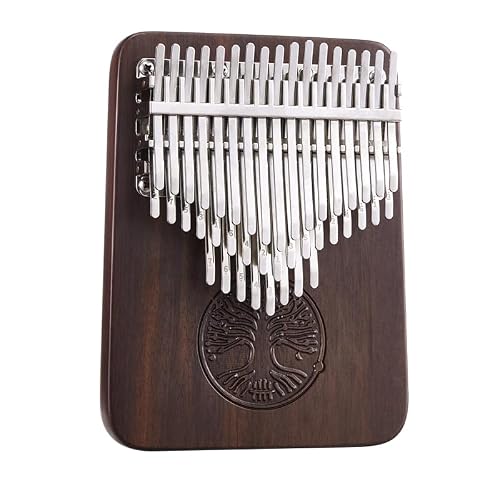
- Three-row 42-note chromatic scale
- Copper supports and split bridge
- Walnut body with recessed grip
Best For: Advanced players and arrangers
Full-Range Gift Set
42-Key Acacia Chromatic Kalimba

- Three-layer 42-key scale
- Solid acacia body
- Large accessory package included
Best For: Learners and gift buyers wanting a complete setup
Amplified Practice Pick
HLURU 34-Key Walnut Chromatic Kalimba

- 34-note double-row range
- Included pickup for amplification
- Solid walnut Life Tree body
Best For: Developing players and small amplified setups
Extended-Range Pick
LingTing 34-Key Violetwood Kalimba

- 34 adjustable carbon-steel tines
- Violetwood body with EVA case
- Includes learning and care accessories
Best For: Players wanting broad range and portable storage
Chromatic Design Pick
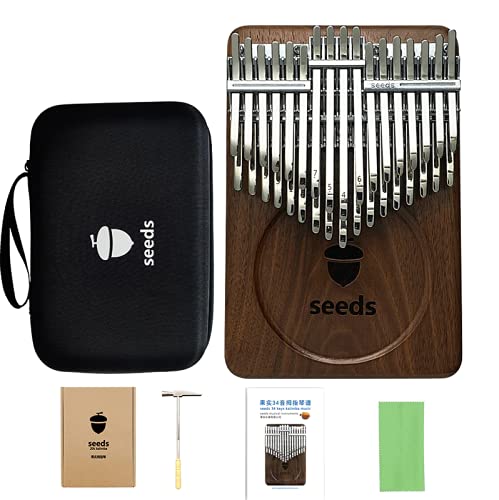
- Double-layer 34-key arrangement
- Familiar C-tuned 17-key layout
- Compact walnut body with resonant tone
Best For: Players expanding songs without changing basic technique
Amplified Performance Pick

- Built-in piezo pickup and preamp
- Chorus and delay effect controls
- Glossy mahogany body with engraved notes
Best For: Players needing amplified sound and onboard effects
Three-Octave Explorer

- Three-octave F3–F6 range
- Lightweight Okoume wood body
- Expandable layout with hard case
Best For: Players needing extensive chromatic range and portability
Accessible Starter
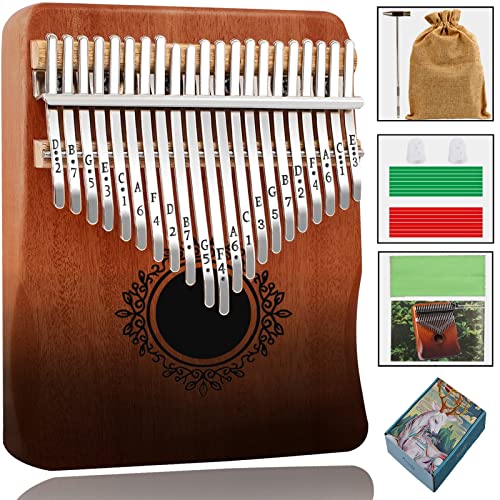
- Beginner-friendly 21-key layout
- Engraved notes and curved hand rest
- Includes extensive starter accessories
Best For: Beginners and gift buyers seeking an approachable kalimba
Walnut Range Specialist

- Expanded 42-key chromatic layout
- Solid natural walnut construction
- Secure-key design and EVA case
Best For: Players wanting broad range in a natural walnut instrument
Natural-Tone Choice – LingTing 42-Key Padauk Chromatic Kalimba
For shoppers comparing chromatic kalimbas, the LingTing LT-K42A stands out for its 42 keys, solid African Padauk construction, and bright, clear sound profile. Its secured tine design is intended to help maintain stable, consistent notes, while the natural reddish wood grain gives it a distinctive appearance.
Best For: Beginners and professionals who want a broad-range chromatic kalimba with a natural solid-wood body and included protection.
Pros:
- 42-key chromatic layout offers a versatile playing range.
- Solid African Padauk wood has visible natural grain and can deepen in tone over time.
- Patented tine fastening helps prevent slipping or shifting during play.
- Includes an EVA case, cleaning cloth, and gift box.
Cons:
- Its 42-key format may feel more demanding for someone used to a standard 17-key kalimba.
- The supplied notes do not list a tuning hammer or songbook among the included components.
The LingTing is a strong pick when wood character, dependable tine stability, and maximum note coverage matter more than a compact beginner format.
Advanced Layout Pick – HLURU 42-Key Walnut Life Tree
The HLURU Life Tree is one of the more feature-rich chromatic kalimbas for advanced playing. Its 42-note, three-row C-major layout adds chromatic tones for key changes, harmonies, and detailed arrangements, while copper supports, a split bridge, and pre-delivery tuning focus on consistent playability.
Best For: Experienced players, arrangers, and musicians who need an expanded three-row chromatic layout.
Pros:
- 42 notes and a symmetric three-row arrangement support advanced melodies and arrangements.
- African walnut body features rounded contours and a dimensional Life Tree relief.
- Four copper pillars and a split bridge reinforce the multi-row key assembly.
- Includes a carrying case, scale stickers, songbook, and tuning hammer.
Cons:
- The advanced three-row layout may have a steeper learning curve than a conventional kalimba.
- At 2.5 pounds, it is relatively substantial for a thumb piano.
Choose this HLURU when arrangement flexibility and structural support are priorities. The recessed back grip is also a practical touch for handling the larger multi-row instrument.
Full-Range Gift Set – 42-Key Acacia Chromatic Kalimba
This 42-key acacia model is a practical all-in-one option among chromatic kalimbas. Its three-layer scale places bass notes in the last row and uses two 17-key rows with a half-step difference, while the integrated body and frame are designed to improve sound transmission and sustain.
Best For: Beginners and experienced players seeking a full-range instrument with extensive accessories and an approachable scale design.
Pros:
- Three-layer 42-key layout expands musical possibilities with intuitive semitone spacing.
- Solid acacia body and manganese-steel keys are designed for a fuller, delicate sound.
- Integrated frame and body support sound transmission and sustain.
- Includes an EVA case, tuning hammer, cleaning cloth, stickers, tutorial sheet music, and badge.
Cons:
- At 1.36 kg, it is heavier than many compact kalimbas.
- The three-layer layout may require adjustment for players accustomed to a single row.
Its generous accessory package and clearly described scale layout make this a particularly convenient choice for learners who want room to grow without assembling a kit separately.
Amplified Practice Pick – HLURU 34-Key Walnut Chromatic Kalimba
The HLURU 34-key Life Tree is a more manageable alternative to larger chromatic kalimbas while still extending beyond a basic diatonic range. Its double-row layout adds bass notes and semitones, and the included pickup makes it suitable for lessons, rehearsals, small performances, and recording setups.
Best For: Developing players who want to explore chromatic playing and connect a kalimba to compatible sound equipment.
Pros:
- 34-note double-row design broadens melodies, harmonies, and key changes.
- Solid African walnut body has a refined waxed finish and Life Tree relief.
- Included pickup adds amplified and recording flexibility.
- Includes a carrying bag, songbook, and tuning hammer.
Cons:
- It offers fewer notes than the 42-key chromatic models in this roundup.
- The pickup requires compatible sound equipment for amplified use.
For players moving beyond a single-row kalimba, this model balances a broader range with useful amplification options and a somewhat less extensive layout than a 42-key instrument.
Extended-Range Pick – LingTing 34-Key Violetwood Kalimba
For shoppers comparing chromatic kalimbas, the LingTing K34V stands out for its 34 adjustable carbon-steel tines and violetwood body. It offers a broad note range in a compact instrument, though tuning requires the included wrench rather than a standard tuning hammer.
Best For: Beginners through professional players who want an extended-range kalimba for home, school, outdoor, or casual music sessions.
Pros:
- 34 adjustable carbon-steel tines provide more range than typical 17- or 21-key models.
- Handmade violetwood body gives each instrument unique wood texture.
- Includes an EVA case, wiping cloth, syllable stickers, and accessories.
- Textbook and straightforward design support learning.
Cons:
- Uses a wrench for tuning and does not include a tuning hammer.
- The larger key count may be more than a casual beginner needs.
The LingTing is a practical choice when range and portability matter most. Its included case and learning materials add gift appeal, while the wrench-based tuning is worth considering before purchase.
Chromatic Design Pick – Seeds Pisces 34-Key Kalimba
The Seeds Pisces is a strong option for shoppers seeking chromatic kalimbas without learning an entirely different playing method. Its double-layer layout adds accidental notes to a familiar 17-key C-tuned arrangement, helping expand song choices while retaining a compact walnut body.
Best For: Players who want chromatic flexibility, familiar 17-key technique, and a portable instrument for varied songs.
Pros:
- 34-key double-layer design adds sharps and other accidental notes.
- Bottom 17 keys match the standard C-tuned 17-key playing style.
- 6.7 mm tine spacing supports individual notes and glissando playing.
- Compact walnut body is approximately the size of a standard 17-key kalimba.
Cons:
- The two-layer layout may require adjustment for players used to a single row.
- Supplied details list a music book but do not specify additional accessories.
With its familiar lower row and added chromatic notes, the Seeds Pisces offers an approachable path into expanded repertoire. Its rich, resonant sound and compact size make it especially versatile for portable playing.
Amplified Performance Pick – MOOZICA EQX 21-Key Kalimba
For performers comparing chromatic kalimbas and amplified instruments, the MOOZICA EQX combines a 21-key C-major layout with a built-in piezo pickup, preamp, chorus, and delay effects. Its solid mahogany construction is designed for a warm, deep acoustic sound as well as amplified use.
Best For: Beginners and experienced players who want an acoustic-electric kalimba for amplified performance and effects-based sound shaping.
Pros:
- Built-in piezo pickup and preamp capture and amplify the kalimba’s tones.
- Chorus and delay controls add extra sound possibilities.
- 21 engraved tones in C major cover F3-E6 and support accessible note identification.
- CNC-hollowed mahogany body is finished for a warm, deep sound.
Cons:
- It has 21 keys, so it offers less note range than the 34-key models in this roundup.
- Its electronic features may be unnecessary for strictly acoustic players.
- The supplied connector is USB Type B, which may require checking compatibility with existing equipment.
The EQX is the most performance-oriented choice here. Select it if amplification and built-in effects are priorities; choose a simpler model if you mainly want an unplugged, traditional playing experience.
Three-Octave Explorer – 41-Key Chromatic Kalimba
For players seeking genuinely versatile chromatic kalimbas, this 41-key Seeds model covers three full octaves from F3 to F6. Its expanded layout includes sharps and flats, making it suitable for arrangements that would require transposition on standard kalimbas.
Best For: Musicians who want broad chromatic range, portability, and room to expand their instrument.
Pros:
- 41 keys cover three full octaves and standard 17-, 21-, and 34-key tabs.
- Lightweight solid Okoume wood body weighs approximately 450 g.
- Laser-engraved notes, included hard case, hammer, music book, and stand support convenient use.
- Ten empty bottom slots allow potential expansion up to 51 keys.
Cons:
- The larger 41-key layout may feel less familiar to beginners.
- Its flat-board design may not provide the resonant body style some players prefer.
- The listed warranty is 30 days.
This is the most range-focused option here, combining a three-octave chromatic layout with a relatively light body. It is a strong pick for experienced players and anyone planning to play more complex music.
Accessible Starter – 21-Key Mahogany Kalimba
This 21-key mahogany thumb piano is a straightforward choice for beginners exploring kalimbas. While it is not described as chromatic, its engraved notes, curved hand rest, and included accessories make it approachable for learning and casual playing.
Best For: Beginners, gift shoppers, and players wanting a compact kalimba with a complete starter kit.
Pros:
- 21 keys provide more range than smaller beginner models.
- Engraved note names help with learning and navigation.
- Ergonomic hand-rest curve and polished edges support comfortable playing.
- Includes a gift box, cloth bag, tuning hammer, stickers, finger protectors, and cleaning cloth.
Cons:
- This model is not identified as a chromatic kalimba and may not include all sharps and flats.
- It has less range than the 41- and 42-key models in this roundup.
- A tuning hammer may still be needed for periodic adjustments.
Choose this model for an uncomplicated introduction to the instrument rather than for full chromatic flexibility. Its accessory bundle and note markings make it especially practical for new players and gifts.
Walnut Range Specialist – 42-Key Chromatic Kalimba
The LingTing Moon Whisperer is a 42-key chromatic kalimba made for players who want extended note coverage in a solid walnut instrument. Its expanded range supports more varied compositions, while the patented key-fastening design is intended to keep the keys secure during play.
Best For: Adults, advanced beginners, and professionals looking for a wide-range chromatic kalimba with a premium walnut presentation.
Pros:
- 42-key chromatic layout offers broad flexibility for compositions and arrangements.
- Solid walnut construction has a natural, unpainted finish.
- Patented design is intended to prevent keys from slipping or moving.
- Includes an EVA case, cleaning cloth, tuning stickers, and gift box.
Cons:
- The expanded 42-key layout may be more demanding for first-time players.
- The supplied notes do not specify the instrument’s exact range or tuning details.
- Included accessories do not list a tuning hammer.
This model balances extensive chromatic capability with the visual appeal of natural walnut. It is worth considering when secure key construction and a gift-ready presentation matter as much as range.
How We Picked These Chromatic Kalimbas
We focused on the features that most affect everyday playing: the number and arrangement of keys, tuning range, wood construction, portability, included accessories, and suitability for different experience levels. We also considered whether each instrument is designed primarily for unplugged practice, stage use, recording, or flexible travel.
Because product listings can vary by seller, verify the current tuning, dimensions, pickup configuration, and included case or tuning hammer before ordering. A larger key count is not automatically better if the layout feels crowded or difficult to learn.
Quick Comparison
| Type | Best suited to | Main advantage | Potential trade-off |
|---|---|---|---|
| 21-key model | Beginners and casual players | Simple, compact layout | Smaller range |
| 34-key model | Developing players | Useful balance of range and size | More complex technique |
| 41- or 42-key model | Advanced players and arrangers | Broad chromatic range | Larger body and steeper learning curve |
| Pickup-equipped model | Performers and recording musicians | Easy amplification and effects | More electronics to manage |
Key Buying Factors for Chromatic Kalimbas
Key Count and Layout
Choose the smallest range that supports the music you want to play. A 21-key kalimba is easier to navigate, while 34- and 42-key Chromatic Kalimbas offer more options for complex arrangements, accidentals, and multiple octaves. Double- or triple-row layouts can increase range but require more orientation practice.
Wood, Resonance, and Comfort
Solid walnut, padauk, okoume, and other hardwood bodies can produce different tonal characters and levels of sustain. More important than the species alone is clean construction, comfortable edges, stable tines, and a body size you can hold without hand fatigue.
Tuning and Maintenance
Look for clearly stated chromatic or C-tuned specifications and make sure a tuning hammer is included or readily available. Check each tine after delivery, especially if the instrument traveled far, and use an electronic tuner or compatible tuning app for adjustments.
Pickup and Effects
A built-in piezo pickup is valuable for live playing, looping, and recording. Models with chorus, delay, or onboard controls add flexibility, but acoustic players may prefer a simpler design with fewer points of failure.
Who Should Buy Which Chromatic Kalimbas?
Beginners: Start with a compact 21-key model or an accessible 34-key instrument that includes a guide, bag, and tuning accessories.
Intermediate and advanced players: Choose a 34-, 41-, or 42-key design if you regularly play arrangements requiring accidentals and extended range. Prioritize a layout you can read quickly over maximum key count.
Performers and recording musicians: Select a pickup-equipped model, especially if you need amplification or built-in effects without relying on an external microphone.
Travelers and gift buyers: Favor a lighter, portable body with a protective case and straightforward tuning. The best chromatic kalimba is the one that matches the recipient’s playing goals rather than simply having the most keys.