
The best camera external recorders with HDMI input make it easier to capture, monitor, or stream footage without relying entirely on a computer. The right model can add standalone recording, passthrough viewing, audio handling, and compatibility with cameras, consoles, or legacy video sources.
We gathered 10 options covering compact capture cards, recorder boxes with built-in screens, multi-input systems, and HDMI cameras with USB output. Use the guide below to narrow your choice by resolution, recording method, display needs, and intended workflow.
Best 10 Camera External Recorders with Hdmi Input Picks for 2026
Best Portable Recorder
4K60 HDMI/DisplayPort Capture Recorder

- 4K60 input with 1080p60 H.264 recording
- HDMI or DisplayPort over USB-C
- Compact body with AUX audio support
Best For: Portable camera, gaming, and device recording
Best Security Camera Source
1080p HDMI/VGA Security Camera

- Direct HDMI or VGA monitoring output
- 1080p video with a wide 2.8mm lens
- HDTVI loopout for DVR/XVR recording
Best For: Surveillance systems feeding an HDMI recorder
Best Multi-Input Recorder
4K60 Dual-HDMI Recorder with Monitor

- Two HDMI inputs for source switching
- Built-in 7-inch preview monitor
- PIP, POP, and PMP multi-screen modes
Best For: Multi-camera, gaming, and production setups
Best Zoom Camera
4K HDMI/USB Manual-Zoom Camera

- 4K30 video with HDMI and USB outputs
- Manual 4X varifocal zoom lens
- HDMI and USB can operate simultaneously
Best For: Industrial monitoring and adjustable camera framing
Best All-in-One Capture Box

- Standalone 4K30 HDMI recording
- Captures legacy AV and tape formats
- Includes 5-inch preview LCD and speaker
Best For: Digitizing HDMI and analog video without a computer
Best Standalone 4K Recorder

- PC-free recording up to 4K30
- 4K HDMI pass-through for live viewing
- TF card and USB storage support
Best For: Standalone recording of cameras, consoles, and presentations
Best Camera With HDMI Output

- 4K30 USB and 1080p HDMI output
- 10X total zoom with manual lens
- Simultaneous computer and monitor output
Best For: Teaching, conferencing, inspection, and long-distance viewing
Most Versatile
UR500A 1080P HDMI Recorder with 7-inch Screen
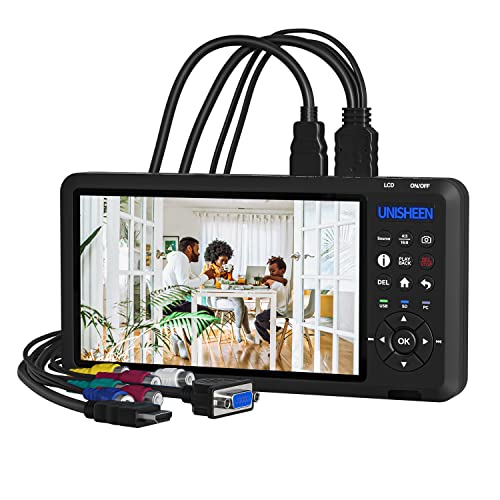
- Accepts HDMI, DVI, CVBS, VGA, and YPBPR inputs
- Records up to 1080p60 directly to removable storage
- Built-in 7-inch monitor with optional battery operation
Best For: Mixed-source capture and portable AV workflows
Best Simple Setup
MYPIN 1080P HDMI Game Recorder
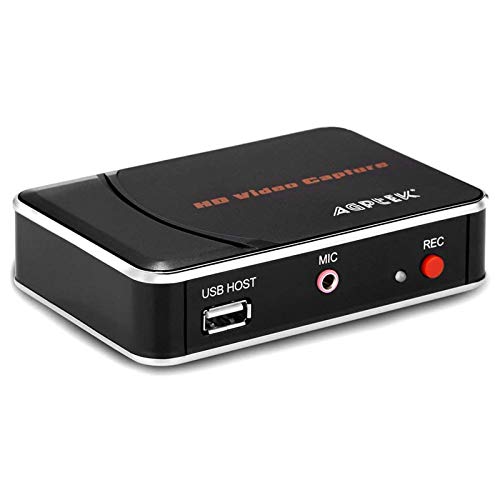
- Captures 1080p HDMI video without a computer
- Saves directly to USB flash drives or external hard drives
- One-touch recording with microphone input for commentary
Best For: Basic standalone HDMI and gameplay recording
Best Portable Monitor
MYPIN 1080p60 HDMI Recorder with LCD
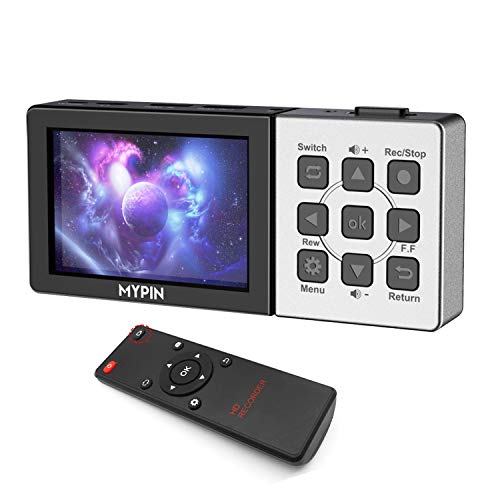
- Records 1080p video at up to 60fps from HDMI sources
- Includes a 3.5-inch LCD, speaker, remote, and battery
- Supports playback, scheduled recording, and mic commentary
Best For: Portable capture with built-in monitoring and playback
Best Portable Recorder – 4K60 HDMI/DisplayPort Capture Recorder
For shoppers comparing camera external recorders with HDMI input, the UNISHEEN UR-M2 is a compact option that accepts HDMI or DisplayPort over USB-C. It passes through 4K at 60 fps and records at 1080p60 using H.264, making it suitable for camera feeds, gaming, streaming, and device mirroring.
Best For: Portable recording from cameras, phones, computers, game consoles, and other compatible HDMI or DisplayPort sources.
Pros:
- Supports 4K60 input and 1080p60 recording.
- Accepts HDMI or DisplayPort through USB-C.
- Compact design with AUX headphone or microphone connectivity.
- Offers instant preview and playback from a TF card using a smartphone.
Cons:
- Recording is limited to 1080p60 rather than 4K.
- Requires compatible storage for recording and playback.
The UR-M2 stands out when portability and flexible source compatibility matter most. Its driver-free setup and audio monitoring features make it practical for creators who want a straightforward standalone recorder.
Best Security Camera Source – 1080p HDMI/VGA Security Camera
The LINOVISION HD1080P is a security camera rather than a standalone recorder, but its direct HDMI output makes it a useful source for camera external recorders with HDMI input. It displays video on a TV or HDMI monitor without an encoder or DVR and also provides a loopout connection for continuous DVR or XVR recording.
Best For: Indoor or outdoor surveillance setups that need direct HDMI monitoring and optional DVR/XVR recording.
Pros:
- Direct HDMI or VGA output for low-delay viewing.
- 1080p imaging with a 2.8mm lens and 103.5° field of view.
- HDTVI loopout supports continuous recording through a DVR or XVR.
- IP67 waterproof rating and night vision up to 40 meters.
Cons:
- It is a camera, not a standalone HDMI recording device.
- Its 1080p output does not target 4K capture workflows.
- Wired installation and corded power may limit placement flexibility.
This model makes sense as a dependable HDMI camera feed for monitoring or external capture. Choose it when surveillance features and direct display output are more important than portable recording.
Best Multi-Input Recorder – 4K60 Dual-HDMI Recorder with Monitor
For multi-source setups, the UNISHEEN UR500 is a capable choice among camera external recorders with HDMI input. It has two HDMI inputs supporting sources up to 4K60, outputs 1080p60, and adds PIP, POP, and PMP viewing modes through its built-in 7-inch screen.
Best For: Creators and production setups that need to switch or combine two HDMI cameras, consoles, computers, or other sources.
Pros:
- Two HDMI inputs support sources up to 4K60.
- Built-in 7-inch screen enables source preview and monitoring.
- PIP, POP, and PMP modes support multi-source layouts.
- Records to USB storage or an SD card and works with OBS over USB.
Cons:
- Output and capture are specified at 1080p60 rather than 4K.
- USB drives, hard drives, SD cards, and optional batteries are not included.
- It cannot record or stream copyrighted or content-protected HDMI sources.
The UR500 is better suited to a small production workflow than a simple single-camera setup. Its dual inputs, monitor, and layout modes provide useful flexibility, while its storage options support standalone recording.
Best Zoom Camera – 4K HDMI/USB Manual-Zoom Camera
The ELP 4K HDMI USB Camera is a camera source for camera external recorders with HDMI input, offering both HDMI and USB outputs simultaneously. It captures up to 4K30, includes a manual 2.8–12mm 4X varifocal lens plus 2X digital zoom, and can display on an HDMI monitor while connecting to a computer over USB.
Best For: Industrial monitoring, presentations, and long-distance or close-up camera views that benefit from manual zoom control.
Pros:
- Provides 4K video at up to 30 fps.
- HDMI and USB outputs can operate concurrently.
- Manual 4X varifocal zoom and 2X digital zoom support flexible framing.
- Plug-and-play UVC operation works with numerous computer platforms.
Cons:
- Manual focus and zoom require hands-on adjustment.
- It is a camera, not a standalone recorder.
- The listed HDMI output is 4K30 rather than 4K60.
This ELP model is a strong fit when the camera itself needs adjustable framing and a direct HDMI feed. Pair it with an external recorder for recording, or use USB and HDMI simultaneously for computer capture and local display.
Best All-in-One Capture Box – SoundBeast 4K HDMI Recorder
For shoppers comparing camera external recorders with HDMI input, the SoundBeast stands out as a versatile standalone capture box. It records HDMI sources up to true 4K at 30 fps or 1080p at 60 fps, and it also converts analog sources such as VHS, VCRs, and camcorders.
Best For: Users digitizing both HDMI and legacy AV video without a computer.
Pros:
- Records HDMI video with audio up to 4K30 or 1080p60.
- Captures AV, RCA, VHS, VCR, DVD, Hi8, and MiniDV sources up to 480p.
- Includes a 5-inch preview LCD, built-in speaker, remote, and multiple storage options.
- Offers Windows-and-OBS live streaming plus a two-year warranty and support.
Cons:
- Does not record or stream copyrighted or content-protected HDMI sources.
- USB live streaming is limited to Windows with OBS; Mac and XSplit are not supported.
- Storage media is not included.
The built-in display and standalone recording make this a practical choice for home archiving and basic capture workflows. Its main limitation is the restricted software support and inability to handle protected HDMI content.
Best Standalone 4K Recorder – ZowieREC HDMI Video Recorder
The ZowieREC is a strong option among camera external recorders with HDMI input when you want PC-free recording. Its aluminum-bodied unit supports 4K input and pass-through, while recording up to 4K30 or 1080p60 to a TF card or USB storage.
Best For: Gamers, camera users, and presenters who need standalone HDMI recording with pass-through.
Pros:
- Records up to 4K30 without requiring a computer.
- Supports 4Kp60 input and loop-out, with 1080p60 recording available.
- Provides HDMI pass-through for viewing while recording.
- Includes pause, resume, scheduling, and TF-card or USB storage support.
Cons:
- Protected or copyrighted HDMI sources are not supported.
- AV-to-HDMI adapter is not included.
- Listed warranty coverage is one year.
With pass-through and scheduling, this recorder is suited to repeatable gameplay, conferencing, and camera workflows. Buyers should confirm their source outputs HDMI and plan separately for storage and any analog conversion.
Best Camera With HDMI Output – IFWATER 4K USB HDMI Camera
Unlike a dedicated recorder, this IFWATER model is a 4K camera with HDMI input-compatible recording workflows through its HDMI output and USB connection. It can display simultaneously on a monitor and computer, making it useful when your setup needs both a camera and a feed for capture or streaming.
Best For: Online teaching, conferencing, inspection, and long-distance subjects requiring manual zoom and focus.
Pros:
- Outputs up to 4K30 over USB and 1080p over HDMI.
- Offers a 5–50mm manual variable-focus lens with up to 10X total zoom.
- Supports simultaneous USB and HDMI output.
- Works as a plug-and-play UVC camera with compatible computers and devices.
Cons:
- It is a camera, not a standalone HDMI recorder.
- Focus is manual and image stabilization is not provided.
- HDMI output is limited to 1080p, according to the supplied notes.
This model makes sense when the priority is producing a flexible camera feed for an external HDMI recorder, monitor, or computer. Its manual lens favors controlled installations over quick, stabilized handheld shooting.
Most Versatile – UR500A 1080P HDMI Recorder with 7-inch Screen
If you need camera external recorders with HDMI input and support for more than one video source, the UNISHEEN UR500A is a flexible standalone option. It accepts HDMI, DVI, CVBS, VGA, and YPBPR inputs, records MP4 video at up to 1080p60, and includes a built-in 7-inch preview display.
Best For: Users capturing video from cameras, VCRs, DVD players, camcorders, and other mixed-format sources without relying on a computer.
Pros:
- Supports multiple video inputs, including HDMI, and captures up to 1080p60.
- Records directly to an SD card, USB flash drive, or external hard drive.
- Built-in 7-inch preview screen, HDMI loop-out, remote control, and optional battery operation.
- Can also connect to Windows, Mac, or Linux computers for USB capture and streaming.
Cons:
- Storage devices and compatible batteries are sold separately.
- Copyrighted or content-protected HDMI sources appear as a black screen.
The UR500A stands out when input flexibility and on-device monitoring matter more than minimal size. Its broad connection options make it particularly useful for archival, event, education, and mixed AV setups.
Best Simple Setup – MYPIN 1080P HDMI Game Recorder
Among camera external recorders with HDMI input, the MYPIN HD Game Recorder is designed for straightforward, computer-free recording. It captures 1080p HDMI video and saves it directly to a USB flash drive or external hard drive, with one-touch operation.
Best For: Gamers and users who want basic HDMI recording to removable USB storage without PC software or live-streaming features.
Pros:
- Records 1080p HDMI video directly to USB storage.
- One-touch start and stop operation with no computer required.
- Supports USB flash drives up to 128GB and hard drives up to 2TB with the stated partition requirements.
- Includes a microphone input for adding commentary.
Cons:
- Does not support live streaming or direct operation with OBS, VLC, or YouTube.
- Does not record party chat through the microphone feature.
- Requires a FAT32 flash drive and accepts only a 3.5mm TRS microphone headset.
This recorder is a good fit when direct USB recording is the priority. Its limited software functionality makes it less suitable for streaming, but the simple standalone workflow is convenient for supported HDMI devices.
Best Portable Monitor – MYPIN 1080p60 HDMI Recorder with LCD
If portability and immediate playback are important in camera external recorders with HDMI input, this MYPIN model adds a 3.5-inch LCD, speaker, remote control, and built-in battery. It records 1080p video at up to 60fps from HDMI sources and saves MP4 files to a TF card.
Best For: Users who want standalone HDMI recording with on-device preview, playback, scheduled recording, and optional microphone commentary.
Pros:
- Records Full HD 1080p video at up to 60fps from HDMI sources.
- 3.5-inch LCD, built-in speaker, and remote control support quick monitoring and operation.
- Built-in 3000mAh battery provides up to three hours of portable video playback.
- Supports scheduled recording, instant playback, and microphone input for TRS commentary.
Cons:
- Storage is limited to a TF card up to 128GB.
- The microphone input accepts only a TRS-standard microphone.
- Its listed computer compatibility requires a USB port and a compatible Windows or macOS setup.
The VG0097 is more feature-rich than a basic HDMI capture box, especially for mobile monitoring and playback. Choose it if the built-in screen, battery, and scheduled recording are more valuable to you than a compact computer-only capture device.
How We Picked These Camera External Recorders with Hdmi Input
We focused on the features that matter most in real-world capture setups: HDMI input compatibility, supported recording resolution and frame rate, passthrough performance, audio connectivity, standalone operation, monitoring options, and ease of use. The selection also represents different budgets and workflows, from basic 1080p recording to 4K60 passthrough and multi-source production.
Because specifications and included accessories can vary, confirm the manufacturer’s supported formats before buying. In particular, check whether the recorder captures 4K or only passes it through while recording at 1080p.
Quick Comparison
| Best For | Look For | Typical Strength |
|---|---|---|
| Simple computer capture | USB output and plug-and-play support | Easy streaming or recording |
| Standalone recording | Memory-card or USB storage support | No computer required |
| Gaming and monitoring | HDMI passthrough and low latency | Smooth display while recording |
| Multi-source production | Two HDMI inputs and PIP/POP/PMP modes | Flexible switching and layouts |
| Legacy video conversion | VGA, DVI, CVBS, or component inputs | Broader source compatibility |
Key Buying Factors for Camera External Recorders with Hdmi Input
Resolution, Frame Rate, and Passthrough
Match the recorder to your camera’s output. A 4K60 passthrough model can let you view a high-resolution signal while recording a lower-resolution file, whereas true 4K recording requires both supported input and storage performance. For sports, gaming, and fast movement, prioritize 60 frames per second when available.
Standalone Recording Vs. USB Capture
Standalone units are useful for field work, presentations, classrooms, and simple archival projects because they can record without a computer. USB capture cards are often better for OBS, video calls, and live production, but they depend on a host computer and compatible software.
Inputs, Outputs, and Audio
Verify the connectors you actually need. HDMI is common, but VGA, DVI, composite, component, DisplayPort, and USB camera outputs serve different sources. If you need commentary or an external microphone, look for an audio input, headphone monitoring, or reliable HDMI audio support.
Screen, Storage, and Controls
A built-in LCD can help with field monitoring and playback, while remote controls and scheduled recording are useful for unattended setups. Check whether storage uses an SD card, USB drive, or computer software, and review maximum card capacity and file-format limitations.
Who Should Buy Which Camera External Recorders with Hdmi Input?
- Choose a compact USB capture card for straightforward streaming, conferencing, or recording through a laptop or desktop.
- Choose a standalone HDMI recorder if you want computer-free operation, portable archiving, or simple one-button recording.
- Choose a recorder with a built-in screen for field monitoring, playback, presentations, or troubleshooting signal sources.
- Choose a dual-input model if you combine two cameras, consoles, or other HDMI devices and need picture-in-picture or source layouts.
- Choose an input-rich recorder for digitizing older equipment such as VCRs, DVD players, camcorders, or VGA-based systems.
- Choose an HDMI/USB camera when you need the camera itself to provide zoom, focus, and simultaneous computer and HDMI output.
Before ordering, confirm resolution support, copy-protection restrictions, required cables, storage compatibility, and whether the advertised recording format matches your intended camera workflow.