
Choosing your first accordion can be surprisingly complex: button and piano layouts, bass counts, reed quality, and instrument size all affect how quickly you learn.
These 10 beginner-friendly options cover compact practice models, children’s instruments, and fuller diatonic accordions for adults ready to build lasting skills.
Best 10 Accordions for Beginners Picks for 2026
Classic Folk Pick

- 31 buttons and 12 bass buttons
- Includes straps and Hohner method book
- G/C/F diatonic tuning
Best For: Beginners pursuing traditional diatonic folk styles
Portable Student Choice

- Piano-style 25-key keyboard
- Includes backpack and padded suitcase box
- Adjustable straps, gloves, and cloth included
Best For: Adult beginners and students wanting easy transport
Folk Practice Upgrade
31-Key F/B/E Diatonic Accordion

- 31 keys and 12 bass buttons
- F/B/E tuning for folk styles
- Carry kit with case, straps, gloves, and wipes
Best For: Folk-focused adult beginners and developing players
Kids’ First Instrument
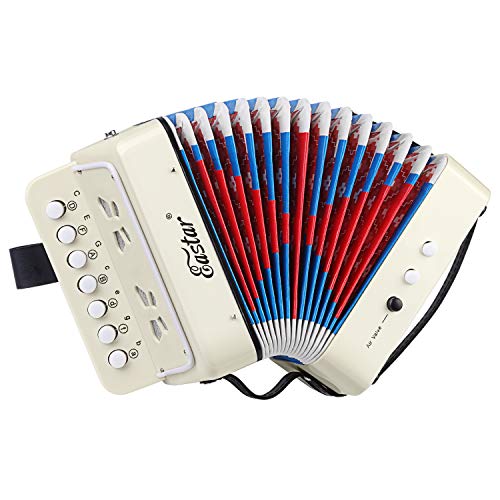
- Lightweight 1.9-pound compact design
- Includes learning guide and hold straps
- Designed for children over age three
Best For: Young children exploring music and accordion basics
Best Beginner Piano Accordion

- Smooth piano-style keys for easier finger placement
- Durable celluloid body and stainless-steel cover
- Lightweight 3-pound design with straps and manual
Best For: Adult beginners learning on piano-style keys
Best Kids’ Starter Accordion

- Seven buttons provide 14 notes for simple practice
- Includes a learning guide for beginners
- Compact 1.4-pound design is easy for children to carry
Best For: Children beginning to explore accordion playing
Best Full-Range Beginner Accordion

- 22 keys and 8 basses allow room to progress
- Responsive non-slip buttons and adjustable voice changers
- Includes backpack, straps, gloves, and cleaning cloth
Best For: Beginners wanting a larger instrument with accessories
Best Starter Pick
17-Key 8-Bass Beginner Accordion

- Crisp-sounding high-quality reeds
- Smooth buttons for easier learning
- Lightweight 1.52 kg ABS body
Best For: Adult beginners and casual practice
Best for Traditional Styles
31-Key G/C/F Diatonic Accordion

- Three-row G/C/F tuning
- 31 treble and 12 bass buttons
- Padded suitcase and adjustable strap included
Best For: Traditional-style learners and ensemble players
Best Piano-Style Option

- Familiar black-and-white piano keys
- Professionally tuned accurate tones
- Padded bag and accessories included
Best For: Adults who prefer a piano-style layout
Classic Folk Pick – Hohner Panther G/C/F
The Hohner Panther is a substantial 3-row diatonic option for learners looking for a traditional folk instrument. With 31 buttons, 12 bass buttons, and a G/C/F tuning, it suits players who already know the style of music they want to study and need a full-size practice instrument.
Best For: Beginners focused on folk, polka, or other diatonic accordion styles who want a recognized Hohner model.
Pros:
- 31 buttons and 12 bass buttons provide a broad playing layout.
- G/C/F tuning works well for players seeking a 3-row diatonic setup.
- Includes straps, a cleaning cloth, and a Hohner Diatonic Method Book.
- Features a matte black basswood body and 1/4-inch jack/XLR connectors.
Cons:
- Available only in G/C/F and matte black.
- No gig bag is included.
- The limited warranty lasts 90 days and covers manufacturer-defect repairs.
Its included method book and familiar Hohner branding make it a practical starting point, but its 13-pound weight and three-row layout may be more instrument than a casual beginner needs.
Portable Student Choice – 25-Key 16-Bass Accordion
This 25-key, 16-bass accordion is aimed at beginners and adults who want a piano-style keyboard with a manageable accessory package. Its adjustable straps, backpack, cleaning cloth, gloves, and padded suitcase box make it convenient for lessons and storage.
Best For: Adult beginners, students, and families seeking a piano-key accordion with carrying and care accessories included.
Pros:
- 25 black-and-white piano-style keys offer a familiar keyboard layout.
- 16 bass keys provide more bass options than many compact student models.
- Includes an accordion backpack, adjustable straps, cleaning cloth, gloves, and padded suitcase box.
- Premium leather windbox is designed to support an airtight seal.
Cons:
- The supplied notes do not specify the instrument’s weight or dimensions.
- The blue finish may not suit every preference.
- Its broad beginner-and-professional positioning provides limited detail about advanced performance features.
The familiar keyboard and generous accessory bundle make this a convenient entry point for piano-key learners, especially those who value portability and protected storage.
Folk Practice Upgrade – 31-Key F/B/E Diatonic Accordion
This 31-key, 12-bass diatonic accordion is designed around folk playing, with F/B/E tuning, airtight bellows, responsive buttons, and hand-tuned reeds. It is a strong choice among accordions for beginners who want a folk-focused setup with a complete carry kit.
Best For: Adult beginners and developing players practicing Irish, polka, bluegrass, or country-oriented diatonic music.
Pros:
- 31 treble keys and 12 bass buttons provide a full diatonic layout.
- F/B/E tuning is suited to the listed folk styles.
- Airtight bellows are designed to support stable airflow and pitch.
- Includes a carry case, backpack, shoulder straps, gloves, and polishing wipes.
Cons:
- F/B/E tuning may be less suitable for learners following a different teaching system.
- At about 7.99 kg, it is relatively heavy for a portable beginner instrument.
- The product details list a stainless-steel body, which may feel less traditional than a fully wooden build.
With its responsive layout and maintenance accessories, this model offers a well-equipped path into folk accordion playing, provided its F/B/E tuning matches your lessons or repertoire.
Kids’ First Instrument – Eastar 10-Key Kids Accordion
The Eastar 10-key accordion is a compact introductory instrument for young children rather than a full-size performance accordion. Its lightweight design, hold straps, learning guide, and small footprint make it approachable for early musical exploration.
Best For: Children over age three who are beginning to explore accordion playing, rhythm, and hand-eye coordination.
Pros:
- Compact 7.5-by-7.2-by-4-inch design weighs about 1.9 pounds.
- Food-grade ABS resin is described as non-toxic, with durable leather bellows.
- Includes a learning guide and hold straps for easier handling.
- Phosphor-bronze reeds are designed for timbre and durability.
Cons:
- With only 10 keys, it is intended for introductory play rather than advanced study.
- It does not include a carrying bag or additional cleaning accessories.
- Its child-sized design will not provide the range of a full-size accordion.
This is a sensible first step for a young child who needs a light, simple instrument, but older beginners should consider a full-size model with more keys and bass controls.
Best Beginner Piano Accordion – AKLOT 17-Key Sky Blue
If you are comparing accordions for beginners, the AKLOT 17 Key Piano Accordion offers a compact adult-friendly format with smooth piano-style keys, an 8-bass layout, and a bright, pure sound profile. Its celluloid body and stainless-steel bellows cover add durability without making the instrument overly bulky.
Best For: Adult beginners who prefer piano-style keys and a lightweight practice accordion.
Pros:
- Smooth, responsive 2cm piano keys provide room for beginner finger placement.
- Celluloid construction is described as stronger and more resilient than ordinary plastic.
- Stainless-steel bellows cover resists cracking and is easy to wipe clean.
- Includes straps and a manual, with a listed weight of 3 pounds.
Cons:
- The 17-key, 8-bass layout offers less range than larger accordions.
- The supplied notes do not specify the manual’s instructional depth.
The AKLOT is a practical starting point for learners who want familiar piano keys, manageable weight, and a more durable finish than a basic plastic model. Its compact range is best suited to introductory practice rather than advanced repertoire.
Best Kids’ Starter Accordion – LIEKE Mini Button Accordion
For shoppers seeking accordions for beginners, the LIEKE mini button accordion is designed as an accessible first instrument for children. Its compact size, simple button layout, learning guide, and lightweight construction make it suitable for early exploration of rhythm, coordination, and sound.
Best For: Children and young beginners who need a small, portable introductory instrument.
Pros:
- Seven-button design produces 14 notes in total.
- Includes a learning guide to support first-time players.
- Food-grade ABS resin body with bellows made from leather, kraft paper, and cloth.
- Compact 7 x 7.2 x 4-inch size and 1.4-pound weight are easy to carry.
Cons:
- The small 7-button range is intended for introductory play rather than advanced music.
- Its plastic body may feel less substantial than a full-size accordion.
- The supplied notes identify it as a children’s instrument, so it may be limiting for adults.
The LIEKE is best viewed as a child-friendly learning and discovery tool rather than a performance accordion. Its included guide and portable design can help a young player build basic hand coordination before moving to a larger instrument.
Best Full-Range Beginner Accordion – 22-Key 8-Bass Red Accordion
If you want accordions for beginners with room to continue developing, this 22-key, 8-bass model provides a larger playing layout than compact starter instruments. Its responsive buttons, adjustable voice changers, straps, backpack, and included accessories create a practical package for home practice and carrying.
Best For: Beginners who want a larger button accordion and a ready-to-carry accessory bundle.
Pros:
- 22 keys and 8 basses provide more playing range than smaller beginner models.
- Black and white non-slip buttons are designed for comfortable, sensitive response.
- Includes an accordion backpack, two straps, gloves, and a cleaning cloth.
- ABS, wood, and metal construction is hand-polished and designed for stable intonation.
Cons:
- At 4.63 kg, it is substantially heavier than compact beginner accordions.
- The larger format may be less comfortable for very young players or those seeking maximum portability.
- The supplied notes do not mention an included learning guide or manual.
This model makes sense for learners who would rather start with additional keys and accessories than replace a small starter instrument quickly. Its heavier body is the main trade-off, so check that the player can manage the weight with the provided straps.
Best Starter Pick – 17-Key 8-Bass Beginner Accordion
BORIYAM Accordion 17 Keys 8 Bass,for Adult Beginners,Accordion Instrument ,Instrument (White)
Check Price On AmazonIf you are looking for accordions for beginners, this compact 17-key, 8-bass model offers a straightforward layout and simple push-and-pull operation. Its smooth round buttons, lightweight ABS body, and bright white finish make it approachable for new players.
Best For: Adult beginners, casual practice, outdoor playing, and gift giving.
Pros:
- High-quality reeds are designed to produce a crisp, clear sound.
- Imported bellows paper is described as durable and resistant to breaking.
- Smooth, rounded button keys are tailored toward beginners.
- At 1.52 kg, it is relatively manageable for carrying and practice.
Cons:
- Its 17-key, 8-bass layout offers a smaller range than the larger models in this roundup.
- No warranty is listed in the supplied details.
This is a sensible entry point for learners who want a simple button accordion for developing basic coordination and musical feel. More advanced players may prefer a model with additional keys and bass buttons.
Best for Traditional Styles – 31-Key G/C/F Diatonic Accordion
For shoppers comparing accordions for beginners who want room to grow, this 31-key diatonic model provides G, C, and F keys, 12 bass/chord buttons, and a broader playing setup. It is designed for styles including Cajun and European music.
Best For: Beginners seeking a fuller traditional setup, ensemble playing, and Cajun or European musical styles.
Pros:
- Three-row G/C/F tuning supports a range of traditional styles.
- 31 treble buttons and 12 bass/chord buttons offer a wider layout.
- Noise-damping technology is intended to reduce unwanted sounds.
- Includes a padded suitcase box and adjustable bass strap.
Cons:
- At 4.5 kg, it is considerably heavier than the smaller beginner model.
- The larger three-row layout may feel more demanding for someone completely new to button accordions.
This is the most expandable choice here for learners who already know the style they want to play or expect to progress into group performance. Its included case and strap also make transport more practical.
Best Piano-Style Option – 22-Key 8-Bass Piano Accordion
This piano-style option stands out among accordions for beginners with its familiar black-and-white keys, 22-key range, and 8 bass buttons. Professional tuning, adjustable straps, and a padded bag make it a practical package for adult learners who want a conventional keyboard layout.
Best For: Adults who prefer piano-style keys and want a ready-to-carry practice package.
Pros:
- Professionally tuned for accurate tones and a sweet sound profile.
- Black-and-white piano keys offer a familiar playing format.
- Premium reeds, ABS, and maple materials are intended for long-term use.
- Includes straps, a padded gig bag, gloves, and a cleaning cloth.
Cons:
- It has only 8 bass buttons, which may limit players seeking a more extensive accompaniment section.
- The supplied listing details show some naming and color inconsistencies.
Choose this model if a piano keyboard feels more intuitive than a button layout. Its accessories and professional tuning add convenience, while the 22-key design provides more range than the smallest option.
How We Picked the Best Accordions for Beginners
We focused on the features that matter most to a new player: a manageable layout, dependable construction, comfortable handling, useful bass accompaniment, and a price that makes sense for a first instrument. We also considered whether each accordion suits children, adult learners, casual practice, or players interested in regional and folk styles.
Because beginner needs vary, this list includes both piano accordions and button accordions. A piano-style keyboard may feel more familiar to people with keyboard experience, while a diatonic button accordion can be more compact and especially well suited to traditional music.
Quick Comparison
- Best for a traditional folk starting point: Hohner Panther G/C/F.
- Best for adult portability: AKLOT 17 Key Piano Accordion.
- Best for broader diatonic range: The 31-key, 12-bass models.
- Best for young children: Eastar or LIEKE toy accordions.
- Best for a simple piano-style layout: The 22-key, 8-bass piano accordions.
Key Buying Factors for Accordions for Beginners
Keyboard or Button Layout
Piano accordions use familiar white and black keys and can be easier to understand for students who already play piano or keyboard. Button accordions are often smaller and provide an efficient layout, but they require learning a different fingering system.
Number of Keys and Bass Buttons
More keys and bass buttons provide additional musical options, but they also add weight and complexity. A compact 17- or 22-key instrument is often enough for basic lessons. Larger 31-key, 12-bass models are better if you expect to play a wider repertoire or want room to progress.
Size, Weight, and Comfort
Check the listed dimensions, carrying case, and shoulder straps before buying. A heavy accordion can discourage practice, especially for children or smaller adults. Good straps and a stable seating position are nearly as important as the keyboard itself.
Sound and Construction
Look for secure keys or buttons, smooth bellows, consistent tuning, and a sturdy exterior. Celluloid or metal-covered construction may offer better durability than very lightweight toy-style materials. Remember that entry-level accordions can vary in tuning and finish, so check current customer feedback before ordering.
Adult Instrument or Toy
Children’s models are useful for exploration and pretend play, but toy accordions may have limited range, simplified construction, or less consistent sound. Adults and serious students should choose a full learning instrument with functional reeds, bass buttons, straps, and a comfortable bellows action.
Who Should Buy Which Accordions for Beginners?
Young beginners: Choose a small Eastar or LIEKE model if the goal is supervised musical exploration. For structured lessons, move to a true student accordion when the child is ready to manage its weight.
Adult beginners on a budget: A 17- or 22-key piano accordion offers a straightforward starting layout without the bulk of a larger professional instrument.
Folk and regional music learners: Consider a G/C/F three-row diatonic accordion, such as the Hohner or Horse models, if their tuning and button system match your intended repertoire.
Players who want room to grow: A 31-key, 12-bass accordion provides more range and accompaniment flexibility, though it requires a greater commitment to weight, technique, and budget.