
The best guitar effects processors for live performances help you replace—or expand—a pedalboard while giving you reliable access to amp models, effects, presets, and stage-ready connections. The right unit can simplify setup, make sound changes faster, and deliver consistent tones from venue to venue.
This roundup compares 10 options across key priorities, including live control, sound-shaping flexibility, connectivity, portability, and price. Whether you need a compact backup, an all-in-one rig, or a processor built for complex performances, use the guide below to narrow your choices.
Best 10 Guitar Effects Processors for Live Performances Picks for 2026
Most Versatile

- Guitar, vocal, amp-modeling, and looper features
- Neural Amp Modeler and Smart Amp Cloner support
- Extensive XLR, MIDI, USB, Wi-Fi, and Bluetooth connectivity
Best For: Guitarists who sing and need an all-in-one live rig
Best Touchscreen Workflow

- 32 amps and more than 170 BOSS effects
- 15 assignable blocks for flexible routing
- Color touchscreen and comprehensive foot control
Best For: Players wanting intuitive editing and adaptable stage control
Best Professional Processing

- 96 kHz processing with 32-bit conversion
- Fast patch changes with delay carryover
- Ten footswitches, expression pedal, MIDI, USB, and Bluetooth
Best For: Professional players needing high-fidelity control on stage
Best All-in-One Stage Rig

- 240-plus effects and extensive amp modeling
- Looper, drum machine, tuner, and IR loading
- USB audio interface with flexible routing
Best For: Performers building a versatile guitar or bass rig around one processor
Best Pedalboard Command Center

- 100-plus HX effects with up to nine at once
- Includes legacy Line 6 effects libraries
- Capacitive switches and scribble strips
Best For: Controlling an existing amp-and-pedal live rig
Best Hands-On Operation
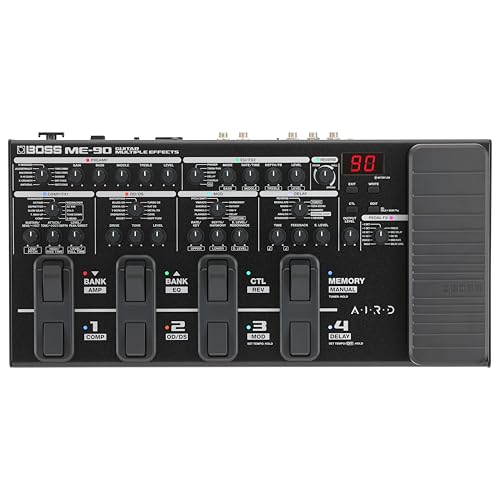
- 60 effects and 11 AIRD amp models
- Eight footswitches and expression pedal
- Battery-powered with intuitive knob controls
Best For: Performers who want quick, physical tone adjustments onstage
Flexible Tone Hub

- 200 presets with 55 amp models and 26 cabinet simulations
- Four footswitches plus expression pedal for live control
- Looper, drum machine, USB-C, and OTG recording
Best For: Players needing broad tones and extensive live control
Portable Performance Choice

- Compact BOSS GT-series sound engine
- Up to seven hours on four AA batteries
- Assignable control switch and expression pedal
Best For: Mobile gigs, busking, and beginner-friendly setups
Practice-to-Stage Workhorse

- 71 effects, 13 amp models, and included expression pedal
- 30-second looper and 68 rhythm patterns
- AUX input, headphone monitoring, and Guitar Lab support
Best For: Players combining practice, songwriting, and compact live rigs
Most Versatile – HeadRush Core
The HeadRush Core is a feature-rich choice for guitarists and singers comparing guitar effects processors for live performances. Its amp modeling, vocal processing, touchscreen interface, Neural Amp Modeler support, looper, drum machine, and flexible connectivity make it suitable for complex live rigs.
Best For: Guitarists who also sing, use multiple stage devices, or need amp cloning and extensive connectivity.
Pros:
- Combines guitar effects, amp modeling, vocal effects, Auto-Tune, looping, and drum patterns.
- Supports Neural Amp Modeler captures, third-party impulse responses, and Smart Amp Cloner functionality.
- Offers stereo outputs, XLR microphone input, MIDI, an FX loop, USB audio, Wi-Fi, and Bluetooth.
- Gapless preset switching with reverb and delay spillover helps maintain smooth transitions.
Cons:
- Its large feature set may require more setup time than a simpler pedal.
- It is corded and weighs about 3.9 kg.
The Core is a strong all-in-one solution when a live performer needs more than guitar tones. Its vocal tools, capture features, and broad I/O make it especially adaptable for demanding stage setups.
Best Touchscreen Workflow – BOSS GX-100
The BOSS GX-100 offers a streamlined approach to guitar effects processors for live performances, pairing a color touch display with a rugged metal chassis. Its 32 amplifier types, more than 170 BOSS effects, flexible routing, and assignable controls provide substantial stage-ready tone-shaping options.
Best For: Guitarists and bassists who prioritize intuitive editing, flexible routing, and hands-on control.
Pros:
- Provides 32 amp types and over 170 effects derived from the BOSS GT-1000.
- Uses 15 assignable blocks for flexible signal-chain design.
- Includes onboard speaker options and support for WAV speaker impulse responses.
- Features a color touchscreen, assignable footswitches, an expression pedal, and toe switch.
Cons:
- Bluetooth audio and mobile-device editing require the optional Bluetooth Audio MIDI Dual Adaptor.
- Its broad routing and assignment options may take time to configure.
The GX-100 is a practical middle ground for performers who want advanced BOSS processing without giving up an accessible interface. The touchscreen and freely assignable controls are particularly useful when changing or refining sounds at rehearsals and shows.
Best Value Feature Set – Donner Arena 2000
The Donner Arena 2000 packs a broad collection of effects, amp simulations, cabinet simulations, looping, and drum rhythms into a compact pedal. For shoppers comparing guitar effects processors for live performances, its XLR outputs, MIDI, expression control, and cabinet-simulation options make it a flexible budget-oriented setup.
Best For: Players who want many built-in sounds and practical live connections in a compact processor.
Pros:
- Includes 278 effect types, 80 amp simulations, and 50 cabinet simulations.
- Provides 50 built-in IRs plus space for 50 additional third-party IRs.
- Offers a 60-second looper, 40 drum rhythms, customizable CTRL mode, and expression control.
- Includes XLR L/R, MIDI, USB-C, aux input, and selectable cabinet-simulation output.
Cons:
- It does not include a battery compartment.
- The headphone output is recommended for headphones rated at 32–64 ohms.
- Its 24-bit/44.1 kHz processing is lower-rate than some flagship processors.
The Arena 2000 is well suited to performers who need a wide palette without a large floorboard. Its direct XLR connectivity, cabinet simulation, and rhythm tools support both conventional band setups and solo performance use.
Best Professional Processing – BOSS GT-1000
BOSS GT-1000 Guitar Effects Processor | Industry-Leading Guitar Effects Processor
Check Price On AmazonThe BOSS GT-1000 is designed for players who want professional-grade guitar effects processors for live performances. Its 96 kHz processing, comprehensive BOSS effects library, fast patch switching, dedicated bass mode, and extensive control options make it a serious performance-focused platform.
Best For: Professional guitarists and bassists who need high-fidelity processing, deep control, and seamless patch changes.
Pros:
- Uses 32-bit AD/DA conversion, 32-bit floating-point processing, and a 96 kHz sampling rate.
- Provides a large BOSS effects library, including MDP effects and newer algorithms.
- Fast patch switching with delay carryover helps preserve performance continuity.
- Includes ten footswitches, six knobs, an expression pedal, Bluetooth, MIDI, USB, and external-control support.
Cons:
- Its professional feature set may be more than casual players need.
- At about 8 pounds, it is heavier than the Donner Arena 2000.
- The supplied dimensions indicate a comparatively large floor unit.
The GT-1000 is a strong choice when response, fidelity, and control matter more than a minimal setup. Its dedicated bass mode and multiple external-control options also make it adaptable for players managing complex live rigs.
Best All-in-One Stage Rig – Valeton GP-200
The Valeton GP-200 is a strong choice among guitar effects processors for live performances when you want extensive modeling, flexible routing, and built-in performance tools in one rugged unit. Its color display, customizable footswitch layout, expression pedal, and large preset capacity are suited to fast changes onstage.
Best For: Guitarists and bassists who need broad amp and effect modeling, looping, rhythm patterns, and USB recording in a single stage-ready processor.
Pros:
- Offers more than 240 effects, including 140-plus amp and cabinet models, with up to 11 simultaneous modules.
- Includes 256 patch slots, 20 user cabinet IR locations, a 180-second looper, drum machine, and chromatic tuner.
- Provides flexible connections and a 6-in/4-out USB-C audio interface with loopback and re-amping support.
- Uses a durable metal chassis and includes a built-in expression pedal plus a protective gig bag.
Cons:
- Its extensive feature set may require more setup time than a simpler pedal-based processor.
- The unit is relatively substantial at about 2.37 kg, which may matter for lightweight rigs.
The GP-200 is particularly compelling for performers who want one device to cover tones, practice functions, recording, and stage control without adding multiple pedals.
Best Pedalboard Command Center – Line 6 HX Effects
The Line 6 HX Effects is designed for guitarists who want a powerful effects controller integrated into an existing amp-and-pedal setup. For guitar effects processors for live performances, its capacitive footswitches, LED rings, and scribble strips make patch and effect control easier to manage onstage.
Best For: Players who already use an amplifier and want a central pedalboard controller with modern HX effects and legacy Line 6 sounds.
Pros:
- Includes more than 100 HX effects and supports up to nine effects simultaneously.
- Adds legacy effects from the M13, M9, M5, DL4, MM4, FM4, and DM4 families.
- Capacitive-sensing footswitches, LED rings, and scribble strips support clear live operation.
- Can act as the command center for an amp and pedal rig.
Cons:
- It focuses on effects and rig control rather than offering the supplied notes’ dedicated amp-modeling and IR-loading features.
- It requires a DC power supply and is heavier than some compact pedal-format options.
The HX Effects makes the most sense when your core tone comes from an existing amp or pedal setup and you want centralized, hands-on control over a wide effects library.
Best Hands-On Operation – BOSS ME-90
BOSS ME-90 Guitar Multi-Effects Guitar Processor | All-In-One Guitar Processor
Check Price On AmazonThe BOSS ME-90 combines multi-effects flexibility with a straightforward, knob-based interface that suits quick tone changes during rehearsals and shows. It is a practical option among guitar effects processors for live performances, especially for players who prefer stompbox-style control and a battery-powered design.
Best For: Performing guitarists who want accessible hands-on editing, built-in amp modeling, an effects loop, and a compact all-in-one setup.
Pros:
- Provides 60 effects, 11 AIRD amp models, IR loading, an effects loop, and seven simultaneous effect categories.
- Eight multi-function footswitches and a redesigned expression pedal offer broad performance control.
- Runs on batteries or external power and includes 36 preset and 36 user patch locations.
- Supports editing through BOSS Tone Studio, with optional Bluetooth audio and MIDI connectivity.
Cons:
- The supplied notes list fewer effects and patch locations than the Valeton GP-200.
- Bluetooth functionality requires the optional Bluetooth Audio MIDI Dual Adaptor.
The ME-90 is a well-rounded choice for players who value immediate knob access and reliable foot control over a menu-heavy editing experience.
Flexible Tone Hub – MOOER GE150 Pro
For guitarists comparing guitar effects processors for live performances, the MOOER GE150 Pro combines broad tone coverage with hands-on control. Its four footswitches, expression pedal, looper, drum machine, and 200 presets make it well suited to set changes and live experimentation.
Best For: Players who want extensive amp modeling, flexible foot control, and built-in looping and rhythm tools.
Pros:
- Offers 200 factory presets, 55 amp models, 26 cabinet simulations, and 20 amp and cab sample slots.
- Four multifunction footswitches and an expression pedal support patch changes and real-time parameter control.
- Includes an 80-second stereo looper, 40 drum rhythms, tuner, AUX input, headphone output, and USB-C/OTG recording.
Cons:
- The standard version is corded rather than battery powered.
- Its extensive features may require more setup time than a simpler effects unit.
The GE150 Pro is a feature-rich choice when live flexibility matters more than minimal controls. Its connectivity and onboard rhythm tools also make it useful for practice, recording, and quick idea capture.
Portable Performance Choice – BOSS GT-1
The BOSS GT-1 is a compact option for guitarists seeking guitar effects processors for live performances without carrying a large floor unit. Its GT-series sound engine, assignable control switch, expression pedal, and battery operation support mobile gigs and quick patch changes.
Best For: Buskers, beginners, and mobile players who want recognizable BOSS effects in a lightweight battery-powered format.
Pros:
- Provides access to a broad selection of BOSS amps and effects in a compact floor unit.
- Four AA batteries offer up to seven hours of playing time for mobile use.
- Easy Select and Easy Edit functions simplify patch selection and tone adjustments.
Cons:
- The supplied notes do not specify the number of onboard effects or amp models.
- Its compact control layout may offer less immediate switching flexibility than larger multi-effects units.
The GT-1 prioritizes portability and straightforward operation. It is a practical fit when battery life, light weight, and quick access to BOSS tones are central to your setup.
Practice-to-Stage Workhorse – Zoom G1X FOUR
The Zoom G1X FOUR gives players a compact way to explore guitar effects processors for live performances while retaining useful practice features. Its 71 effects, 13 amp models, expression pedal, looper, and rhythm patterns cover everyday playing and small live applications.
Best For: Players who want an affordable-feeling, practice-friendly unit with built-in rhythms, looping, and expression control.
Pros:
- Includes 71 effects, 13 amp models, and an expression pedal for tone shaping.
- The 30-second looper and 68 rhythm patterns support rehearsal and live experimentation.
- AUX input, amp or headphone monitoring, and Guitar Lab software add flexibility for practice and editing.
Cons:
- Its 30-second looper is shorter than the MOOER GE150 Pro’s 80-second looper.
- It provides fewer listed amp models and effects than the MOOER GE150 Pro.
- The supplied notes do not detail dedicated live patch-switching controls beyond the unit’s general interface.
The G1X FOUR is especially appealing when looping and rhythm practice are as important as effects. It offers a compact feature set for players moving between home practice, songwriting, and live use.
How We Picked the Best Guitar Effects Processors for Live Performances
We evaluated these processors based on the features that matter most onstage: sound quality, preset organization, footswitch access, expression control, amp and cabinet modeling, routing flexibility, and connection options. We also considered practical details such as USB audio, MIDI, XLR or balanced outputs, looper and drum tools, onboard editing, and portability.
The selection covers several use cases rather than a single “best” design. Some models focus on deep professional routing, while others emphasize quick operation, compact size, vocal support, or strong value for beginners and gigging players.
Quick Comparison
- Best all-in-one versatility: HeadRush Core combines guitar and vocal processing with a touchscreen-oriented workflow.
- Best for advanced routing: BOSS GT-1000 offers extensive control for complex stage rigs.
- Best compact professional option: Line 6 HX Effects is well suited to players who already use an amplifier or modeler.
- Best value-focused choices: Donner Arena 2000, MOOER GE150 Pro, and Zoom G1X Four pack substantial features into lower-cost formats.
- Best straightforward operation: BOSS ME-90 favors hands-on controls and fast adjustments.
Key Buying Factors for Guitar Effects Processors for Live Performances
Footswitch Layout and Preset Control
Live use requires quick changes without menu diving. Look for enough footswitches for snapshots, scenes, effects, or patch navigation. Assignable switches and bank controls are especially useful when songs require multiple sounds.
Outputs, Routing, and Monitoring
Check whether the processor connects directly to a PA, mixer, amplifier, or powered speaker. Balanced outputs, XLR connections, stereo routing, effects loops, and headphone outputs can make a major difference in setup flexibility. USB audio is valuable for recording, practice, and firmware management.
Amp Modeling, Cabinet Simulation, and IR Support
If you perform direct to front-of-house, convincing amp and cabinet modeling is essential. IR loading expands your tonal options, while flexible signal chains let you place drives, modulation, delays, and reverbs where they work best.
Editing, Reliability, and Portability
Touchscreens and computer editors can speed programming, but physical knobs may be faster during rehearsals or performances. Favor sturdy construction, dependable switching, readable displays, and a size that fits your board or travel setup.
Who Should Buy Which Guitar Effects Processors for Live Performances?
Choose HeadRush Core if you want a modern all-in-one system with guitar and vocal capabilities. Choose BOSS GT-1000 or GX-100 for sophisticated effects, modeling, and stage control, with the GT-1000 aimed more at demanding multi-device rigs and the GX-100 offering a streamlined advanced workflow.
Choose Line 6 HX Effects if you mainly need premium effects and flexible integration with an existing amp or modeler. Choose BOSS ME-90 for hands-on operation, or BOSS GT-1 when portability and a compact backup matter most.
Choose Valeton GP-200 for a feature-rich guitar-and-bass-friendly floor unit with direct recording features. Choose Donner Arena 2000 or MOOER GE150 Pro when you want broad modeling and effects at a value-oriented price. Choose Zoom G1X Four for an affordable, compact option with an expression pedal and practice-friendly features.