
Plastic welders can make cracked bumpers, tanks, bins, panels, and household parts repairable instead of disposable. The best kits combine dependable heat, useful attachments, and enough staples or rods to handle common DIY jobs.
We compared 10 plastic welding kits for home workshops, focusing on versatility, temperature or power control, included accessories, safety, and ease of use. Use the guide below to narrow the options for your projects and experience level.
Best 10 Plastic Welders for Home Workshops Picks for 2026
Best Overall Staple Kit

- 1,000 stainless-steel staples in six types
- Rapid one- to two-second staple heating
- Includes pliers and a carry case
Best For: Home mechanics handling varied plastic repairs
Best 2-in-1 Accessory Set

- Includes hot cutting and smoothing tips
- 800 staples plus 38 welding rods
- Overheating protection and UL-certified cord
Best For: DIYers wanting multiple plastic-repair functions
Best Safety-Focused Option

- UL-certified tool, factory, and process
- Includes triangle tips, mesh, tape, rods, and sandpaper
- Supports many common plastic types
Best For: Occasional repairs with certification as a priority
Best for Smoothing Repairs

- Combines a welding gun and soldering iron
- Reaches up to 800°F within five minutes
- Includes 1,000 hot-staple repair pieces
Best For: Plastic repairs that need reinforcement and surface cleanup
Best Value Kit

- UL-certified 80W welding iron
- Includes rods, mesh, tape, and tools
- Two interchangeable repair tips
Best For: DIY repairs on automotive, recreational, and household plastics
Most Versatile
220W Plastic Welder and Hot Stapler

- 220W rapid-heating design
- Rod welding and hot-staple modes
- 1,000 staples and multiple rod types
Best For: Mixed plastic repairs requiring varied materials and reinforcement
Best for Staple Repairs

- Rapid-heating hot-staple design
- 200 staples in four shapes
- Built-in LED and included pliers
Best For: Crack repairs on automotive and household plastic parts
Versatile Starter Pick

- Three temperature settings
- 56 rods for multiple plastics
- Includes soldering and welding tips
Best For: DIYers handling varied plastic repairs
Organized Hot-Staple Specialist
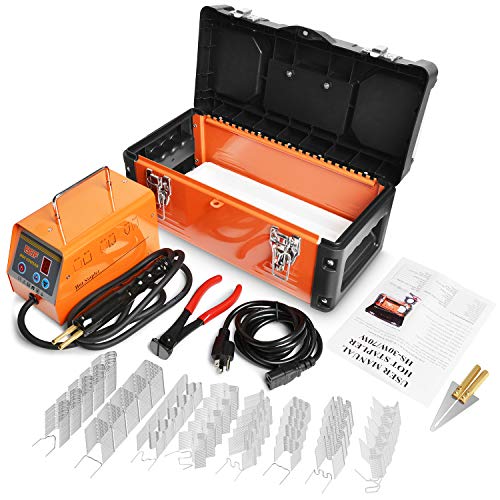
- Five power levels with LED display
- Includes 800 repair staples
- Comes with a storage toolbox
Best For: Repeated crack-reinforcement projects
Fast Dual-Repair Option
SEESII 150W 2-in-1 Plastic Welder

- 150W rapid-heating welding gun
- Separate 60W finishing soldering iron
- Includes 200 staples and 20 rods
Best For: Bumper and structural plastic repairs
Best Overall Staple Kit – ATOLS Upgraded Plastic Welder
For home workshops seeking versatile plastic welders for home workshops, the ATOLS kit is built around hot-staple reinforcement. It includes six staple styles and is designed for repairs ranging from bumpers and dashboards to radiators, handles, headlights, and other plastic parts. The front light, ergonomic rubber handle, and included case make it practical for repeated repair work.
Best For: Home mechanics and DIY users repairing cracks, tabs, corners, and broken plastic components.
Pros:
- Includes 1,000 stainless-steel staples in six shapes and sizes.
- Heats staples in about one to two seconds.
- Supplied with pliers and a portable carry case.
- Front operating light and rubberized handle support easier handling.
Cons:
- It is a corded AC tool, so it requires access to an outlet.
- The kit is focused on staple welding rather than a dedicated plastic-rod welding setup.
Choose this ATOLS model when staple quantity and repair versatility matter most. Its broad accessory selection makes it a strong all-around option for a home repair bench.
Best 2-in-1 Accessory Set – Allturn 2-in-1 Plastic Welder
The Allturn combines hot-staple repair with hot cutting and smoothing accessories, making it one of the more flexible plastic welders for home workshops. Its 100W tool reaches high staple temperatures quickly, while the kit adds welding rods, 800 staples, a knife, smoothing tips, pliers, and other supplies for broader DIY work.
Best For: DIY users who want one kit for staple reinforcement, plastic smoothing, cutting, and rod-based repairs.
Pros:
- Includes an M8 hot cutting tip and two M6 smoothing tips.
- Comes with 38 plastic welding rods and 800 staples in four styles.
- Staples heat in one to two seconds, according to the supplied notes.
- Internal overheating protection and a UL-certified power cord add useful safety features.
Cons:
- The hot cutting and smoothing tips should not be used continuously for more than five minutes at a time.
- At 3.39 pounds, it is heavier than some compact options.
The Allturn is a compelling choice when accessory range matters more than minimum size. Allow the auxiliary tips to cool as directed, and it can cover a wide variety of workshop plastic tasks.
Best Safety-Focused Option – JOUNJIP 80W Plastic Welder
For shoppers prioritizing certification and straightforward operation, the JOUNJIP is a compact 80W choice among plastic welders for home workshops. It heats to 525°F and includes triangle tips, wire mesh, aluminum tape, welding rods, and sandpaper for repairs on bumpers, kayaks, tanks, dashboards, headlights, toys, and other compatible plastics.
Best For: Home users who value UL certification, a compact tool, and a basic rod-welding repair setup.
Pros:
- The welder, factory, and production process are UL certified.
- Includes two triangle tips, mesh, tape, rods, and sandpaper.
- Supports repairs involving HDPE, LDPE, PP, ABS, PE, TPO, PA, and other plastics.
- Backed by a one-year manufacturer warranty and stated US customer service.
Cons:
- The 80W design heats to 525°F in a few minutes rather than offering rapid staple heating.
- The standard kit includes only 20 black welding rods.
- It is a corded tool with a 70-inch cord.
This JOUNJIP kit suits buyers who prefer a conventional plastic-welding iron and want certification details clearly stated. It is especially practical for occasional repairs using rods, mesh, or tape.
Best for Smoothing Repairs – RX WELD 2-in-1 Plastic Welder
The RX WELD pairs a 100W hot-staple plastic welding gun with a soldering iron, giving home workshops two tools for repairing and finishing plastic. The gun addresses cracks, while the soldering iron is intended to smooth plastic scars. It is suited to bumpers, dashboards, kayaks, canoes, toys, fuel tanks, and DIY plastic projects.
Best For: Users who want to reinforce cracks and clean up the visible surface of a plastic repair.
Pros:
- Combines a plastic welding gun and soldering iron in one kit.
- Designed to reach up to 800°F within five minutes.
- Includes 1,000 hot-staple repair pieces, according to the product title.
- Includes a one-year quality guarantee and stated 24-hour problem-resolution support.
Cons:
- The product notes do not specify the included staple shapes or a detailed accessory breakdown.
- It is a corded 110V tool.
- The maximum temperature is reached within five minutes, not immediately.
The RX WELD stands out when the finish after welding matters as much as the structural repair. Its paired tools can reduce the need to buy a separate smoothing tool for home plastic projects.
Best Value Kit – Deluxe 80W Plastic Welder
For home workshops seeking plastic welders for home workshops, the JOUNJIP Deluxe Kit offers an 80W airless welding iron, interchangeable tips, and materials for common automotive, recreational, and household repairs. Its UL certification and broad accessory selection make it a practical DIY option.
Best For: DIY repairs on bumpers, kayaks, tanks, bins, outdoor furniture, toys, and other thermoplastic items.
Pros:
- UL-certified welder with an 80W professional-grade iron.
- Includes PP and PolyPlaz rods, reinforcing mesh, tape, sandpaper, and a wire brush.
- Two interchangeable tip styles support different repair tasks.
Cons:
- Temperature can vary with the work-area temperature.
- Its 525°F maximum may require careful technique on different plastics.
The included materials and two tip designs provide useful flexibility for occasional home repairs. Choose it if you want a well-equipped, safety-certified kit rather than a stapler-focused tool.
Most Versatile – 220W Plastic Welder and Hot Stapler
This 220W kit is aimed at home workshops that need plastic welders for home workshops with rapid heating and multiple repair methods. It combines plastic-rod welding with hot-staple reinforcement and includes a large assortment of staples, rods, and accessories.
Best For: Frequent repairs on bumpers, dashboards, motorcycles, kayaks, toys, recycling bins, and plastics including ABS, PP, TPO, TPE, and related materials.
Pros:
- 220W output is designed for faster heating.
- Supports both plastic rods and embedded hot staples.
- Includes 1,000 hot staples, 100 plastic rods, mesh, pliers, and smoothing tips.
- LED headlamp, non-slip handle, and overheat protection support easier operation.
Cons:
- The large accessory count may be more than occasional users need.
- Requires a corded 110V connection.
With two repair techniques and a broad selection of consumables, this is the most adaptable choice in the group. It suits users who expect to repair different plastic types and want hot-staple reinforcement available.
Best for Staple Repairs – WEP 960-V LED Plastic Welder
The WEP 960-V is a focused hot-staple tool for home workshops comparing plastic welders for home workshops. It rapidly heats shaped staples that can join cracks in bumpers, dashboards, gas tanks, and other ABS plastic parts, with an integrated LED for visibility.
Best For: Straightforward crack repairs on automotive and household plastic parts using hot staples.
Pros:
- Includes 200 staples in four shapes for different crack patterns.
- Built-in LED helps illuminate the repair point.
- Compact kit includes pliers for trimming excess staples.
- Overheating protection and one-year USA technical support are included.
Cons:
- Focuses on hot-staple repairs rather than plastic-rod welding.
- Supplied staple quantity is smaller than the larger 220W kit.
- Designed for 110–127V USA power and should not be connected to 220V.
This is a sensible pick when your main goal is joining cracks quickly with embedded staples. Its LED and included pliers add convenience, but users needing rod-based repairs should consider a more comprehensive kit.
Versatile Starter Pick – 100W 2-in-1 Plastic Welder
For home workshops needing flexible plastic welders for home workshops, this 100W corded kit combines plastic repair and soldering functions in a compact gun-style tool. Three temperature settings, multiple tips, and rods for several plastic types make it suitable for varied household, automotive, and recreational repairs.
Best For: DIYers repairing car bumpers, dashboards, kayaks, and assorted plastic items.
Pros:
- 100W heating element reaches working temperature quickly.
- Three adjustable temperature settings provide more control.
- Includes 56 rods covering ABS, PP, PE, TPE, PC, PUR, and PA plastics.
- 2-in-1 design supports plastic welding and soldering tasks.
Cons:
- It is corded, so use is limited by access to an outlet.
- The manufacturer notes that the new tool may produce a small amount of first-use smoke.
This is a practical all-around option when a home workshop needs one portable tool for surface repairs and plastic filler work. Its broad rod selection is especially useful for occasional projects involving different plastic materials.
Organized Hot-Staple Specialist – 5-Level Plastic Repair Welder
This hot-stapler kit is a focused choice among plastic welders for home workshops, using heated stainless-steel staples to reinforce cracked plastic. Its five-level power adjustment, LED power display, and included toolbox make it well suited to repeated repair sessions involving automotive and recreational equipment.
Best For: Workshop users reinforcing cracked bumpers, motorcycle panels, boat parts, and other plastic components.
Pros:
- Five adjustable power levels help limit excessive heat and plastic penetration.
- LED screen displays the selected power level.
- Includes 800 staples, a cutter, and a triangular smoothing electrode.
- Toolbox, long handle, and light support organized, portable use.
Cons:
- This kit focuses on staple-based reinforcement rather than plastic-rod welding.
- At 9.86 pounds, it is substantially heavier than the other listed options.
Choose this model when structural crack reinforcement is the priority. The large staple supply and storage case add convenience for ongoing projects, while adjustable power gives more control over different plastic repair jobs.
Fast Dual-Repair Option – SEESII 150W 2-in-1 Plastic Welder
For demanding plastic welders for home workshops, the SEESII pairs a 150W hot-stapler with a separate 60W soldering iron. Rapid staple heating, filler rods, and finishing accessories let users reinforce cracks from the inside before smoothing the repair surface.
Best For: DIYers and garage users repairing thick bumpers, dashboards, kayaks, toys, and similar plastic parts.
Pros:
- 150W welding gun is designed for thick bumpers and structural reinforcement.
- Hot stapler heats staples to 600°C in about three seconds, according to the supplied specifications.
- Separate 60W soldering iron supports filler-rod repairs and surface finishing.
- Includes 200 assorted staples, 20 rods, pliers, a utility knife, and sandpaper.
Cons:
- The kit uses separate welding and soldering tools, which requires managing more equipment.
- The included rod quantity is smaller than the 56-piece rod assortment in the 100W kit.
This is the strongest fit for users who want both rapid internal reinforcement and a smoother finished surface. Its lightweight tools and broad accessory set make it approachable for beginners while retaining useful capability for workshop repairs.
How We Picked These Plastic Welders for Home Workshops
We focused on kits designed for practical repairs rather than industrial fabrication. Selection criteria included heating performance, power options, control features, included hot-staple styles, plastic-welding tips, rods, pliers, storage, and overall versatility. We also considered whether a kit supports both reinforcement with heated staples and conventional plastic welding with a hot tip or rod.
Because workshop needs vary, the list includes compact 80W-class tools, higher-powered models, 2-in-1 kits, and options with adjustable output. UL-listed or UL-certified construction is a useful advantage, but buyers should still follow the manufacturer’s operating and cooling instructions.
Quick Comparison
| What to Compare | Best For | Why It Matters |
|---|---|---|
| Power rating | Light to heavy repairs | Higher wattage can shorten heat-up time and help with thicker plastic, though technique remains important. |
| 2-in-1 design | Mixed repair jobs | Combines hot stapling with tip-based plastic welding or soldering. |
| Adjustable control | Different plastic types | Helps reduce scorching on thin parts and improve control on thicker sections. |
| Accessory count | Frequent DIY repairs | Extra staples, rods, tips, and pliers reduce the need for immediate replacement purchases. |
Key Buying Factors for Plastic Welders for Home Workshops
Power and Heat Control
Choose an 80W to 100W tool for occasional repairs such as small cracks, trim, and household plastic. A 150W or 220W model may be more suitable for repeated automotive work or thicker components. Adjustable power or temperature is especially helpful when working with varied plastics.
Staple and Tip Selection
Hot staples reinforce cracks from the back and are often the fastest way to stabilize a damaged bumper or enclosure. Look for multiple staple shapes, including flat, wave, and corner styles. A kit with interchangeable tips and plastic rods offers more flexibility for filling gaps and rebuilding edges.
Ergonomics, Visibility, and Safety
LED work lights, comfortable grips, organized storage, and accessible controls make repairs easier. Check cord length and voltage compatibility before buying. Use eye protection, ventilation, heat-resistant gloves, and a nonflammable work surface; melted plastic and hot staples can cause burns and fumes.
Who Should Buy Which Plastic Welders for Home Workshops?
Occasional home users: Choose a straightforward 80W or 100W kit with basic staples and a few welding tips. It should cover small household repairs without unnecessary complexity.
Automotive DIYers: A 2-in-1 kit with a larger staple assortment, pliers, rods, and higher power is the better fit for bumper covers, brackets, and interior trim.
Frequent workshop users: Prioritize adjustable output, rapid heating, durable construction, broad accessory compatibility, and a storage case. A higher-powered model can save time, but only if it offers enough control for delicate plastics.
Before ordering, confirm replacement staple availability and check the tool’s voltage, warranty, and included accessories. Matching the welder to the plastic thickness and repair method will matter more than choosing the highest wattage alone.