
Choosing the right solder can make stained glass work feel much easier from the start. For beginners, the best option is usually a dependable alloy that flows smoothly, bonds well, and gives you enough working time to build neat seams.
This roundup focuses on beginner-friendly choices across solder, flux, and starter kits so you can match the product to your project style and skill level.
Best 10 Stained Glass Solder for Beginners Picks for 2026
Classic Starter Solder
Canfield 60/40 Solder for Stained Glass

- 60/40 tin-lead blend for stained glass
- Melting range of 360°–376°F
- 1 lb spool made in the USA
Best For: Beginners who want a classic 60/40 solder spool
Easy-Clean Flux Choice
IMPRESA Liquid Zinc Flux for Stained Glass

- Liquid zinc flux for stained glass work
- Brush included for easier application
- Water-soluble cleanup within 6 to 8 hours
Best For: Beginners who want a brush-included flux with simple cleanup
Thicker Wire Option
ANOSON 60/40 Solder, 3mm, 1 lb Spool

- 60/40 alloy for copper foil stained glass
- 3 mm wire with smooth flow
- 1 lb spool backed by a 1-year warranty
Best For: Beginners who prefer a thicker solder wire
Full Starter Kit
Stained Glass Kit with 100W Iron and Solder

- Includes 100W soldering iron and 2 mm solder wire
- Covers cutting, foiling, and soldering tools
- Best for starting from scratch
Best For: Beginners who want an all-in-one stained glass kit
Premium Smooth-Flow Option
AIM Artist Pure 60/40 Stained Glass Solder

- Smooth flow with longer liquid stage
- Designed for copper foil and came lead
- 1 lb spool with 3 mm wire
Best For: Beginners who want a traditional, smooth-beading solder
Lead-Free Practice Wire
2.0mm Lead Free Solder Wire for Stained Glass Craft
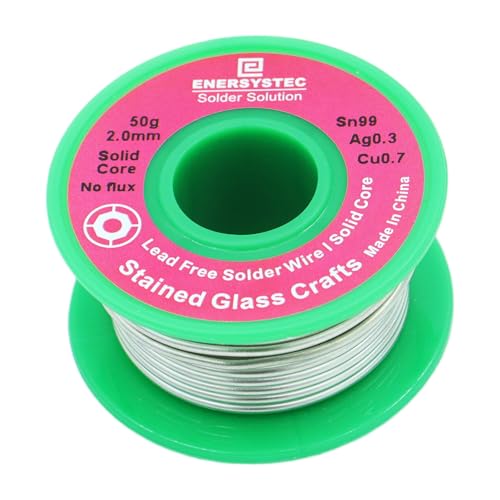
- Lead-free Sn99 Ag0.3 Cu0.7 alloy
- No flux core; requires extra flux
- 50 g spool for craft and training use
Best For: Beginners who want a lead-free solder for practice
Beginner-Friendly Traditional Pick
AIM Artist Pure 50/50 Stained Glass Solder
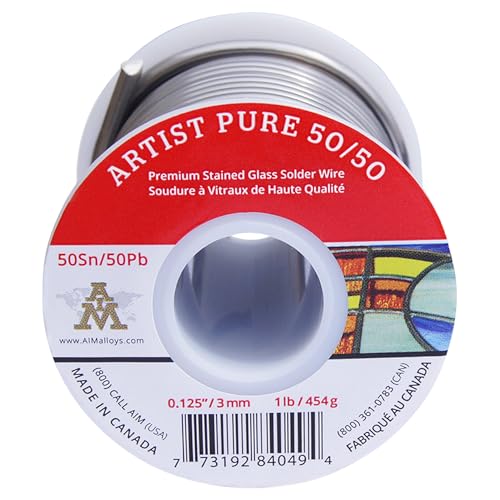
- Explicitly ideal for beginners and experienced artisans
- Widest pasty range in the Artist Pure line
- Works with lead came and repairs
Best For: New hobbyists who want a traditional 50/50 solder
Starter Kit Pick
All-in-One Stained Glass Beginner Kit

- 100W adjustable soldering iron included
- Comes with solder wire, flux, and copper foil
- Also includes cutters, pliers, and file
Best For: New crafters who want a full stained glass starter set
Bulk Solder Pick
1 lb 60/40 Solder Wire for Stained Glass

- Standard 60/40 tin-lead formula
- Large 1 lb spool for repeat use
- 3mm solid-core wire for stained glass
Best For: Beginners who already have tools and want a large solder supply
Small Spool Pick
100g 60/40 Solder Wire for Stained Glass

- Compact 100g spool for light use
- 60/40 solid-core formula for stained glass
- 3mm wire with 183-190°C melting range
Best For: Beginners who want a smaller practice spool
Classic Starter Solder – Canfield 60/40 Solder for Stained Glass
If you want stained glass solder for beginners that behaves predictably, this Canfield 60/40 spool is a straightforward place to start. The 60/40 blend is designed for stained glass work, with a relatively low melting range that helps make soldering easier to control while learning copper foil techniques.
Best For: Beginners who want a classic 60/40 solder spool made in the USA.
Pros:
- 60% tin / 40% lead blend made for stained glass soldering
- Low melting temperature range of 360°–376°F
- 1 lb spool gives you a practical amount for practice and projects
- Made in the USA using virgin material
Cons:
- Contains lead, so handling and cleanup matter
- No flux or other accessories included
For beginners focused on learning the soldering step itself, this is a simple, purpose-built solder option without extra complexity. It’s a solid pick if you want one spool to practice with and understand how standard stained glass solder flows.
Easy-Clean Flux Choice – IMPRESA Liquid Zinc Flux for Stained Glass
When shopping for stained glass solder for beginners, flux is the product that helps prep surfaces for a cleaner bond. This IMPRESA liquid zinc flux is made for stained glass supplies and is designed to work with copper, zinc, and lead foil, with a brush included for easier application.
Best For: Beginners who want an easy-to-apply liquid flux with quick cleanup.
Pros:
- Compatible with copper, zinc, and lead foil
- Includes a precision brush for controlled application
- Water-soluble formula allows cleanup within 6 to 8 hours
- Made in the USA
Cons:
- It is flux, not solder wire
- Needs timely cleanup after use
For a beginner’s stained glass setup, flux is essential support gear rather than the main soldering material. This bottle stands out for its brush-in-cap style convenience and water-soluble cleanup, which can make the learning process less messy.
Thicker Wire Option – ANOSON 60/40 Solder, 3mm, 1 lb Spool
This ANOSON spool is another stained glass solder for beginners option, especially if you want a slightly thicker 3 mm wire format. The 60/40 alloy is described as ideal for copper foil work, with a low melting point and smooth flow that can help new makers build cleaner solder lines.
Best For: Beginners who want a 3 mm 60/40 solder wire with smooth flow.
Pros:
- 60/40 tin-lead alloy intended for copper foil stained glass
- 3 mm diameter can be easier to handle for some projects
- Low melting point and smooth flow support easier soldering
- 1 lb spool with a 1-year warranty
Cons:
- Contains lead
- Thicker 3 mm wire may not suit every soldering style
If you want a standard stained glass solder with a bit more body in the wire, this is a practical choice. The controlled high-purity alloy and warranty add reassurance for someone still learning what good solder flow should feel like.
Full Starter Kit – Stained Glass Kit with 100W Iron and Solder
If you’re looking for stained glass solder for beginners and want more than just solder, this kit bundles the core tools into one package. It includes a 100W soldering iron, 2 mm 60/40 solder wire, copper foil tape, flux paste, cutters, pliers, and several accessories for cutting, foiling, and soldering glass projects.
Best For: Beginners who want a full stained glass starter kit with soldering tools included.
Pros:
- Includes 100W soldering iron plus 2 mm 60/40 solder wire
- Comes with copper foil tape, flux paste, and multiple hand tools
- Provides cutters, pliers, gloves, files, and a carry bag for setup
- Soldering iron has adjustable temperature and multiple replacement tips
Cons:
- More than a simple solder purchase if you only need wire
- Kit may include more tools than a casual beginner needs
This is the broadest beginner-friendly option in the group because it covers the full stained glass workflow, not just soldering. It makes sense if you want to start from scratch and prefer one kit instead of buying each tool separately.
Premium Smooth-Flow Option – AIM Artist Pure 60/40 Stained Glass Solder
If you’re comparing stained glass solder for beginners, this 60/40 wire is a strong choice when you want a smooth, controllable bead. It is made with high-purity virgin metals and is designed for copper foils and came lead, with a melting range that stays liquid a bit longer to help you shape cleaner lines.
Best For: Beginners who want a smooth-flowing solder for copper foil and came work.
Pros:
- Designed for stained glass work with copper foils and came lead
- Liquidous stage lasts longer for smoother, cleaner beads
- Made with high-purity virgin metals for consistent flow
- 1 lb spool gives plenty of material for practice and projects
Cons:
- Contains lead and includes a Proposition 65 warning
- 3 mm wire may be more material than some very fine-detail jobs need
- Not a lead-free option
Overall, this is a practical pick if you want a traditional stained glass solder that prioritizes smooth flow and bead control. It suits beginners who are comfortable using a leaded alloy and want a dependable wire for learning clean solder lines.
Lead-Free Practice Wire – 2.0mm Lead Free Solder Wire for Stained Glass Craft
This lead-free option is worth a look if you want stained glass solder for beginners and prefer to avoid leaded alloys. It uses a solid-core Sn99 Ag0.3 Cu0.7 formula with no flux core, so you’ll need extra flux to get better flowability and a cleaner joint.
Best For: Beginners who want a lead-free solder wire for stained glass practice and craft projects.
Pros:
- Lead-free Sn99 Ag0.3 Cu0.7 alloy
- No flux core, which can be useful for controlled practice with added flux
- Designed for stained glass craft, solder training, and DIY projects
- Solid-core 2.0 mm wire in a small 50 g spool
Cons:
- No flux core means you must use extra flux separately
- 50 g spool is smaller than many full-size solder options
- May be less convenient than flux-core wire for quick beginners’ setup
For learners who want to practice with a lead-free material, this wire is straightforward and purpose-built. Just plan on using flux with it, since the product notes specifically say better flowability comes with extra flux.
Beginner-Friendly Traditional Pick – AIM Artist Pure 50/50 Stained Glass Solder
For stained glass solder for beginners, this 50/50 alloy is a practical traditional choice because the manufacturer specifically says it is ideal for both beginners and experienced artisans. It offers the widest pasty range in the Artist Pure line and is suited to lead came work as well as general-purpose repairs.
Best For: New stained glass hobbyists who want a traditional 50/50 alloy for learning and lead came work.
Pros:
- Specifically described as ideal for beginners and experienced artisans
- Widest pasty range in the Artist Pure stained glass wire lineup
- Works with lead came and general-purpose repairs
- 1 lb spool and 3 mm wire size support regular project use
Cons:
- Contains lead and includes a Proposition 65 warning
- Melting range is a bit wider than the 60/40 option
- Not positioned as a lead-free alternative
This is a sensible beginner option if you want a conventional stained glass solder with a broad working range. The notes clearly support it as a learning-friendly alloy, especially if your projects involve lead came.
Starter Kit Pick – All-in-One Stained Glass Beginner Kit
If you’re shopping for stained glass solder for beginners, this kit goes beyond just solder and gives you the core tools needed to cut, foil, and solder projects in one box. It includes a 100W soldering iron with adjustable temperature, multiple tips, 2mm solder wire, flux paste, copper foil tape, and a full glass-cutting setup, making it a practical starting point for new crafters.
Best For: Beginners who want a complete stained glass starter kit with tools for cutting glass and soldering seams.
Pros:
- Includes 100W soldering iron with ON/OFF button and adjustable temperature.
- Comes with 2mm solder wire, solder paste, flux paste, and copper foil tape.
- Adds essential glass-cutting tools like cutters, pliers, and a hand file.
- Carry bags and extra accessories make it easier to keep everything organized.
Cons:
- The notes say the soldering iron is suitable for melting 1mm solder wire, so thicker wire may not heat well.
- Large kit size may be more than needed if you only want solder wire.
This is the most beginner-friendly option in the group if you need more than solder alone. It’s a broad, practical kit for learning stained glass basics from cutting through final soldering.
Bulk Solder Pick – 1 lb 60/40 Solder Wire for Stained Glass
For buyers focused specifically on stained glass solder for beginners, this 60/40 solid-core wire is a straightforward option when you already have tools and just need solder. The 3mm wire comes in a 1 lb spool, and the product notes call out its 60% tin and 40% lead composition, 183b0C melting point, and need for additional flux.
Best For: Beginners who already have a soldering setup and want a larger spool for practice and repeat projects.
Pros:
- 60/40 tin-lead composition is designed for stained glass work.
- Large 1 lb spool is useful for multiple projects.
- 3mm diameter gives you a substantial wire size for soldering seams.
- Solid-core wire with no flux added lets you pair it with your preferred flux.
Cons:
- Contains lead, so it is not ideal for those who want a lead-free option.
- Flux is not included and must be purchased separately.
- May be more solder than a casual beginner needs for a first project.
This is a simple, utilitarian choice for stained glass users who want a heavier supply of standard 60/40 solder. It makes the most sense once you’ve already settled on your tools and just need dependable wire.
Small Spool Pick – 100g 60/40 Solder Wire for Stained Glass
If you want stained glass solder for beginners without committing to a huge spool, this 100g 60/40 solid-core wire is a compact, low-commitment option. The notes describe it as bright, strong solder joints with a 3mm diameter and a melting range of 183b0C to 190b0C, which makes it easy to understand as a basic stained-glass solder choice.
Best For: Beginners who want a smaller spool for practice, testing, or occasional projects.
Pros:
- Small 100g spool is easy to try without buying a bulk roll.
- 60/40 solid-core formula is intended for stained glass.
- 3mm diameter and stated melting range help define the product clearly.
- Notes mention bright, full solder joints and high soldering strength.
Cons:
- Smaller quantity may not last long for larger projects.
- No flux is listed in the included components.
This is the most practical pick if you want to start small and see how 60/40 solder behaves on stained glass seams. It’s a sensible beginner spool when you don’t need a full pound.
How We Picked the Best Stained Glass Solder for Beginners
We focused on materials and kits that suit Stained Glass Solder for Beginners: consistent solder flow, common 60/40 and 50/50 blends, practical wire diameters, and starter-friendly bundle value. We also prioritized products that are easy to source, simple to use, and appropriate for copper foil stained glass work.
Quick Comparison
Most beginners will do best with 60/40 solder because it melts and solidifies in a predictable way, making seams easier to control. Flux matters too, since a water-soluble, easy-to-apply formula can improve wetting and help solder move evenly. Starter kits are worth considering if you need the iron, cutter, and solder together in one purchase.
Key Buying Factors for Stained Glass Solder for Beginners
Alloy Type
60/40 solder is the most common starting point because it balances flow and handling. It is generally easier for new crafters than alloys that are too soft or too quick to freeze. 50/50 solder can still be useful for certain finishing tasks, but it is often less forgiving for first-time seam work.
Wire Diameter
Thicker solder wire, such as 3mm or 0.125 inch, is popular for stained glass because it feeds steadily and is easier to control on larger joints. Smaller diameters may work, but beginners often find them less efficient when learning to build smooth beads.
Flux Compatibility
Good flux is essential. Look for a flux that is labeled for stained glass and compatible with copper foil and zinc came if your projects use both. A brush-included bottle can be especially helpful for cleaner application and less waste.
Lead Vs. Lead-Free
Lead-free solder is a good consideration if you want a safer material choice, but it may behave differently than traditional solder. Many beginners still prefer 60/40 leaded solder for its familiar working properties, provided they follow proper safety practices and ventilation.
Kit Vs. Standalone Materials
If you already own a soldering iron and basic tools, buying solder and flux separately may be the smarter value. If you are starting from zero, a kit can reduce guesswork and help you get to your first project faster.
Who Should Buy Which Stained Glass Solder for Beginners?
If you want the easiest learning curve, choose a 60/40 solder with a 3mm wire diameter plus a matching stained glass flux. If you are focused on safer material choices, a lead-free solder may fit better, though it may take more practice. If you need everything at once, a starter kit is the most convenient path for Stained Glass Solder for Beginners. For larger, more experienced projects, heavier 1 lb spools are usually the best value because they reduce the need to repurchase mid-project.