
A plasma cutter can make quick work of sheet metal, brackets, and repair projects—but the right first machine depends on more than its advertised amperage. Available electrical power, a suitable air compressor, and realistic cutting capacity matter just as much.
These 10 options span compact 50A dual-voltage units through higher-output models. Use the product details below to narrow your choices, then check the buying guide for the setup questions that matter most.
Best 10 Plasma Cutter for Beginners Picks for 2026
Best for Remote Control
Bestarc BTC500 Pro 50A Pilot Arc Cutter

- Bluetooth app control up to 98 feet
- Pilot arc for rusty or painted metal
- Air sensor and fault-code display
Best For: DIY users who value remote settings and clear diagnostics
Best Lightweight Pick
ARCCAPTAIN CUT50 Dual-Voltage Cutter
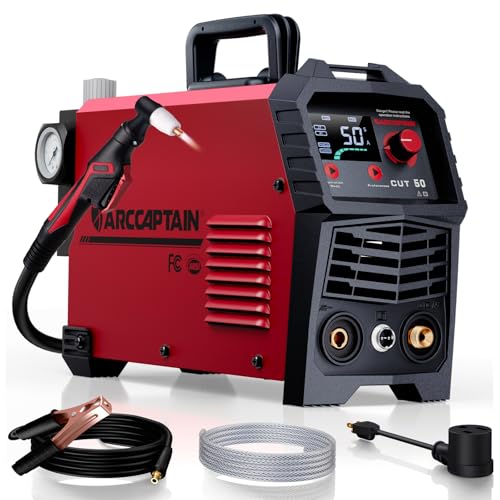
- 13 pounds with shoulder strap
- LED screen shows error codes
- 110V/220V operation with 2T/4T modes
Best For: Users who need a cutter that is easy to carry
Best for Air-Pressure Visibility

- LED screen displays air pressure
- Non-touch pilot arc for coated metal
- Adjustable pilot-arc and post-flow times
Best For: Workshop users who want visible air-pressure feedback
Best Compact Pilot-Arc Pick

- Listed weight of 10.14 pounds
- Non-touch pilot arc
- Display shows air pressure and error codes
Best For: DIY users seeking a lighter pilot-arc cutter
Best for Visible Settings

- 110V/220V input
- Display shows pressure, voltage, and current
- Non-touch pilot arc
Best For: Beginners who want visible settings and dual-voltage flexibility
Best for Simple Controls

- Automatic 120V/240V detection
- Straightforward amperage adjustment
- Requires 90 PSI, 60 L/min compressor
Best For: First-time DIY users with the specified air supply and circuit
Best for Adjustable Cutting Modes

- Non-touch pilot arc
- Adjustable 2T/4T and post-flow settings
- Needs dedicated 40A-or-higher circuit
Best For: Beginners who want room to learn adjustable cutting controls
Quick-Setup Pick

- 110V/220V operation
- Quick-connect air plug
- Pilot arc and 2T/4T/TEST modes
Best For: Home shops prioritizing quick air hookup
Non-HF Pick

- Non-HF blow-back start
- Digital status and error display
- 110V/220V clean-cut ratings
Best For: DIY and auto work where non-HF starting is preferred
Air-Monitoring Pick

- Real-time air-pressure display
- 12.57-pound listed weight
- 110V/220V non-touch pilot arc
Best For: Garage users learning air-pressure setup
Best for Remote Control – Bestarc BTC500 Pro 50A Pilot Arc Cutter
If you want a plasma cutter for beginners that makes settings and troubleshooting easier to manage, the Bestarc BTC500 Pro adds Bluetooth app control, an air-pressure sensor, and a fault-code display. Its non-touch pilot arc is useful when cutting rusty or painted metal.
Best For: DIY users who want remote adjustments and clear status feedback in a home workshop or garage.
Pros:
- App adjusts current and modes from up to 98 feet away.
- Non-touch pilot arc helps start cuts on dirty or rough metal.
- Dual-voltage operation, 2T/4T modes, and adjustable pilot-arc and post-flow times add flexibility.
Cons:
- Requires a separate compressor supplying clean, dry air.
- Its additional controls may be more than a first-time user needs.
Choose this model if remote control and on-machine diagnostics matter more to you than a simple control layout. The stated recommended cutting capacity varies by voltage, so check your available power before planning thicker cuts.
Best Lightweight Pick – ARCCAPTAIN CUT50 Dual-Voltage Cutter
At a listed 13 pounds, the ARCCAPTAIN CUT50 is a plasma cutter for beginners who expect to move between a garage and job sites. Its LED screen shows operating information and error codes, while the pre-installed air filter and quick-connect fitting simplify air-line hookup.
Best For: DIY users who prioritize portability and straightforward on-screen feedback.
Pros:
- 13-pound design includes a shoulder strap.
- Runs on 110V or 220V, with a stated 50A maximum on 220V.
- LED display, 2T/4T modes, and adjustable post-flow provide useful control.
Cons:
- Air compressor is sold separately.
- The stated current range on 110V tops out at 35A, not 50A.
This is a practical choice when carrying the cutter matters. Its stated recommended maximum cutting thickness is 12 mm on 110V and 18 mm on 220V, so match expectations to the outlet you will use.
Best for Air-Pressure Visibility – Bestarc 50A Pilot Arc V10
The Bestarc 50A Pilot Arc V10 suits shoppers looking for a plasma cutter for beginners with air pressure, voltage, current, and error codes visible on one LED screen. Its non-touch pilot arc can start on rusty, painted, or dirty metal without placing the torch head against the surface.
Best For: Home-workshop users who want prominent air-pressure feedback and pilot-arc control.
Pros:
- Screen displays air pressure alongside voltage, current, and fault codes.
- Built-in air filter and quick-connect 1/4-inch NPT fitting simplify hookup.
- Adjustable pilot-arc time, post-flow, and 2T/4T modes suit different cutting tasks.
Cons:
- Requires a separately purchased compressor and dry compressed air.
- Air pressure must be adjusted manually; the sensor does not regulate it automatically.
The display makes this model especially helpful when you want to monitor air supply as you learn. Its listed weight is 20.9 pounds, so it is less convenient to carry than lighter options in this group.
Best Compact Pilot-Arc Pick – Bestarc 50A Pilot Arc V8
For a plasma cutter for beginners that combines pilot-arc cutting with a compact listed size, consider the Bestarc 50A Pilot Arc V8. It weighs 10.14 pounds and offers an LED display for air pressure, voltage, current, and error codes.
Best For: DIY users who want a lighter cutter with a non-touch pilot arc and visible operating information.
Pros:
- Listed at 10.14 pounds for easier carrying.
- Non-touch pilot arc helps with rusty, painted, or dirty metal.
- Dual-voltage operation, air sensor, and adjustable 2T/4T, pilot-arc, and post-flow settings.
Cons:
- Compressor must be purchased separately; dry compressed air is required.
- Air pressure is adjusted manually rather than automatically.
This V8 is a useful fit when you want the Bestarc pilot-arc controls without the higher listed weight of the V10. Allow time to set the air regulator correctly before cutting.
Best for Visible Settings – TOOLIOM 50A Pilot Arc
The TOOLIOM 50A is a practical plasma cutter for beginners who want to see air pressure, voltage, and current while they work. Its dual-voltage input and non-touch pilot arc make it a flexible choice for cutting several common metals.
Best For: New users who value a clear display and want to cut on either 110V or 220V power.
Pros:
- Display shows air pressure, voltage, and current.
- Non-touch pilot arc lets the torch start without contacting the workpiece.
- Rated clean cuts are 1/4 inch at 110V and 5/8 inch at 220V.
Cons:
- Clean-cut capacity is lower on 110V.
- Specified air-pressure settings differ by input voltage: up to 50 PSI at 110V and 65 PSI at 220V.
If monitoring settings matters more to you than maximizing output on a standard outlet, this model is worth considering. Plan your cuts around its voltage-specific clean-cut ratings rather than its higher maximum-capacity figures.
Best for Simple Controls – Reboot RBC6000D 60A
The Reboot RBC6000D is a plasma cutter for beginners looking for straightforward amperage adjustment and stated air-pressure guidance. It automatically detects 120V or 240V input and comes with a PT31 torch and tips.
Best For: First-time users with a suitable compressor and electrical circuit who want simple controls for DIY metal projects.
Pros:
- Automatically detects 120V or 240V input.
- Controls are described as intuitive, with clear PSI guidance.
- Specified cutting thickness is 1/2 inch at 120V/35A and 5/8 inch at 240V/60A.
Cons:
- Requires an air compressor rated for at least 90 PSI and 60 L/min.
- Specified breaker requirements are 50A at 120V or 40A at 240V, so check your circuit before buying.
This is the simpler-control pick of the three, but its compressor and breaker requirements are important checks for a home workshop. Confirm those first so the easy-to-use controls translate into a workable setup.
Best for Adjustable Cutting Modes – SILATU STC650P 65A
The SILATU STC650P is a plasma cutter for beginners who expect to grow into more adjustable controls. Alongside its non-touch pilot arc, it provides 2T/4T operation, adjustable pilot-arc duration, and a display for key settings and error codes.
Best For: New users willing to learn extra settings for cutting tasks such as mesh metal and longer cuts.
Pros:
- Non-touch pilot arc can start without the torch head contacting the metal.
- Display shows air pressure, voltage, current, and error codes.
- Adjustable pilot-arc duration, post-flow time, and 2T/4T modes offer room to refine operation.
- Specified maximum cuts are 12 mm at 110V and 20 mm at 220V.
Cons:
- Requires a dedicated circuit with a breaker rated at 40A or higher.
- Air compressor is sold separately; air pressure must be adjusted manually.
Choose this model if those added controls are useful to you, rather than just appealing on paper. Before buying, make sure your circuit and separate air supply meet the stated requirements.
Quick-Setup Pick – GZ GUOZHI CUT-50
If you’re comparing a plasma cutter for beginners and want to spend less time connecting the air supply, the GZ GUOZHI CUT-50 is worth a look. Its 1/4-inch industrial D-type air plug is designed for quick compressor connection, and the machine supports both 110V and 220V power.
Best For: Home-shop users who want a quick air connection and the flexibility to switch between 110V and 220V.
Pros:
- Pilot arc helps cut rough, painted, or rusty metal.
- 2T, 4T, and TEST functions provide control options.
- Overheating and overcurrent protection are included.
Cons:
- Requires a separate source of dry, compressed air.
- Listed cutting capacities depend on voltage, current, and air pressure; check your intended setup.
The quick-connect approach is its main beginner-friendly advantage. If thicker cuts are the goal, note that the stated maximum is higher on 220V than on 110V.
Non-HF Pick – YESWELDER CUT-55DS PRO
For shoppers seeking a plasma cutter for beginners with clear operating feedback, the YESWELDER CUT-55DS PRO pairs a digital status display with a non-high-frequency blow-back start. Its non-touch pilot arc is useful when a project involves painted, rusty, or rough metal.
Best For: DIY and automotive users who want non-HF starting, visible settings, and room to work with different metal thicknesses.
Pros:
- Display shows operating parameters and error codes.
- Runs on 110V or 220V, with published clean-cut ratings for each.
- Adjustable post-flow and 2T/4T modes offer more control over cutting sessions.
Cons:
- A separate air supply is needed to operate a plasma cutter.
- The extra modes and post-flow setting may take some familiarization.
This is a strong option if non-HF starting matters in a workspace with other electrical equipment. Use its clean-cut ratings—5/16 inch on 110V and 25/64 inch on 220V—to judge whether it fits your typical jobs, rather than relying on maximum-cut figures alone.
Air-Monitoring Pick – SILATU STC550P
The SILATU STC550P makes a practical plasma cutter for beginners who want help tracking a key setup variable: its digital display shows real-time air pressure, and a manual regulator lets you adjust it. The machine also offers 110V/220V operation and a non-touch pilot arc for uneven, rusty, or painted surfaces.
Best For: Garage users who want visible air-pressure feedback, portable dimensions, and straightforward controls.
Pros:
- Built-in air sensor, filter, and 1/4-inch NPT quick-connect fitting support air setup.
- 12.57-pound listed weight makes it easier to move between work areas.
- 2T/4T modes and adjustable post-flow accommodate short or longer cuts.
Cons:
- Air compressor must be purchased separately.
- The notes specify a 40A circuit breaker; verify your electrical setup before buying.
Its air-pressure readout is the standout feature for someone learning to dial in a consistent cut. For capacity planning, SILATU states maximum cuts of 1/2 inch on 110V and 7/10 inch on 220V under its recommended conditions; those are maximums, not clean-cut ratings.
How We Picked the Best Plasma Cutter for Beginners
We focused on practical starting points: input-voltage flexibility, stated cutting output, pilot-arc availability, setup aids such as displays or air sensors, and the likely demands on a home-shop electrical circuit and compressor. These are comparison criteria, not the results of hands-on cut tests. Confirm the current listing and manual before buying; included accessories and specifications can change.
Quick Comparison: What Separates the 10 Picks?
Most selections are dual-voltage machines rated around 50A, a useful category for shoppers who want to start on a compatible 110V/120V supply and retain the option of higher-voltage power later. The Reboot RBC6000D, rated at 60A, and SILATU 65A target buyers considering more output; the YESWELDER CUT-55DS PRO and SILATU 55A sit between those groups. Several models advertise non-touch pilot arcs, which can simplify starting on painted, rusty, or expanded metal. Bestarc offers multiple 50A variants, so compare their exact feature lists rather than assuming they are interchangeable.
Key Buying Factors for a Plasma Cutter for Beginners
Electrical Supply and Real Cutting Capacity
Check the machine’s input-voltage and circuit requirements before you order. Dual voltage does not mean identical cutting performance on both inputs: available output can be lower on 110V/120V than on 220V/240V. Treat advertised maximum cuts as upper limits, not the thickness you should expect to cut quickly or cleanly every day. Match your routine material thickness to the manufacturer’s clean-cut rating at the voltage you will actually use.
Air, Torch, and Consumables
A plasma cutter needs a compressor that can meet its specified airflow and pressure while cutting—not merely reach that pressure while idle. Clean, dry air helps protect consumables and maintain cut quality, so budget for filtration or a moisture separator if needed. Check whether the package includes a torch, ground clamp, regulator, tips, and electrodes, and whether replacements are easy to source. Pilot-arc and non-HF descriptions can matter if you plan to cut imperfect surfaces or work near electronics, but follow the manufacturer’s guidance rather than assuming every model behaves the same way.
Ease of Setup and Safety
Displays and air sensors may make initial setup easier, but clear instructions and accessible support matter too. Plan for appropriate eye and skin protection, ventilation, fire-safe surroundings, and secure workpiece grounding. Never cut a sealed container or unknown coated metal without addressing the hazards first.
Who Should Buy Which Plasma Cutter for Beginners?
For occasional light fabrication, begin by comparing the 50A dual-voltage models on their actual low-voltage ratings, included gear, and consumable availability. If surface contamination or expanded metal is common, prioritize a model with a documented pilot arc. Buyers with a suitable higher-voltage circuit and frequent thicker cuts can compare the 55A–65A choices, while checking duty cycle and compressor demand before paying for more amperage. If your shop lacks adequate power or compressed air, solve that constraint first; it will determine which Plasma Cutter for Beginners is genuinely practical.