
Deep-sky targets such as nebulae, galaxies, and star clusters demand more than high magnification. The right telescope balances aperture, optical quality, stability, ease of use, and the observing conditions available to you.
This roundup compares 10 strong options, from compact tabletop Dobsonians and beginner-friendly app-guided models to large-aperture instruments and smart telescopes designed for assisted viewing or astrophotography.
Best 10 Telescopes for Deep Sky Viewing Picks for 2026
Top Smart-Tracking Pick
Celestron StarSense Explorer 10-inch Dobsonian

- 10-inch reflector for bright deep-sky views
- Smartphone-guided celestial navigation
- Stable manual Dobsonian base
Best For: New and experienced observers wanting guided navigation and substantial aperture
High-Contrast Compact Optics
Skymax 180mm Maksutov-Cassegrain

- 180mm matched Maksutov-Cassegrain optics
- 94% reflectivity mirror coating
- Fully baffled tube for reduced stray light
Best For: Observers seeking compact, contrast-focused optics with included 2-inch accessories
Advanced GoTo Flagship
Celestron CPC Deluxe HD 11-inch

- 11-inch EdgeHD aperture for maximum light gathering
- GPS and SkyAlign computerized pointing
- Visual and astroimaging-ready platform
Best For: Experienced astronomers seeking a large, automated telescope system
Portable Beginner Choice
Sky-Watcher Heritage 130mm Tabletop Dobsonian

- 130mm aperture in a compact tabletop design
- Collapsible and fully assembled
- Includes two eyepieces and red-dot finder
Best For: Beginners needing an easy-to-store telescope for casual observing
Best Computerized Deep-Sky Telescope

- 8-inch Schmidt-Cassegrain optics
- 40,000+ object GoTo database
- SkyAlign setup and automatic tracking
Best For: Automated deep-sky and planetary observing
Best Smart Telescope for Deep-Sky Viewing
UNISTELLAR Odyssey Smart Telescope

- App-based viewing with live image stacking
- Automatic focus, finding, and tracking
- Deep Dark Technology for light-polluted skies
Best For: Simple, shareable observing with a phone or tablet
Best Refractor for Deep-Sky Astrophotography
SVBONY SV503 102mm ED Refractor

- 102 mm f/7 ED refractor optics
- S-FPL51 glass reduces color fringing
- Dual-speed focuser and field rotator
Best For: Hands-on visual observing and astrophotography
Best Smart Telescope for Deep Sky Imaging
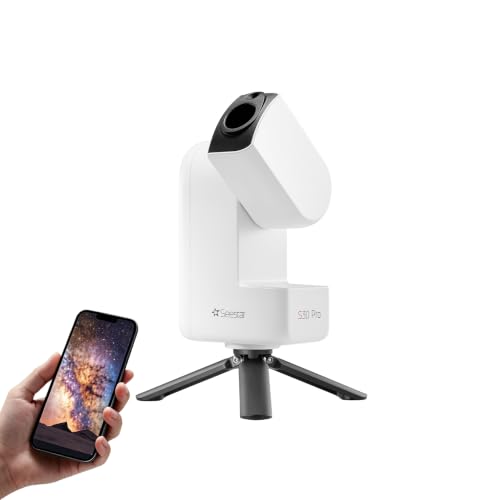
- App-controlled GoTo and automatic tracking
- Portable 3.6-pound design with light-pollution filters
- Dual-camera 4K deep-sky imaging with AI processing
Best For: Beginners seeking automated, portable deep-sky astrophotography
Best Large-Aperture Equatorial Telescope
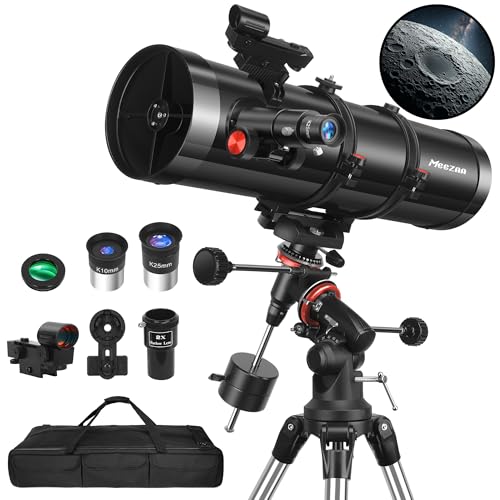
- 150mm reflector with 650mm focal length
- 26x–130x magnification using included optics
- Equatorial mount with slow-motion controls and carry bag
Best For: Hands-on deep-sky, lunar, and planetary observing
Best App-Guided Dobsonian for Deep Sky Viewing
Celestron StarSense Explorer 150mm

- 150mm reflector for bright deep-sky views
- StarSense app identifies targets using sky recognition
- Simple manual tabletop Dobsonian base
Best For: Beginners wanting guided visual observation of nebulae, galaxies, and clusters
Top Smart-Tracking Pick – Celestron StarSense Explorer 10-inch Dobsonian
For shoppers seeking telescopes for deep sky viewing without a steep learning curve, the Celestron StarSense Explorer 10-inch Dobsonian combines substantial light-gathering capacity with smartphone-guided navigation. Its 254mm Newtonian reflector is designed for vivid views of bright nebulae, galaxies, star clusters, planets, and the Moon.
Best For: Beginners and experienced observers who want strong deep-sky performance with app-assisted target finding.
Pros:
- Large 10-inch aperture and StarBright XLT coatings support bright, sharp views.
- StarSense technology uses smartphone sky recognition to help locate targets.
- Manual Dobsonian base offers a stable, straightforward setup without external power.
- Includes a 32mm eyepiece, 25mm eyepiece, red-dot finder, and two-year warranty.
Cons:
- The telescope weighs 54.8 pounds and has a 56-inch optical tube, limiting portability.
- Manual operation requires you to follow and reacquire targets yourself.
This is a particularly practical choice when deep-sky capability matters more than compactness. The smartphone dock simplifies navigation, while the large reflector provides the aperture needed for more rewarding views from darker locations.
High-Contrast Compact Optics – Skymax 180mm Maksutov-Cassegrain
The Sky-Watcher Skymax 180mm is a compact compound telescope for deep sky viewing that emphasizes contrast and controlled light transmission. Its matched Maksutov-Cassegrain optics, 94% reflectivity mirror coating, and fully baffled tube are designed to produce charcoal-black skies and contrast-rich images.
Best For: Observers who prioritize compact optical-tube dimensions, high contrast, and a supplied 2-inch viewing setup.
Pros:
- 180mm aperture provides substantial light-gathering capability in a compact design.
- Matched optics and fully multi-coated surfaces support contrast-rich views.
- Fully baffled tube helps reduce stray light during observation.
- Includes a 28mm 2-inch eyepiece, 2-inch 90-degree diagonal, and 9×50 finder.
Cons:
- The 2700mm focal length produces a relatively narrow field of view for large targets.
- The optical tube is supplied with an altazimuth mount, so buyers should confirm the mounting setup meets their needs.
With a 19-pound weight and an 18-centimeter listed optical-tube length, this model is easier to accommodate than many large-aperture instruments. Its long focal length and baffled, high-contrast optical design make it better suited to concentrated observing than sweeping very wide areas of sky.
Advanced GoTo Flagship – Celestron CPC Deluxe HD 11-inch
For serious users comparing telescopes for deep sky viewing and imaging readiness, the Celestron CPC Deluxe HD 11-inch pairs a large 280mm aperture with EdgeHD optics and a computerized dual fork-arm mount. StarBright XLT coatings, GPS, SkyAlign technology, and upgraded tracking hardware support accurate pointing and sustained observation.
Best For: Experienced astronomers who want maximum light gathering, automated GoTo operation, and an astroimaging-ready platform.
Pros:
- 11-inch EdgeHD optical tube provides maximum light gathering among these picks.
- StarBright XLT coatings are applied across the optical surfaces for increased transmission.
- GPS, SkyAlign, and the NexStar+ hand control support computerized setup and pointing.
- Fastar compatibility and optional wedge features support advanced imaging workflows.
Cons:
- At 125.6 pounds, this is a substantial system to transport and set up.
- It requires a DC power supply for operation.
- The premium feature set and large footprint may be excessive for casual visual observing.
This is the most feature-rich and light-gathering-focused option in the group, but its weight and powered mount make it a serious equipment commitment. It is best matched with an established observing location and users prepared to take advantage of its tracking and imaging capabilities.
Portable Beginner Choice – Sky-Watcher Heritage 130mm Tabletop Dobsonian
The Sky-Watcher Heritage 130mm is a compact entry point into telescopes for deep sky viewing. Its 5-inch-plus aperture, collapsible optical tube, and tabletop Dobsonian design make it easier to transport and use while still offering more light-gathering ability than many small beginner instruments.
Best For: Beginners and families wanting a ready-to-use, portable telescope for casual Moon, planet, and deep-sky observing.
Pros:
- 130mm aperture offers useful light gathering in a compact package.
- Collapsible tabletop design is easy to transport and store.
- Arrives fully assembled with no assembly required.
- Includes 10mm and 25mm eyepieces plus a red-dot finder.
Cons:
- A tabletop mount requires a sturdy, suitable surface for observing.
- Manual operation does not provide computerized target locating or tracking.
- Its 5-inch-plus aperture has less light-gathering capacity than the larger models here.
This model is a sensible choice when convenience and portability are more important than maximum aperture. The simple manual layout and included accessories reduce setup friction, while the collapsible design makes it practical for beginners with limited storage space.
Best Computerized Deep-Sky Telescope – Celestron NexStar 8SE
For observers comparing telescopes for deep sky viewing, the Celestron NexStar 8SE combines a substantial 8-inch Schmidt-Cassegrain aperture with computerized object locating and tracking. Its 40,000-plus-object database and SkyAlign system make it a practical choice when you want to spend more time observing and less time searching.
Best For: Adults who want automated access to galaxies, globular clusters, planets, and lunar detail in a compact, portable setup.
Pros:
- 8-inch optics gather light for detailed planetary, lunar, and deep-sky views.
- GoTo mount automatically locates and tracks targets from a database of more than 40,000 objects.
- SkyAlign simplifies setup by using three bright stars or planets for alignment.
- Compatible with Celestron accessories and includes a two-year US warranty with technical support.
Cons:
- Power options such as AA batteries, an AC adapter, or a PowerTank are not included.
- Manual focusing and computerized alignment may feel more involved than a basic manual telescope.
- The narrow 0.75-degree field of view is better suited to focused targets than very wide sky views.
The NexStar 8SE is a strong all-around deep-sky platform for users who value aperture and automation. It is especially appealing if manually locating faint objects would be frustrating, though you should plan for a separate power solution.
Best Smart Telescope for Deep-Sky Viewing – UNISTELLAR Odyssey Smart Telescope
The UNISTELLAR Odyssey takes a streamlined approach to telescopes for deep sky viewing, using an app, automatic focusing, target recognition, and live image stacking. Its 85 mm optics and Deep Dark Technology are designed to help reveal galaxies and nebulae while reducing the complexity of traditional setup.
Best For: Beginners, families, and tech-focused observers who prefer app-based viewing and sharing from city skies or dark sites.
Pros:
- Live image stacking builds color and detail during observation.
- Smart Star Finder, Stellar Autofocus, and motorized tracking automate key observing steps.
- Deep Dark Technology helps reduce the effects of light pollution.
- Portable 8.8-pound telescope includes a 5.5-pound tripod and offers up to five hours of rechargeable battery use.
Cons:
- Viewing requires a compatible phone or tablet; there is no eyepiece.
- Android 10 or later and iOS 18 or later are required for the app.
- Results depend on the target, sky conditions, and time spent collecting light.
Odyssey is a convenient choice when you want automated, shareable deep-sky observing rather than traditional eyepiece viewing. It offers a particularly accessible workflow, but users seeking hands-on optical control may prefer a conventional telescope.
Best Refractor for Deep-Sky Astrophotography – SVBONY SV503 102mm ED Refractor
For buyers choosing telescopes for deep sky viewing with future imaging in mind, the SVBONY SV503 offers a 102 mm f/7 ED refractor with fully multi-coated optics and S-FPL51 glass. Its dual-speed focuser, long focus travel, and rotating field design support careful camera and accessory setup.
Best For: Adult visual observers and astrophotographers who want a manual ED refractor with reduced color fringing and flexible accessory compatibility.
Pros:
- 102 mm aperture and fully multi-coated optics support bright, high-contrast views.
- S-FPL51 ED glass helps reduce chromatic aberration for sharper, more natural-looking images.
- 1:10 dual-speed focuser and 90 mm focus travel allow precise focusing with imaging accessories.
- 360-degree field rotator simplifies camera alignment without rotating the optical tube.
Cons:
- Manual focus and a manual optical tube require more hands-on operation.
- No finderscope is included according to the supplied specifications.
- The listed product is the optical tube setup, so a suitable mount and observing accessories may be needed.
The SV503 is a capable foundation for detailed visual observation and astrophotography, particularly for users who appreciate precise manual control. Its ED glass and imaging-friendly focuser are notable strengths, but completing the setup may require additional equipment.
Best Smart Telescope for Deep Sky Imaging – Seestar S30 Pro
The ZWO Seestar S30 Pro is a highly automated option for anyone seeking telescopes for deep sky viewing without a complicated setup. Its app-controlled GoTo, automatic tracking, apochromatic optics, and built-in light-pollution filters are designed to make deep-sky imaging accessible, including from brighter urban locations.
Best For: Beginners who prioritize portable, app-guided deep-sky astrophotography over traditional eyepiece viewing or planetary observation.
Pros:
- Automatic GoTo targeting and tracking simplify locating celestial objects.
- Compact 3.6-pound design is convenient for travel, camping, and outdoor use.
- Dual-camera 4K imaging, AI processing, and one-tap capture support detailed deep-sky photos.
- Built-in filters and apochromatic optics can help produce clearer images in urban skies.
Cons:
- Designed for deep-sky objects and not intended for planetary observation.
- Requires a smartphone or tablet and relies on software settings for imaging.
- Must remain stationary during deep-sky imaging for stable tracking.
The S30 Pro is best understood as a smart imaging system rather than a conventional visual telescope. Choose it for automated, shareable deep-sky photos and portability; choose a larger manual reflector if your priority is direct, eyepiece-based viewing.
Best Large-Aperture Equatorial Telescope – MEEZAA 150EQ
The MEEZAA 150EQ combines a 150mm aperture with a 650mm focal length, making it a strong traditional choice among telescopes for deep sky viewing. Its German equatorial mount, manual slow-motion controls, and included eyepieces support hands-on observing of deep-sky objects, planets, and the Moon.
Best For: Beginners and families who want a large-aperture reflector with manual tracking, broad magnification options, and a complete starter accessory package.
Pros:
- 150mm aperture provides strong light-gathering capability for deep-space observation.
- 26x to 130x magnification range offers flexibility for different targets.
- German equatorial mount includes precision dials and slow-motion controls.
- Includes two eyepieces, a 2x Barlow lens, moon filter, phone adapter, tripod, and carry bag.
Cons:
- Manual focus and tracking require more hands-on learning than an automated telescope.
- The equatorial mount and 65cm optical tube may be less convenient to transport than compact designs.
- Phone adapter supports basic capture but does not provide automated astrophotography.
This model offers a conventional astronomy experience with useful aperture and a mount that can teach manual sky tracking. It is a practical fit if you want to observe deep-sky targets directly and do not mind learning the equatorial setup.
Best App-Guided Dobsonian for Deep Sky Viewing – Celestron StarSense Explorer 150mm
The Celestron StarSense Explorer 150mm Dobsonian is a straightforward option for shoppers comparing telescopes for deep sky viewing. Its 150mm Newtonian reflector gathers substantial light, while the StarSense app uses your smartphone to guide you toward nebulae, galaxies, star clusters, and planets without requiring an advanced telescope background.
Best For: Beginners who want bright deep-sky views with smartphone-assisted object finding and a simple tabletop Dobsonian base.
Pros:
- 150mm reflector provides bright views of targets such as the Orion Nebula and Andromeda Galaxy.
- StarSense sky recognition guides users to objects with on-screen arrows.
- Curated target lists show recommended objects based on time and location.
- Manual tabletop Dobsonian base offers simple setup and smooth target positioning.
Cons:
- Manual operation means it does not automatically track objects across the sky.
- At 25 pounds, the telescope and base are less lightweight than compact smart designs.
- Tabletop use requires a stable, suitable surface.
The StarSense Explorer balances substantial aperture with beginner-friendly guidance. It is a compelling choice for visual observers who want to discover deep-sky targets more easily while retaining the simplicity and responsiveness of a manual Dobsonian.
How We Picked the Best Telescopes for Deep Sky Viewing
We focused on the features that matter most when observing faint, distant objects: usable aperture, optical design, mount stability, tracking capability, setup time, portability, and overall value. The selection includes manual Dobsonians, computerized Schmidt-Cassegrain and Maksutov-Cassegrain telescopes, refractors, Newtonian reflectors, and app-controlled smart telescopes.
Because no single instrument suits every observer, we also considered whether each telescope is appropriate for beginners, visual observers, families, or users who want digital assistance and image capture.
Quick Comparison
| Type | Best For | Main Advantage | Primary Trade-Off |
|---|---|---|---|
| Tabletop Dobsonian | Beginners and casual observers | Strong aperture for the price | Requires a sturdy table and manual tracking |
| Full-size Dobsonian | Visual deep-sky observing | Excellent light gathering | Bulky compared with compact designs |
| GoTo compound telescope | Convenient locating and tracking | Computerized object finding | Higher cost and more setup |
| Refractor | Sharp, low-maintenance viewing | Simple operation and contrast | Large apertures become expensive |
| Smart telescope | App-assisted viewing and imaging | Automated alignment and digital results | Less traditional eyepiece-based observing |
Key Buying Factors for Telescopes for Deep-Sky Viewing
Aperture and Light Gathering
Aperture is usually the most important specification for faint targets. Larger mirrors or lenses collect more light and can reveal dimmer galaxies, nebulae, and globular clusters. However, extra aperture often increases weight, cost, and setup demands.
Optical Design
Dobsonian reflectors generally offer the most aperture per dollar. Schmidt-Cassegrain and Maksutov-Cassegrain models provide compact tubes and can work well on computerized mounts. Refractors are straightforward and deliver crisp views, while smart telescopes use cameras and software rather than conventional eyepiece viewing.
Mount, Tracking, and Setup
A stable mount is essential for useful high-power views. Manual mounts are affordable and intuitive, but objects drift across the field. GoTo tracking helps locate and follow targets, while app-guided systems simplify alignment. Check whether the telescope requires batteries, an external power source, or a level observing surface.
Portability and Observing Location
Dark skies can matter as much as aperture. If you must carry the telescope to a rural site, a slightly smaller instrument that you will actually transport may outperform a larger model that stays indoors. Also consider storage space, cooldown time, and the stability of your patio, balcony, or table.
Who Should Buy Which Telescopes for Deep Sky Viewing?
Choose a tabletop Dobsonian for an affordable, hands-on introduction to visual astronomy. A larger Dobsonian is the strongest choice for observers who prioritize maximum deep-sky detail and have room for storage. Select a GoTo compound telescope if you want computerized locating, tracking, and a broad target list.
A refractor suits buyers who value sharp, low-maintenance optics and may also observe the Moon and planets. A smart telescope is best for users who prefer app control, automated observing, or sharing digital images. Before buying, match the telescope’s size and controls to your experience level, observing site, and willingness to learn the night sky.