
Choosing among the best telescopes for astrophotography depends on what you want to capture, how much setup you can manage, and whether you prefer a traditional optical tube or an app-controlled smart telescope.
These 10 picks cover portable smart cameras, computerized reflectors, Dobsonian visual scopes, and dedicated apochromatic refractors for lunar, planetary, and deep-sky imaging.
Best 10 Telescopes for Astrophotography Picks for 2026
Best Smart Telescope
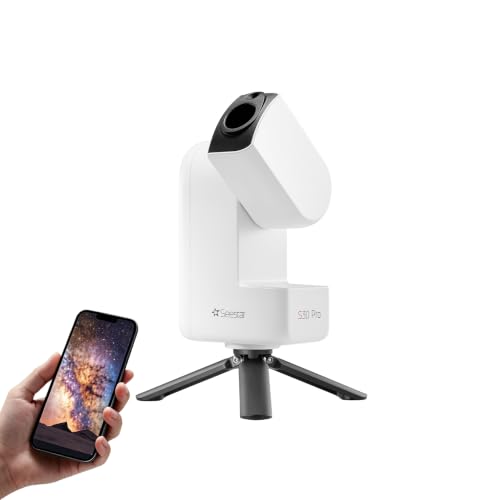
- Automatic GoTo, tracking, and app control
- 4K dual-camera imaging with AI processing
- Portable design with urban-friendly light-pollution filters
Best For: Beginners seeking easy, portable deep-sky astrophotography
Best Large-Aperture Telescope

- 8-inch Schmidt-Cassegrain optical system
- GoTo access to 40,000-plus objects
- SkyAlign simplifies computerized setup
Best For: Visual observers wanting a versatile platform with astroimaging potential
Best Portable Smart Telescope

- Backpack-friendly 3-pound design
- Dual lenses for astronomy and daytime subjects
- 4K auto-tracking with app-based processing
Best For: Travelers wanting compact, automated day-and-night imaging
Best Optical Tube for Imaging
SVBONY SV550 AP0 80mm Triplet APO
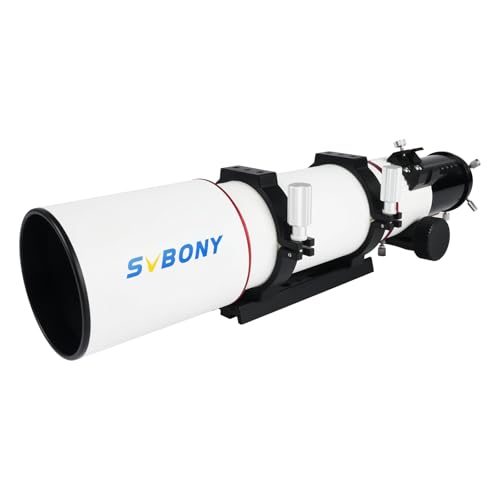
- 80mm triplet apochromatic refractor
- 480mm focal length with a wide field of view
- Dual-speed focuser and full-frame-friendly design
Best For: Experienced users assembling a dedicated camera-based imaging rig
Best Large-Aperture Pick
Celestron StarSense Explorer 10-inch Dobsonian

- Large 254mm reflector for bright deep-sky views
- Smartphone sky recognition simplifies target finding
- Stable manual Dobsonian base with included accessories
Best For: Visual observers who prioritize aperture and easy navigation
Best Traditional Beginner Setup
MEEZAA 150EQ Newtonian Reflector
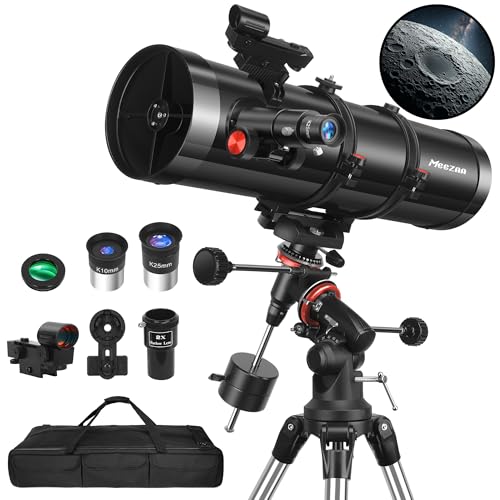
- 150mm aperture with 650mm focal length
- Manual equatorial mount with slow-motion controls
- Includes phone adapter, carry bag, eyepieces, and Barlow lens
Best For: Beginners learning manual tracking and smartphone-assisted viewing
Best Portable Imaging Option

- 1.85-pound app-controlled design for travel
- Auto GOTO, 360-degree rotation, and EQ mode
- Up to 90-second exposures with smart processing
Best For: Portable, beginner-friendly digital astrophotography
Best Computerized Option

- Computerized GoTo system tracks more than 4,000 objects.
- 130mm Newtonian reflector supports planetary and deep-sky viewing.
- Portable design includes eyepieces and Starry Night software.
Best For: Beginners seeking guided navigation and occasional astrophotography
Best Optical Upgrade
SVBONY SV503 102mm ED Refractor

- ED glass reduces chromatic aberration for cleaner images.
- Dual-speed focuser offers precise control with accessories.
- 360-degree rotator simplifies camera alignment.
Best For: Astrophotographers building a dedicated camera-ready setup
Best Smartphone-Guided Choice
Celestron StarSense Explorer DX 130AZ

- StarSense app guides users to celestial targets by smartphone.
- 130mm reflector supports detailed planetary and deep-sky views.
- Manual mount includes dual-axis slow-motion controls.
Best For: Beginners wanting easy target finding and introductory imaging
Best Smart Telescope – ZWO Seestar S30 Pro
The ZWO Seestar S30 Pro is a particularly approachable choice among telescopes for astrophotography. Automatic GoTo targeting, tracking, autofocus, one-tap capture, and app control simplify deep-sky and wide-field imaging, while built-in light-pollution filters suit urban observers.
Best For: Beginners who want portable, largely automated deep-sky and wide-field astrophotography from a smartphone or tablet.
Pros:
- Automatic GoTo targeting and tracking reduce setup complexity.
- Dual-camera 4K imaging, AI processing, and automatic mosaic stitching support detailed captures.
- Compact 3.6-pound design with anti-dew protection and battery power is convenient for travel.
- Built-in light-pollution filters can help produce clearer images in urban environments.
Cons:
- Designed for deep-sky and wide-field imaging rather than planetary observation.
- Deep-sky imaging requires the device to remain stationary for stable tracking.
- The 30mm objective and 160mm focal length are specialized for wide-field use.
Choose the S30 Pro when ease of use and portability matter more than traditional eyepiece-based observing or advanced manual control. Its automated workflow is well suited to getting started quickly with astrophotography.
Best Large-Aperture Telescope – Celestron NexStar 8SE
For buyers seeking telescopes for astrophotography that can also support serious visual observing, the Celestron NexStar 8SE offers substantial light-gathering power in a computerized Schmidt-Cassegrain design. Its 8-inch aperture, GoTo mount, and SkyAlign system make it a capable step up from a manual telescope.
Best For: Observers who want a versatile, large-aperture telescope for lunar, planetary, and deep-sky viewing with astroimaging potential.
Pros:
- 8-inch Schmidt-Cassegrain optics gather light for lunar detail, planets, galaxies, and globular clusters.
- Computerized GoTo mount provides access to a database of more than 40,000 objects.
- SkyAlign can align the telescope using three bright stars or planets without requiring their names.
- Compatible with additional Celestron accessories as the setup develops.
Cons:
- Manual focusing and an alt-azimuth single-fork mount may require more hands-on technique for imaging.
- Power options such as AA batteries, an AC adapter, or an external PowerTank are not included.
- Its larger 10.88 kg weight is less travel-friendly than compact smart telescopes.
The NexStar 8SE is a strong choice when aperture and observing versatility take priority. It is visual-astronomy friendly and astroimaging ready, but buyers should account for power needs and the additional demands of a larger computerized setup.
Best Portable Smart Telescope – DWARF 3 Smart Telescope
The DWARF 3 is one of the most travel-friendly telescopes for astrophotography, weighing about 3 pounds and fitting in a standard backpack. Its dual-lens system, automatic tracking, app control, and cloud-powered processing make it suitable for quick imaging sessions without a computer-heavy workflow.
Best For: Travelers, beginners, and hobbyists who want one compact device for astrophotography, landscapes, wildlife, and panoramas.
Pros:
- Lightweight 3-pound design is easy to carry on outdoor trips.
- Telephoto and wide-angle lenses support deep-space subjects, Milky Way scenes, star trails, landscapes, and wildlife.
- Automatic GoTo, 4K tracking, autofocus, and app-based processing simplify capture.
- AZ and EQ modes provide flexibility for different shooting approaches.
Cons:
- Its compact 35mm objective is aimed at portability rather than maximum light gathering.
- Cloud-powered image processing relies on the dedicated app workflow.
- It is an imaging camera system rather than a traditional eyepiece-centered telescope.
The DWARF 3 makes the most sense for buyers who value mobility and automated results. Its dual-purpose imaging design is especially appealing if astronomy is only one part of your outdoor photography routine.
Best Optical Tube for Imaging – SVBONY SV550 AP0 80mm Triplet APO
The SVBONY SV550 AP0 is a dedicated optical tube for buyers building a more traditional camera-based astrophotography system. Its 80mm triplet apochromatic refractor uses S-FPL51 ED glass, a dual-speed focuser, and extensive internal baffling to prioritize color correction, contrast, and controlled stray light.
Best For: Experienced astrophotographers who already have a compatible camera, mount, and supporting accessories.
Pros:
- 80mm air-spaced triplet APO optics are designed to reduce chromatic aberration.
- 480mm focal length and 5.6-degree field of view suit targets such as M42 and M45.
- 2.5-inch dual-speed 1:10 focuser supports precise focusing and helps reduce vignetting with full-frame cameras.
- Multiple internal light barriers and extensive baffling support high-contrast imaging.
Cons:
- This is an optical tube assembly, so a camera and suitable mount are required separately.
- Manual focus means setup and focusing are more hands-on than with smart telescopes.
- Its 2.86 kg tube is less convenient for minimalist travel setups.
The SV550 AP0 is the specialist option in this roundup. It rewards users who want to choose their own camera and mount and who value apochromatic optics over integrated automation.
Best Large-Aperture Pick – Celestron StarSense Explorer 10-inch Dobsonian
For shoppers comparing telescopes for astrophotography, the Celestron StarSense Explorer 10-inch Dobsonian is primarily a visual-observing telescope with a large 254mm aperture and smartphone-assisted navigation. Its manual Dobsonian mount is designed for straightforward setup and targeting rather than automated imaging.
Best For: Beginners and visual observers who want strong deep-sky views, simple smartphone guidance, and a large aperture.
Pros:
- Large 10-inch reflector gathers substantial light for the Moon, planets, nebulae, galaxies, and star clusters.
- StarSense technology uses smartphone sky recognition to help locate targets.
- Stable manual Dobsonian base, 2-inch Crayford focuser, and included eyepieces and accessories.
- Includes a two-year warranty and unlimited support from Celestron.
Cons:
- At 54.8 pounds, it is less convenient to transport than compact options.
- Manual operation does not provide motorized tracking for long-exposure astrophotography.
This is a compelling choice when visual performance matters more than imaging convenience. The large aperture can reveal more detail, while the app reduces the learning curve, but serious astrophotographers may prefer a mount designed for automated tracking.
Best Traditional Beginner Setup – MEEZAA 150EQ Newtonian Reflector
Among telescopes for astrophotography, the MEEZAA 150EQ offers a conventional Newtonian reflector with a 150mm aperture, phone adapter, and German equatorial mount. It can introduce beginners to manual tracking and basic smartphone-assisted captures, though the mount is manually operated.
Best For: Beginners and families who want an affordable, portable telescope package with an equatorial mount and broad accessory bundle.
Pros:
- 150mm aperture and 650mm focal length provide useful light-gathering capability for lunar, planetary, and deep-sky viewing.
- Equatorial mount includes precision dials and slow-motion controls for manual tracking.
- Includes 25mm and 10mm eyepieces, a 2X Barlow lens, moon filter, phone adapter, and red-dot finderscope.
- All components fit in the included carry bag for storage and travel.
Cons:
- Manual equatorial tracking is less convenient for extended astrophotography exposures.
- Setup and alignment may require more learning than an app-guided or fully automated telescope.
The 150EQ is a practical starter package for learning the basics of an equatorial setup. Its phone adapter supports casual capture, but users planning demanding long-exposure astrophotography should verify that the mount meets their tracking requirements.
Best Portable Imaging Option – DWARF Mini Smart Telescope
The DWARF Mini is the most imaging-focused option here for shoppers comparing telescopes for astrophotography. Its 1.85-pound design, app control, Sony IMX662 sensor, automated tracking, EQ mode, and exposures up to 90 seconds make it suited to convenient digital deep-sky capture.
Best For: Travelers, beginners, and casual astrophotographers who want automated, app-controlled imaging in a highly portable package.
Pros:
- Ultra-lightweight 1.85-pound body fits easily in a backpack for travel and dark-sky outings.
- App-controlled sky atlas, Auto GOTO, and 360-degree rotation simplify target selection and tracking.
- EQ mode supports single-frame exposures up to 90 seconds and includes light-pollution filtering.
- Built-in cloud processing helps enhance captured data for easy sharing.
Cons:
- The 30mm objective is much smaller than the apertures of the two reflector telescopes.
- Operation depends on the included battery and smartphone app rather than traditional eyepiece viewing.
The DWARF Mini prioritizes portability and automated digital capture over conventional optical observing. It is a convenient entry point for imaging nebulae and star clusters, especially for users who value quick setup and app-based processing.
Best Computerized Option – Celestron NexStar 130SLT
The Celestron NexStar 130SLT is a practical choice among telescopes for astrophotography when guided object locating matters. Its computerized GoTo system can find and track targets from a database of more than 4,000 celestial objects, while the 130mm Newtonian reflector provides useful views of planets and deep-sky targets. Keep in mind that its altazimuth mount and manual focus are better suited to casual or entry-level imaging than long-exposure astrophotography.
Best For: Beginners who want computerized navigation, portable setup, and visual astronomy with occasional camera use.
Pros:
- Computerized GoTo locating and tracking for more than 4,000 objects.
- 130mm aperture and parabolic mirror support planetary and deep-sky viewing.
- Compact design, 2-inch eyepiece compatibility, and included 20mm and 9mm eyepieces.
- Includes Starry Night software, a two-year warranty, and U.S.-based technical support.
Cons:
- Altazimuth mounting is less suitable for extended-exposure astrophotography.
- Manual focus and battery-powered operation add practical limitations for imaging sessions.
This model stands out for convenience rather than advanced imaging control. Its automated tracking and 130mm aperture make it a versatile starting point, especially for users who want to spend less time searching and more time observing.
Best Optical Upgrade – SVBONY SV503 102mm ED Refractor
The SVBONY SV503 102mm ED refractor is one of the more imaging-focused telescopes for astrophotography in this lineup. Its S-FPL51 ED glass helps reduce chromatic aberration, while the 714mm f/7 focal length, dual-speed focuser, and 360-degree field rotator support careful camera alignment and focusing. It is an optical tube rather than a complete computerized telescope setup, so a compatible mount and imaging accessories are needed.
Best For: Astrophotographers prioritizing reduced color fringing, precise focus, and flexible camera alignment.
Pros:
- S-FPL51 ED glass helps minimize chromatic aberration for sharper, more natural-color images.
- Dual-speed 1:10 focuser and 90mm focus travel support precise focusing with imaging accessories.
- 360-degree field rotator allows camera alignment without rotating the optical tube.
- Fully multi-coated 102mm objective and retractable dew-shield-style hood support brighter, higher-contrast views.
Cons:
- Does not include a finderscope, mount, or complete astrophotography rig.
- Manual focus means the user must handle focusing and tracking separately.
For users building a dedicated imaging system, this refractor offers the most specialized optical and focusing features here. Budget separately for a stable mount, camera, and other accessories to complete the setup.
Best Smartphone-Guided Choice – Celestron StarSense Explorer DX 130AZ
The Celestron StarSense Explorer DX 130AZ makes finding targets straightforward, which is valuable when comparing telescopes for astrophotography as a beginner. Its smartphone-powered StarSense app uses sky recognition to guide users to stars, planets, nebulae, and galaxies, while the 130mm Newtonian reflector delivers strong visual views. The manual altazimuth mount is best for basic or short-exposure camera use rather than advanced long-exposure imaging.
Best For: Beginners who want smartphone-assisted target finding and a simple manual telescope for visual observing and introductory imaging.
Pros:
- StarSense app analyzes star patterns and provides on-screen navigation to targets.
- 130mm reflector shows the Moon, planets, Orion Nebula, Andromeda Galaxy, and other deep-sky objects.
- Manual mount includes dual-axis slow-motion controls for smoother adjustments.
- Includes 25mm and 10mm eyepieces, a StarPointer finderscope, and a two-year warranty.
Cons:
- Manual altazimuth mounting is not designed for extended-exposure astrophotography.
- Requires a compatible smartphone for the guided sky-tour feature.
This telescope combines a capable 130mm reflector with approachable smartphone guidance. It is a strong fit for users who value easy target discovery and visual observing first, while keeping introductory camera experimentation in the mix.
How We Picked These Telescopes for Astrophotography
We selected products across several skill levels, budgets, and imaging styles rather than treating one telescope design as ideal for everyone. The lineup includes smart telescopes with built-in cameras, computerized GoTo systems, Newtonian reflectors for larger apertures, and ED or apochromatic refractors designed for cleaner photographic results.
Our comparison emphasizes optical performance, tracking or pointing assistance, portability, camera compatibility, setup demands, and the type of targets each telescope handles best. A visual telescope can be excellent for observing yet require additional equipment for long-exposure imaging, so that distinction matters.
Quick Comparison
| Type | Best For | Main Advantage | Watch Out For |
|---|---|---|---|
| Smart telescope | Simple automated imaging | Integrated camera and app control | Less upgrade flexibility |
| Computerized reflector | Beginners wanting GoTo | Good aperture for the price | Mount and collimation considerations |
| Dobsonian | Visual deep-sky observing | Large aperture at low cost | Usually not suited to long exposures |
| ED or apochromatic refractor | Dedicated astrophotography | Sharp, high-contrast images | Often needs a separate mount and accessories |
Key Buying Factors for Telescopes for Astrophotography
Imaging Target
For the Moon and planets, aperture and focal length can help reveal fine detail, while a high-speed camera is often more important than long tracking. Nebulae and galaxies typically benefit from accurate motorized tracking, a suitable field of view, and a camera that supports stacking or long exposures.
Mount and Tracking
The mount is often more important than the optical tube for astrophotography. Alt-azimuth mounts are convenient for casual imaging but introduce field rotation during longer exposures. Equatorial mounts are better suited to extended deep-sky exposures, although they require more setup and alignment.
Optics, Aperture, and Focal Ratio
Larger aperture gathers more light, but it also increases size, weight, and cooling time. Refractors generally provide simple, low-maintenance operation, while Newtonian reflectors can offer excellent light-gathering value but may need periodic collimation. A shorter focal ratio produces a wider field and can reduce exposure demands.
Camera Compatibility and Accessories
Check whether the telescope supports your intended camera, reaches focus, and provides the adapters you need. Budget for a sturdy mount, field flattener or reducer when appropriate, power, dew control, filters, and software. Smart telescopes simplify much of this process by integrating the camera and controls.
Who Should Buy Which Telescopes for Astrophotography?
Choose a smart telescope if you want the quickest route from setup to shareable deep-sky images, especially for travel or casual observing. A computerized Newtonian or Schmidt-Cassegrain is a better fit if you want guided object finding, visual observing, and room to learn more advanced imaging techniques.
Pick a large Dobsonian when visual astronomy and maximum aperture matter more than long-exposure photography. Choose an ED or apochromatic refractor if image quality, compact optical design, and compatibility with a dedicated tracking mount are your priorities. Beginners should favor manageable weight and straightforward setup; experienced imagers can prioritize mount precision, camera integration, and upgrade potential.