
Finding the best star tracker for a lightweight telescope means balancing payload capacity, portability, tracking accuracy, setup time, and the type of observing or astrophotography you plan to do.
This roundup compares 10 compact tracking mounts, guided telescope systems, and smart astronomy options so you can choose a setup that fits your equipment, experience level, and budget.
Best 10 Star Trackers for Lightweight Telescopes Picks for 2026
Best GoTo Pick
Sky-Watcher Star Adventurer GTi

- Full GoTo EQ tracking mount
- Illuminated polar scope and built-in Wi-Fi
- Includes tripod, pier extension, and counterweight
Best For: Portable astrophotographers wanting a complete GoTo kit
Best Complete Telescope
Celestron StarSense Explorer DX 5

- 5-inch Schmidt-Cassegrain optical tube
- Smartphone-guided target finding
- Includes eyepieces, tripod, and altazimuth mount
Best For: Beginners focused on guided visual astronomy
Best Lightweight Tracker
- 7-pound portable tracking platform
- Wi-Fi smartphone control via SAM Console
- Modular design works with photographic tripods
Best For: Traveling wide-field astrophotographers
Best App-Controlled Mount
Explore Scientific iEXOS-100-2

- PMC-Eight eight-CPU control system
- ExploreStars app with GoTo navigation
- Clutched dual-axis gears and altitude adjustment
Best For: Tablet-based GoTo telescope setups
Beginner Tracking Telescope

- 130mm Newtonian reflector
- Motorized RA tracking
- Includes two eyepieces and finder
Best For: Beginners wanting a complete, motorized backyard telescope
Compact Astrophotography Tracker

- Compact PETG and carbon-fiber shell
- Custom and lunar tracking speeds
- USB-C power-bank compatibility
Best For: Portable camera and lightweight astrophotography rigs
Smartphone-Guided Lightweight Telescope
- 10.4-pound portable design
- Smartphone sky-recognition guidance
- 114mm Newtonian reflector
Best For: Beginners seeking portable, app-assisted target finding
Portable GoTo Mount

- Full GoTo equatorial tracking
- Built-in Wi-Fi and illuminated polar scope
- Includes counterweight bar and 5 lb weight
Best For: Portable telescope and camera astrophotography rigs
Precision Alignment Accessory
Celestron StarSense Autoguider

- Three-minute automatic alignment
- Assisted polar alignment and autoguiding
- Designed for compatible Celestron computerized mounts
Best For: Celestron users upgrading alignment and tracking precision
All-in-One Smart Tracker
- 3.6-pound app-controlled telescope
- Automatic GoTo and celestial tracking
- One-tap deep-sky imaging and processing
Best For: Beginners seeking portable, automated astrophotography
Best GoTo Pick – Sky-Watcher Star Adventurer GTi
For photographers comparing star trackers for lightweight telescopes, the Sky-Watcher Star Adventurer GTi stands out as a portable full GoTo EQ mount with useful alignment and connectivity features. The kit includes its tripod, pier extension, counterweight bar, and 5-pound counterweight.
Best For: Portable astrophotographers who want GoTo operation, built-in Wi-Fi, and a complete tracking-mount kit.
Pros:
- Full GoTo functionality with multiple tracking rates
- Built-in illuminated polar scope supports polar alignment
- Includes tripod, pier extension, counterweight bar, and 5-pound counterweight
- Built-in Wi-Fi and portable design
Cons:
- At 26 pounds, it is heavier than a compact tracker head
- Not water resistant
The GTi is the most complete option here for users who want a self-contained equatorial setup rather than a bare tracking platform. Its included hardware and GoTo controls add convenience, though they also increase carrying weight.
Best Complete Telescope – Celestron StarSense Explorer DX 5
The Celestron StarSense Explorer DX 5 is a complete 5-inch Schmidt-Cassegrain telescope rather than a standalone tracker. For shoppers exploring star trackers for lightweight telescopes, its compact optical tube and smartphone-assisted navigation make it a practical backyard astronomy package, although its manual altazimuth mount is designed for locating and viewing rather than motorized tracking.
Best For: Beginners and backyard observers who want guided visual astronomy with a 5-inch optical system.
Pros:
- StarSense app uses smartphone sky recognition to help locate targets
- 130mm Schmidt-Cassegrain optics with StarBright XLT coatings
- Includes 25mm and 10mm eyepieces, diagonal, finderscope, mount, and tripod
- Manual altazimuth mount has dual-axis slow-motion controls
Cons:
- It is not a motorized star tracker
- Manual focusing and operation require user input
This is a better fit for visual observing than long-exposure astrophotography. The app simplifies target finding, while the 5-inch aperture offers a capable starting point for Moon, planet, and brighter deep-sky views.
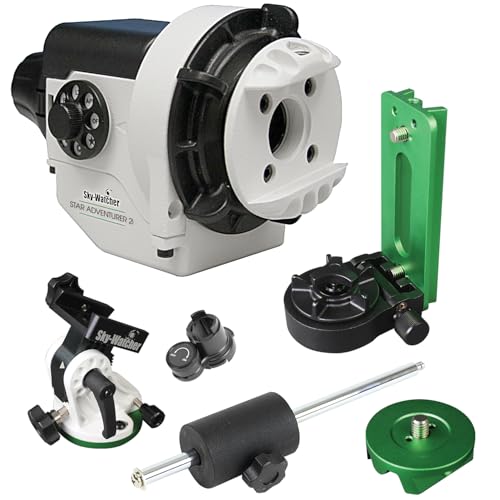
Best Lightweight Tracker – Star Adventurer 2i Pro Pack
The Sky-Watcher Star Adventurer 2i Pro Pack is a compact motorized tracking platform for wide-field astrophotography, time-lapse work, and selected telescopic applications. Among star trackers for lightweight telescopes, its 7-pound weight and modular compatibility with existing photographic tripods make it especially travel friendly.
Best For: Wide-field shooters and travelers who prioritize low weight, modular setup, and smartphone control.
Pros:
- Portable 7-pound tracking platform
- Works with existing photographic tripods
- Wi-Fi enables smartphone control through the SAM Console app
- Deluxe equatorial base supports polar alignment positioning
Cons:
- Its modular design may require additional compatible equipment
- Positioned primarily for wide-field astrophotography rather than a complete telescope setup
The 2i Pro Pack is the strongest portability choice in this group. It offers useful tracking and Wi-Fi without the larger footprint of a full mount-and-tripod package, making it appealing for lightweight imaging kits.
Best App-Controlled Mount – Explore Scientific iEXOS-100-2
The Explore Scientific iEXOS-100-2 is a GoTo equatorial mount and tripod built around the PMC-Eight control system. For users evaluating star trackers for lightweight telescopes, it offers app-based navigation, clutched dual-axis movement, and adjustable balancing, though the supplied notes do not specify its total weight or payload capacity.
Best For: Telescope users who want Wi-Fi or Bluetooth app control and precise equatorial positioning.
Pros:
- PMC-Eight system uses eight independent CPUs for responsive control
- ExploreStars app supports alignment, GoTo navigation, and object information
- Clutched dual-axis worm gears use quiet belt-driven stepper motors
- RA-axis sight hole and adjustable altitude control assist polar alignment
Cons:
- Does not include a polar scope according to the supplied details
- App control is designed for tablets rather than smartphones
- No payload capacity or item weight is provided in the notes
This mount is compelling when control features and smooth equatorial adjustment matter most. Its app ecosystem and balancing controls should appeal to users building a more deliberate telescope-tracking setup, but buyers should verify compatibility and capacity for their particular optical tube.
Beginner Tracking Telescope – AstroMaster 130EQ-MD
For beginners seeking star trackers for lightweight telescopes, the Celestron AstroMaster 130EQ-MD combines a 130mm Newtonian reflector with a German equatorial mount and motorized right-ascension tracking. Its included slow-motion controls, red-dot finder, and no-tool setup make it a practical backyard option.
Best For: Beginners who want a complete telescope with automatic tracking for planets and brighter deep-sky objects.
Pros:
- 130mm optics provide useful light-gathering capability for lunar, planetary, and deep-sky viewing.
- Included RA motor drive automatically follows centered objects as they move across the sky.
- Includes 20mm and 10mm eyepieces, a StarPointer finder, tripod, and a two-year warranty.
Cons:
- At 17 pounds, it is less lightweight than compact tabletop telescope setups.
- The motor drive requires a 9V alkaline battery.
- Its manual-focus, equatorial design may take some practice for first-time users.
The AstroMaster 130EQ-MD is a strong fit when built-in tracking matters more than minimum weight. It offers a larger aperture and a fuller accessory package, though its equatorial mount and heavier build are better suited to a stable backyard setup than frequent transport.
Compact Astrophotography Tracker – Equatorial Mount Star Tracker
Among star trackers for lightweight telescopes, this compact equatorial mount is aimed more at portable astrophotography setups than visual telescope observing. Its PETG and carbon-fiber shell, USB-C power, customizable rotation speeds, and support for both hemispheres provide flexible control in a small package.
Best For: Astrophotographers using a camera, gimbal, or lightweight rig who want portable equatorial motion and custom speed settings.
Pros:
- Compact 3.54-by-3.54-by-3.15-inch design weighs less than a full telescope mount.
- Supports stellar, lunar, and custom rotation speeds, plus northern and southern hemispheres.
- Can run from a power bank and doubles as a gimbal head for time-lapse photography.
Cons:
- It does not include a ball head, which is required for connecting a camera to the 1/4-inch output screw.
- A USB-A-to-USB-C cable is required; USB-C-to-USB-C power is prohibited.
- The supplied notes do not specify a telescope payload capacity.
This tracker is best viewed as a compact motion platform for cameras and very lightweight rigs, not a complete telescope system. Check your equipment’s mounting hardware and weight before choosing it for telescope use.
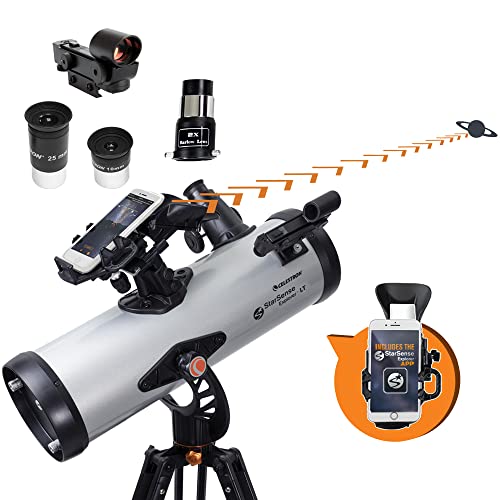
Smartphone-Guided Lightweight Telescope – StarSense Explorer LT 114AZ
The Celestron StarSense Explorer LT 114AZ offers a lightweight way to find celestial targets, using smartphone sky recognition rather than motorized tracking. Its 114mm Newtonian reflector, manual altazimuth mount, altitude slow-motion adjustment, and guided app make it approachable for beginners.
Best For: Beginners who prioritize portability and smartphone-assisted target finding for lunar, planetary, and brighter deep-sky viewing.
Pros:
- At 10.4 pounds, it is lighter and easier to transport than many full-size tracked telescopes.
- StarSense Explorer app uses sky recognition to guide users to selected targets.
- 114mm optics and included 25mm and 10mm eyepieces support a broad range of beginner observations.
Cons:
- The altazimuth mount is manual and does not automatically track objects.
- Smartphone docking and app use are required for the guided navigation feature.
- Following targets requires manual altitude adjustment with the sliding rod.
This is a good lightweight alternative when easy locating matters more than automated movement. It can help new observers find targets quickly, but users wanting hands-free tracking should consider a motorized mount instead.
Portable GoTo Mount – Star Adventurer GTi
For photographers building a setup around star trackers for lightweight telescopes, the Sky-Watcher Star Adventurer GTi offers a portable equatorial platform with full GoTo performance. Its built-in Wi-Fi, illuminated polar scope, counterweight system, and camera dovetail make it suited to compact astrophotography rigs, though the camera itself is not included.
Best For: Portable astrophotography setups using a lightweight telescope, DSLR, or mirrorless camera.
Pros:
- Full GoTo performance in a compact mount head.
- Built-in Wi-Fi supports convenient control.
- Includes a counterweight bar and 5-pound counterweight.
- Illuminated polar scope helps with polar alignment.
Cons:
- Camera or mirrorless body is not included.
- At 6.9 kg, it may be heavier than the smallest travel trackers.
The Star Adventurer GTi is a versatile choice when you need more than basic tracking from a portable mount. Its equatorial design and included counterweight hardware make it particularly practical for lightweight telescope and camera combinations.
Precision Alignment Accessory – Celestron StarSense Autoguider
The Celestron StarSense Autoguider is an alignment and guiding accessory for compatible Celestron computerized mounts. For users comparing star trackers for lightweight telescopes, it stands out by automating sky alignment, improving GoTo accuracy, and assisting with polar alignment rather than serving as a standalone tracking mount.
Best For: Celestron computerized telescope owners who want easier alignment and more precise tracking for imaging or observing.
Pros:
- Automatically aligns to the night sky in about three minutes.
- Improves GoTo accuracy for high-power eyepieces and small imaging sensors.
- Includes assisted polar alignment and precision autoguiding features.
- Offers multiple control options, including NexStar+, CPWI, and compatible Wi-Fi control.
Cons:
- Works with Celestron computerized mounts rather than operating as a standalone tracker.
- Compatibility should be checked before purchase.
This is best viewed as a convenience and precision upgrade for an existing Celestron system. It can simplify setup considerably, but buyers seeking a complete tracker for a lightweight telescope will still need a compatible computerized mount.
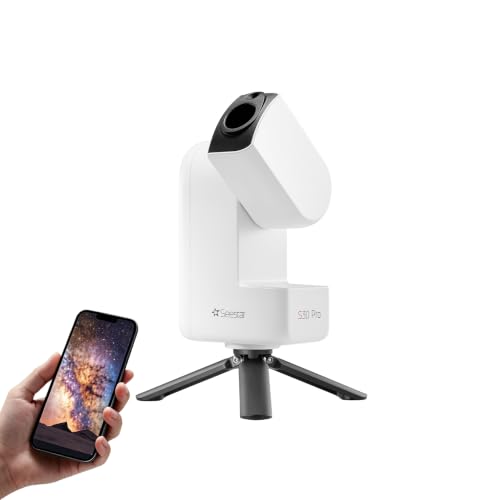
All-in-One Smart Tracker – ZWO Seestar S30 Pro
The ZWO Seestar S30 Pro combines a compact telescope, automatic GoTo, and tracking in a 3.6-pound smart-telescope package. For shoppers researching star trackers for lightweight telescopes, it is an especially simple option: the app handles targeting and capture, while built-in filters, dual-camera imaging, and automated processing support quick astrophotography sessions.
Best For: Beginners and travelers who want app-controlled deep-sky and wide-field imaging without assembling a separate telescope and mount.
Pros:
- Automatic GoTo targeting and tracking through a smartphone or tablet.
- Lightweight, compact design suited to travel and outdoor use.
- Built-in light-pollution filtering and apochromatic optics support clearer images.
- One-tap capture, AI processing, and automatic mosaic stitching simplify imaging.
Cons:
- Designed for deep-sky and wide-field imaging rather than planetary observation.
- Deep-sky imaging requires the device to remain stationary for stable tracking.
- Its integrated design does not provide the flexibility of a separate telescope mount.
The Seestar S30 Pro is the most approachable option here for users who prioritize portability and automation. It is not a conventional tracker for mounting a separate lightweight telescope, but its integrated system can make astrophotography substantially easier to start.
How We Picked the Best Star Trackers for Lightweight Telescopes
We focused on systems suited to portable telescope setups, small optical tubes, and entry-level astrophotography rigs. Selection criteria included stated payload capacity, equatorial tracking capability, GoTo or app control, portability, included hardware, setup requirements, and compatibility with cameras or accessories.
Because “lightweight” varies by telescope, camera, finder, and mounting hardware, treat each product’s payload rating as a starting point rather than a target. A mount usually tracks more smoothly when operated below its maximum capacity, especially for long-exposure imaging.
Quick Comparison
| Best For | Look For | Typical Advantage |
|---|---|---|
| Portable equatorial imaging | Counterweight, polar alignment, adjustable tracking | Better results with cameras and small scopes |
| Simple visual observing | Motorized tracking or app guidance | Keeps targets centered with less manual adjustment |
| GoTo beginners | Integrated computer control and alignment tools | Faster target finding and easier operation |
| Minimal setup | Smart telescope or guided system | Less traditional mount and accessory management |
Key Buying Factors for Star Trackers for Lightweight Telescopes
Payload Capacity and Balance
Check the combined weight of the telescope, camera, diagonal, finder, dew shield, and mounting accessories. Counterweights and a properly balanced right ascension axis are important for equatorial mounts. If astrophotography is the priority, choose extra capacity rather than operating at the limit.
Tracking and Alignment
Equatorial tracking is generally preferable for longer exposures because it follows the sky’s rotation more naturally. GoTo systems simplify target selection, while app-enabled alignment can reduce the learning curve. Consider whether the mount requires a clear view of the sky, a polar scope, an alignment camera, or a phone connection.
Portability and Setup
Review the total packed weight, tripod stability, pier or extension requirements, power source, and time needed to assemble the system. A compact mount that is easy to carry and align may be more useful than a heavier model with higher theoretical capacity.
Use Case and Compatibility
Some products are better suited to visual observing, while others are designed around DSLR or mirrorless cameras, small refractors, or automated imaging. Confirm attachment standards, included dovetail hardware, camera compatibility, software support, and whether essential accessories are included.
Who Should Buy Which Star Trackers for Lightweight Telescopes?
Choose a portable GoTo equatorial mount if you want automated target finding and room to grow with a small telescope or camera. A simpler star tracker is a strong choice for travelers and photographers who prioritize low weight and wide-field imaging. Motorized beginner telescope packages suit visual observers who want basic tracking without assembling a separate mount and optical tube.
App-guided systems are appealing when you want help locating objects but still prefer conventional telescope viewing. Finally, a smart telescope is worth considering if your main goal is streamlined, app-controlled astrophotography rather than hands-on use of a traditional eyepiece. Before buying, verify current payload specifications, included components, software compatibility, and regional power requirements.