
The right bench power supply makes circuit testing more controlled, repeatable, and safe. This roundup compares 10 adjustable DC sources across voltage range, current capacity, display resolution, controls, and useful extras such as USB charging.
Whether you are powering prototypes, troubleshooting boards, anodizing parts, or running demanding bench projects, the best choice depends on how much precision and output power your work requires.
Best 10 Bench Power Supplies for Circuit Testing Picks for 2026
Best Compact High-Current Pick
Jesverty SPS-3010V 32V/10A Bench Supply

- 0–32V and 0–10A output range
- Encoder controls with fine resolution
- USB-A/USB-C charging and output switch
Best For: Compact, high-current electronics testing
Best Precision 60V Pick
WEP 605D-III Digital Bench Supply
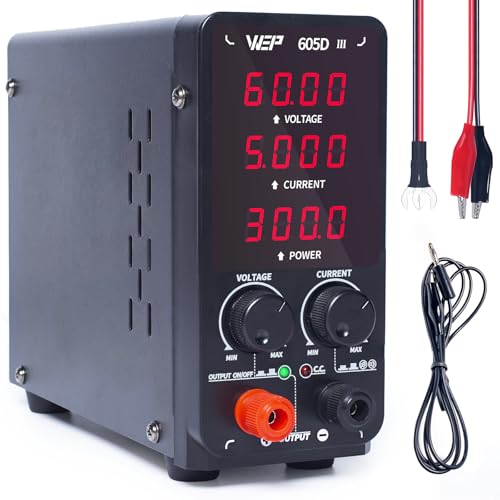
- 0–60V and up to 5A output
- 0.01V, 0.001A, and 0.1W readings
- Automatic CV/CC operation and protection
Best For: Precise higher-voltage bench testing
Best Simple 60V Value

- 0–60V and 0–5A output
- Automatic CV/CC mode conversion
- Multiple protections and included clip leads
Best For: Straightforward 60V circuit testing and repair
Best USB-C Convenience Pick
WANPTEK DPS3010U 30V/10A Supply

- 0–30V and 0–10A, up to 300W
- USB-C 5V/3.6A quick charging
- Four-digit display and short-circuit alarm
Best For: Repair benches needing 10A output and USB-C
High-Power Compact Pick

- 0–32V and 0–10.1A adjustable output
- 4-digit display with fine voltage/current resolution
- Memory, key lock, USB charging, and five protections
Best For: Demanding circuit testing and high-power electronics work
Precision Control Pick

- Digit-selecting encoder for precise adjustments
- 4-digit display with 0.01V/0.001A resolution
- Output button, overcurrent alert, and 18W USB charging
Best For: Hobbyist testing, repairs, and fine front-panel adjustments
Portable Lab Pick

- Lightweight 0.8kg portable design
- Real-time voltage, current, and power display
- Low-ripple output with CV/CC and multiple protections
Best For: Mobile workbenches, education, repairs, and routine testing
High-Power Choice
NICE-POWER 30V 30A Bench Supply

- Up to 30V, 30A, and 900W via rear terminals
- Output switch and encoder controls simplify setup
- Four-digit V/A/W display with multiple protections
Best For: High-current repair, testing, and lab work
Balanced Workbench Pick

- 0–30V and 0–10A output with 300W maximum power
- Displays voltage, current, and wattage in real time
- Compact design includes a 5V/2A USB port
Best For: General-purpose circuit testing and repair
Compact Testing Pick

- Small 1.54-pound enclosure saves valuable bench space
- Encoder controls provide digit-by-digit adjustment
- 0–30V, 0–5A output with multiple protection features
Best For: Portable DIY, LED, and low-current testing
Best Compact High-Current Pick – Jesverty SPS-3010V 32V/10A Bench Supply
For bench power supplies for circuit testing, the Jesverty SPS-3010V combines a 0–32V, 0–10A output with precise encoder controls and a compact footprint. Its output switch and four-digit display are practical when you frequently change test setups.
Best For: Electronics repair, Arduino and Raspberry Pi projects, battery charging, and high-current circuit testing where bench space is limited.
Pros:
- Coarse and fine encoder knobs support 0.01V and 0.001A setting resolution.
- USB-A and USB-C ports provide 20W quick charging.
- Output ON/OFF button lets you adjust settings without removing the load.
- Compact 7.1 × 3.6 × 6.2-inch design with OCP and temperature-regulated cooling.
Cons:
- Included test leads are described as giveaway leads and may not suit long-term high-current use.
- AC input selection depends on the factory configuration and destination.
The SPS-3010V is a space-saving choice for users who want 10A capability, fast adjustment, and convenient charging ports in one unit.
Best Precision 60V Pick – WEP 605D-III Digital Bench Supply
Among bench power supplies for circuit testing, the WEP 605D-III stands out for its 60V range, 5A output, and detailed digital readouts. Digital rotary encoders make repeated voltage and current adjustments straightforward.
Best For: Higher-voltage circuit work, anodizing, electroplating, Arduino projects, breadboards, and lab-style testing requiring precise readings.
Pros:
- Displays voltage to 0.01V, current to 0.001A, and power to 0.1W.
- Automatically operates in constant-voltage or constant-current mode.
- Short-circuit, overload, and temperature protections are built in.
- Compact lunch-box-style enclosure saves workbench space.
Cons:
- Designed for 110–127V US specifications and should not be connected to a 220V outlet.
- Its maximum output is 5A, lower than some 10A supplies.
This is a strong option when measurement detail and a 60V ceiling matter more than maximum current capacity.
Best Simple 60V Value – Naweisz NP6005 60V/5A Supply
The Naweisz NP6005 is a straightforward option for bench power supplies for circuit testing, offering 0–60V and 0–5A output with coarse and fine adjustment knobs. Its three-digit LED display keeps the essential readings visible without adding unnecessary complexity.
Best For: Circuit troubleshooting, 48V equipment testing, electronics repair, electroplating, battery charging, and classroom DIY work.
Pros:
- 60V output range suits many higher-voltage DC testing tasks.
- Automatic CV/CC conversion responds to load changes.
- Includes anti-reverse connection, thermal, overload, and short-circuit protection.
- Compact and lightweight at about 2.95 pounds.
Cons:
- Three-digit display resolution is less detailed than four-digit alternatives.
- Maximum output current is limited to 5A.
Choose the NP6005 if you want broad voltage coverage and basic protective features in a portable, uncomplicated bench supply.
Best USB-C Convenience Pick – WANPTEK DPS3010U 30V/10A Supply
For bench power supplies for circuit testing, the WANPTEK DPS3010U adds useful everyday features to a 0–30V, 0–10A switching supply. Its coarse and fine encoder knobs, four-digit display, USB-C charging, and short-circuit alarm make it practical for active electronics work.
Best For: Electronics repair, communication equipment maintenance, laboratory projects, and testing circuits or devices that benefit from a convenient USB-C port.
Pros:
- 0–30V and 0–10A range provides up to 300W of output.
- Coarse and fine coding knobs speed voltage and current adjustment.
- USB and Type-C ports provide 5V/3.6A quick charging.
- Short-circuit alarm, OCP, thermal, voltage, and power protections are included.
Cons:
- Its 30V maximum is lower than the 60V supplies in this roundup.
- Supplied output test leads may be a limiting factor for demanding setups.
The DPS3010U is a well-rounded choice for users who want 10A output plus USB-C convenience and automatic input-voltage detection.
High-Power Compact Pick – 32V 10.1A 300W Bench Supply
For demanding bench power supplies for circuit testing, this YITRANIC model combines a 0–32V, 0–10.1A adjustable output with up to 300W of power. Its compact housing, precise 4-digit display, output control, and automatic CV/CC switching make it practical for development boards, sensors, repairs, and larger electronics projects.
Best For: Users who need high output power in a compact bench supply for demanding testing and repetitive work.
Pros:
- Provides adjustable 0–32V and 0–10.1A output with up to 300W.
- Displays voltage and current to 0.01V and 0.001A resolution.
- Includes memory recall, key lock, output switching, and five protection features.
- Compact 1kg design includes an 18W QC USB charging port.
Cons:
- Its 10.1A maximum may be more capacity than needed for basic low-power projects.
- The built-in fan adds an active cooling component.
This is the strongest choice of the three when power headroom matters. The dual-switch logic, memory function, and protective features also suit repeat testing and extended bench use.
Precision Control Pick – 30V 10A Encoder Bench Supply
This NANKADF unit is a practical option among bench power supplies for circuit testing when precise front-panel adjustment is important. Its encoder lets you select individual digits, while the 4-digit display, output enable/disable button, automatic CV/CC operation, and USB fast-charging port support everyday electronics work.
Best For: Hobbyists and repair users who prioritize convenient, fine-grained adjustment and straightforward output control.
Pros:
- Encoder adjustment allows individual-digit voltage and current changes.
- 4-digit LED display provides 0.01V and 0.001A resolution.
- Output button helps prevent accidental powering of a connected load.
- Selectable overcurrent protection can stop output and sound an alert during a short circuit.
Cons:
- The supplied details list a 150W output rating, so it offers less power than the 300W model.
- Its listed input range is 115V, rather than the wider 100–240V input specified for the YITRANIC unit.
The encoder-based interface is the main reason to choose this model. It should appeal to users who frequently make small, exact setting changes and want a dedicated output-disable control.
Portable Lab Pick – 30V 5A Regulated Power Supply
For portable bench power supplies for circuit testing, the EARNMee 3005MS offers a 0–30V, 0–5A range in a lightweight 0.8kg design. Its 4-digit display shows voltage, current, and power in real time, while low ripple noise, automatic CV/CC operation, and included test leads make it ready for electronics testing, prototyping, repairs, and battery charging.
Best For: Mobile workbenches, education, and routine low-to-medium-power circuit testing.
Pros:
- Compact 195 × 102 × 80mm form factor weighs only 0.8kg.
- Adjustable 0–30V and 0–5A output suits a wide range of projects.
- Simultaneous real-time voltage, current, and power monitoring improves visibility.
- Includes overload, short-circuit, and over-temperature protection plus an output switch.
Cons:
- Its 5A current limit is lower than the 10A-plus options in this group.
- The listed 110V AC input may be less versatile for international use.
This model emphasizes portability and clear monitoring rather than maximum output. It is a balanced fit for users who move between work areas or need a ready-to-use supply for standard testing and repair tasks.
High-Power Choice – NICE-POWER 30V 30A Bench Supply
For demanding bench power supplies for circuit testing, this NICE-POWER model provides up to 30V and 30A, with automatic constant-voltage/constant-current operation and power readouts. Its output switch and encoder controls make setup more convenient, but note the important current-limit distinction between the front and rear terminals.
Best For: High-current electronics repair, motor work, aging tests, electroplating, and laboratory projects.
Pros:
- Offers up to 900W, 30V, and 30A through the rear high-current terminal.
- Output on/off switch lets you set voltage and current before energizing the load.
- Four-digit display shows voltage, current, and power with 0.01V and 0.001A resolution.
- Includes overvoltage, overcurrent, overheating, and termination protection.
Cons:
- The front panel is suitable only for output currents up to 5A.
- Input is specified for AC 115V ±10% at 60Hz, so users must verify compatibility.
- Its higher-power design may be more than needed for small circuits.
This is the strongest option of the three for applications that genuinely need substantial current. For safer, accurate high-current operation, connect loads above 5A to the rear high-current terminals and verify the input specification before use.
Balanced Workbench Pick – Jesverty SPS-3010 30V 10A
The Jesverty SPS-3010 is a practical middle ground among bench power supplies for circuit testing, combining a 0–30V, 0–10A output with a compact enclosure and real-time voltage, current, and power readings. Coarse and fine adjustment controls help with routine bench setup, while the included leads are best treated as starter accessories.
Best For: General electronics testing, repairs, education, and space-conscious workbenches needing up to 10A.
Pros:
- Adjustable 0–30V and 0–10A output with up to 300W maximum power.
- Four-digit display shows output voltage, current, and wattage in real time.
- Automatically switches between constant-voltage and constant-current modes.
- Compact, lightweight design includes a 5V/2A USB port and temperature-regulated fan.
Cons:
- Supplied test leads are described as giveaways and may not suit sustained high-current use.
- It offers less current and power than the 30A NICE-POWER model.
- Factory power-cord and AC-input details can vary by destination.
With its useful readouts, automatic operating modes, and modest footprint, the SPS-3010 is a versatile everyday supply. Consider upgrading the test leads if your circuits require prolonged operation near the unit’s current limit.
Compact Testing Pick – NICE-POWER 30V 5A Mini Supply
For portable bench power supplies for circuit testing, this compact NICE-POWER unit delivers adjustable 0–30V and 0–5A output in a small enclosure. Its encoder controls are designed for direct digit-by-digit setting, while the 3-digit display keeps the essential voltage and current readings visible.
Best For: LED testing, electronics DIY, repair, electrolysis, and small workbenches where portability matters.
Pros:
- Compact 1.54-pound design saves bench space and is easy to carry.
- Encoder knob supports direct digit selection for voltage and current settings.
- Provides adjustable 0–30V and 0–5A output with a 150W rating.
- Includes overvoltage, overcurrent, overpower, overtemperature, and short-circuit protection.
Cons:
- The 3-digit display provides less resolution than the four-digit models listed here.
- Its 5A maximum output is less suitable for high-current circuit testing.
- Only one output load cord is included, according to the package details.
This model makes sense when size, simple controls, and easy portability are more important than maximum output or display precision. Its broad 100–240V input range also makes it convenient for use with either 110V or 230V conditions.
How We Picked the Best Bench Power Supplies for Circuit Testing
We evaluated these models by focusing on the specifications that matter during everyday electronics work: adjustable voltage and current limits, constant-voltage and constant-current operation, display readability, adjustment controls, output switching, and connector convenience. We also considered practical differences between compact switching supplies and higher-power benchtop units.
Because testing needs vary, the list includes supplies from roughly 30V models suited to general prototyping through 60V and 900W options for more demanding applications. USB and USB-C outputs were treated as useful secondary features rather than substitutes for a dedicated regulated output.
Quick Comparison
- Best general-purpose range: 0–30V or 0–32V, with up to 10A, suits most microcontroller, hobby, repair, and prototype work.
- Best for higher-voltage testing: 60V, 5A models provide extra headroom for specialized circuits and anodizing tasks.
- Best for high-current projects: A 0–30V, 30A supply is better suited to motors, power electronics, and other demanding loads.
- Best for convenient charging: Models with USB or USB-C ports can power compatible accessories while keeping the main terminals available.
Key Buying Factors for Bench Power Supplies for Circuit Testing
Voltage and Current Range
Choose a maximum voltage comfortably above your project’s normal requirement, but do not pay for extreme output if you mainly test low-voltage boards. Current capacity matters when starting motors, charging batteries, or testing power circuits. A 10A supply offers useful flexibility, while a 5A unit may be more compact and economical for lighter loads.
Constant-Voltage and Constant-Current Control
CC/CV operation lets the supply regulate either the selected voltage or a preset current limit. This is valuable for protecting prototypes, observing startup behavior, and testing loads without immediately exposing them to excessive current.
Display and Adjustment Controls
Four-digit displays can make small voltage or current changes easier to monitor than basic three-digit readouts. Encoder knobs with coarse and fine adjustment are particularly useful when dialing in exact test conditions. An output-enable button adds another layer of convenience and helps prevent accidental energizing while connecting leads.
Connections, Cooling, and Protection
Check whether the included terminals, clips, and cables match your setup. Look for short-circuit, over-voltage, over-current, and over-temperature protection, but verify the manufacturer’s specifications before relying on any feature. Fan noise, ventilation, and the supply’s physical footprint also matter on a crowded bench.
Who Should Buy Which Bench Power Supplies for Circuit Testing?
Students, hobbyists, and general electronics users should usually choose a 0–30V or 0–32V adjustable model with clear controls and a 5A-to-10A range. These supplies cover most breadboard, Arduino, Raspberry Pi accessory, and repair tasks.
Users testing higher-voltage circuits or anodizing setups should consider a 60V model, provided its current rating and included accessories meet the application’s needs.
Power-electronics, motor, and battery-project users should prioritize the highest suitable current rating, robust cooling, and dependable protection. A 30A unit offers substantially more headroom, but it also needs adequate bench space, wiring, and ventilation.
For the best overall balance, select the model that provides your required voltage and current with some reserve, offers readable measurements, and includes controls you will actually use. Avoid choosing solely by maximum amperage: regulation behavior, adjustment precision, safety features, and physical usability are just as important during circuit testing.